

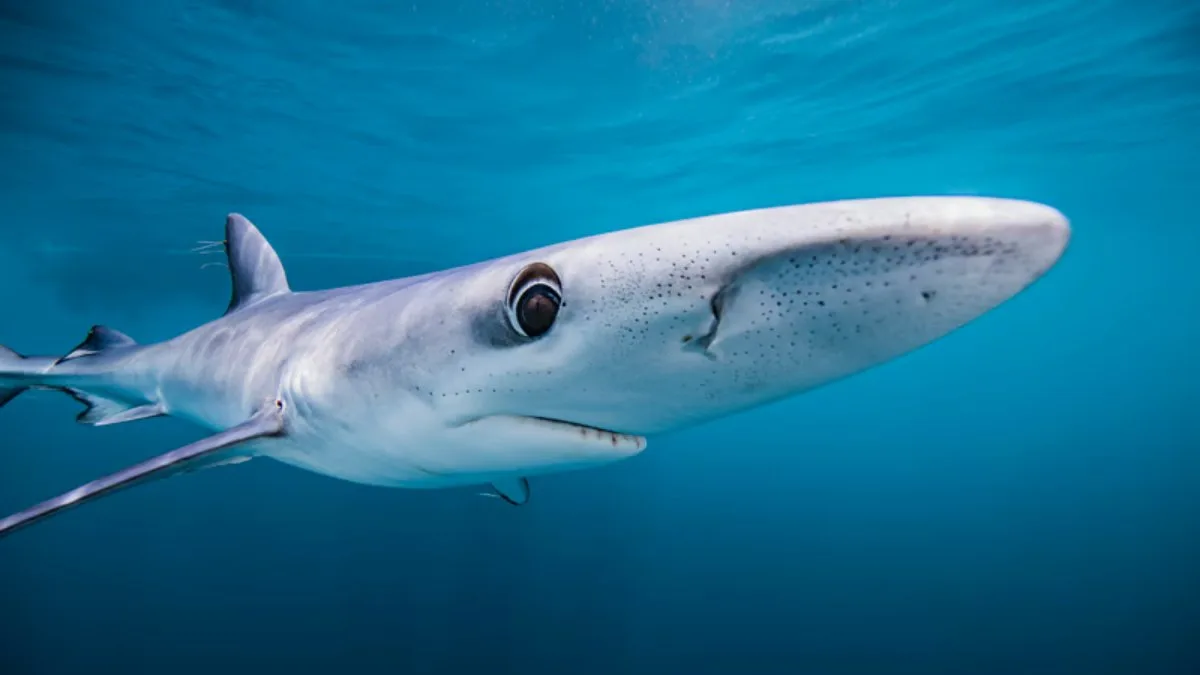
There's a moment when you see a blue shark for the first time that makes you understand why it's called that. The blue shark isn't just blue in the way that "blue" is a descriptive category. The shark is actively, intensely blue on its dorsal side, fading to a silvery-blue on its flanks, and white on its belly. In sunlit water, the effect is luminous. The blue seems to glow from within. The coloration is beautiful, which is why it's somewhat tragic that this beauty hasn't saved the species from becoming one of the most heavily fished sharks on the planet. Blue sharks are killed by the millions estimated at 100,000 to 400,000 annually in official catches alone, with potential millions more in unreported or illegal fishing. They're apex predators that have become victims of a human appetite for shark fins and fishmeal. The tragedy is compounded by the fact that blue sharks aren't aggressive toward humans, they're not invading human territory, and they're not particularly profitable compared to larger sharks. They're simply accessible and numerous enough to be worth harvesting. For now.
The Countershade Advantage
The blue shark's coloration is an example of countershading, a camouflage strategy used by countless marine animals. The dark upper surface makes the shark difficult to see from above against the darker depths. The light underside makes it hard to spot from below against the brighter surface. This coloration evolved because blue sharks hunt in open water where there's nowhere to hide. They depend entirely on the angles of approach and light to conceal themselves from prey until the last moment. The strategy works for fish-sized prey that don't move very fast. It's less effective against faster prey like other sharks or larger fish that have their own sophisticated sensory systems. Blue sharks compensate for this limitation through sheer relentlessness. They're fast swimmers that can maintain high speeds for extended periods. They hunt through exhaustion, pursuing prey until it can't run anymore.
The blue shark's body is built for endurance rather than explosive power. Its body is relatively slender, its pectoral fins are long and narrow, and its tail provides steady propulsion. Compare this to the great white shark, which has a more compact body, stouter fins, and a tail designed for acceleration. Blue sharks are distance swimmers. They migrate across ocean basins. A blue shark tagged off New York was recaptured near Africa six months later. Another was tagged off California and later found in the Arabian Sea. These aren't random movements. The sharks are traveling with purpose, probably following food sources and responding to seasonal patterns of prey abundance. The journey requires energy, which means blue sharks need to eat frequently enough to maintain their reserves while traveling constantly. This might make them especially vulnerable to overfishing—they can't simply reduce their feeding rate and hunker down. They have to keep swimming, keep eating, keep searching.
How endangered is this animal?
The Litter Advantage and the Threat
Blue sharks reproduce at a relatively high rate compared to many shark species, which should make them resilient to fishing pressure. Females are ovoviviparous, meaning they produce eggs that hatch inside the mother and the resulting pups are born live. A single female can produce 25 to 100 pups at a time. Some populations show evidence of higher fertility rates than that. At first glance, this reproductive capacity suggests blue sharks should be able to sustain significant fishing pressure. Yet populations have still crashed. The issue is timing and geographic vulnerability. Blue sharks reproduce at rates that keep populations stable when mortality from fishing is around 10 to 15 percent annually. Beyond that threshold, populations decline. Current fishing pressure in many regions exceeds 50 percent annually, and in some areas reaches 80 percent. At those levels, even high reproductive rates can't compensate for the mortality.
Geographically, the problem is acute in certain regions. The Atlantic blue shark population has declined roughly 60 percent since the 1970s. The Pacific population is harder to assess, but the trends suggest similar declines. Meanwhile, populations in the Indian Ocean appear more stable, partly because fishing intensity there is lower and partly because we're less certain about the actual numbers given poor monitoring. The disparity in protection between regions means that blue sharks have safe areas and danger zones, but the danger zones are extensive and in regions where fishing is most intense.
The Fin Trade's Invisible Victims
Most of the blue sharks killed are killed for their fins, not their meat. A shark fin destined for shark fin soup might be worth $100 to $200 per kilogram. Fins are light and durable, which means they're efficient to process and ship. A boat can take on a large catch by weight in fins while taking up minimal space. That economics is why blue sharks, which are more abundant than larger sharks but less profitable individually, are nonetheless heavily fished. The practice of shark finning—cutting off the fins and discarding the body—is technically illegal in many countries and heavily restricted in others. Yet enforcement is difficult. A fishing boat can claim its catch is for meat and discard the bodies at sea. The fins end up in markets anyway, and the waste of the carcass is invisible to regulators.
Some countries have implemented regulations requiring sharks to be landed with their fins still attached, on the theory that this prevents finning. But processors have responded by accepting shark fins from various sources and claiming they're from legal fisheries. Traceability is nearly impossible. A package of shark fins doesn't carry a label saying "legally caught blue shark" or "illegally finned tiger shark." The trade just happens, and blue sharks are a significant, invisible part of it. The invisibility is almost the point. Nobody buys blue shark specifically. The species is an accident of fishing they get caught alongside other sharks, and their fins get processed alongside other fins, and the public never knows they're eating an ocean that's depleting one of the most beautiful sharks alive.
Conservation Without Certainty
Here's what makes conservation challenging for blue sharks: we're not entirely sure how many there are. Population estimates range widely because blue sharks range widely and they're difficult to monitor in international waters. They're not bound to one nation's territorial waters or any single region. A conservation effort in Australian territorial waters might protect sharks that were caught in international waters, or that originated from populations that reproduce elsewhere. The blue shark is less a discrete population than a global phenomenon, a species that treats ocean basins as uninterrupted habitat. Conservation at that scale requires international cooperation, which is difficult because different nations have different economic interests in shark fishing. Some nations view shark fisheries as an important source of income and protein. Others are willing to restrict fishing if compensation is provided. Still others lack the capacity to enforce restrictions, even if they pass laws banning them.
Some conservation organizations argue that listing blue sharks on CITES restricting international trade would protect populations more effectively than current measures. Others worry that CITES listing would simply drive the trade underground, making it even harder to monitor. The debate hinges on empirical questions we can't fully answer: would CITES listing actually reduce fishing pressure, or just reduce legal reporting of it? Without better data on population sizes and fishing pressure, the answer remains uncertain.
The blue shark's future depends partly on economic factors beyond marine biology. If the market for shark fins collapses, fishing pressure would decrease even without formal protection. If Asian markets continue to demand shark fin, blue sharks will be fished regardless of conservation measures. If technology improves and allows more efficient fishing, pressure increases. If climate change disrupts ocean currents and the systems that blue sharks depend on navigate, populations might crash regardless of human fishing. The shark's global distribution, which seemed like an advantage from an evolutionary perspective, has become a liability in a world where humans fish the entire ocean.
Quick Facts:
Blue sharks can reach lengths of 3.8 meters and are built for endurance rather than speed, with long migrations across ocean basins documented through tagging studies. The species reaches sexual maturity relatively quickly, at around 5 to 6 years old, allowing populations to reproduce more rapidly than larger shark species. Blue shark litters can exceed 100 pups, with some females producing more than 130 offspring in a single pregnancy. The species has one of the highest metabolic rates among sharks, requiring frequent feeding to maintain their constant swimming behavior. Blue sharks are found in every ocean between roughly 50 degrees north and 50 degrees south latitude, making them one of the most geographically widespread shark species.
Sources
Sources & Further Reading
Overview
Also Known As
Blue dog, Great blue shark (Prionace glauca)
Size
1.8–2.8 m; up to 3.8 m (12.5 ft)
Distribution
Deep temperate and tropical waters worldwide; highly migratory
Habitat
Open ocean, epipelagic zone; surface to 350 m depth
Food / Diet
Squid, herring, mackerel, smaller sharks, seabirds
Lifespan
15–20 years
Help us save the oceans
by surfing the web!
.png)
.png)
.png)

.png)
.png)
.png)
.png)
.png)
.png)