

There's something almost absurd about an Atlantic puffin's face. The beak is an aggressively bright orange-red, as if someone took a crayon and went wild. The eyes are ringed with pale blue. The cheeks look like they've been rouged. In winter, these birds look perfectly respectable—dusky greys and blacks, understated. Then spring arrives, and they're suddenly strutting around in what can only be described as Technicolor drag. Scientists still aren't entirely sure why they bother with this seasonal costume change, though it probably signals breeding fitness to potential partners. What we do know is that the transformation happens through a kind of cosmetic molting: the puffin's face literally sheds the dull outer layers of skin, revealing the vibrant tissue underneath. It's nature's version of removing a disguise.
The Beak That Defies Engineering
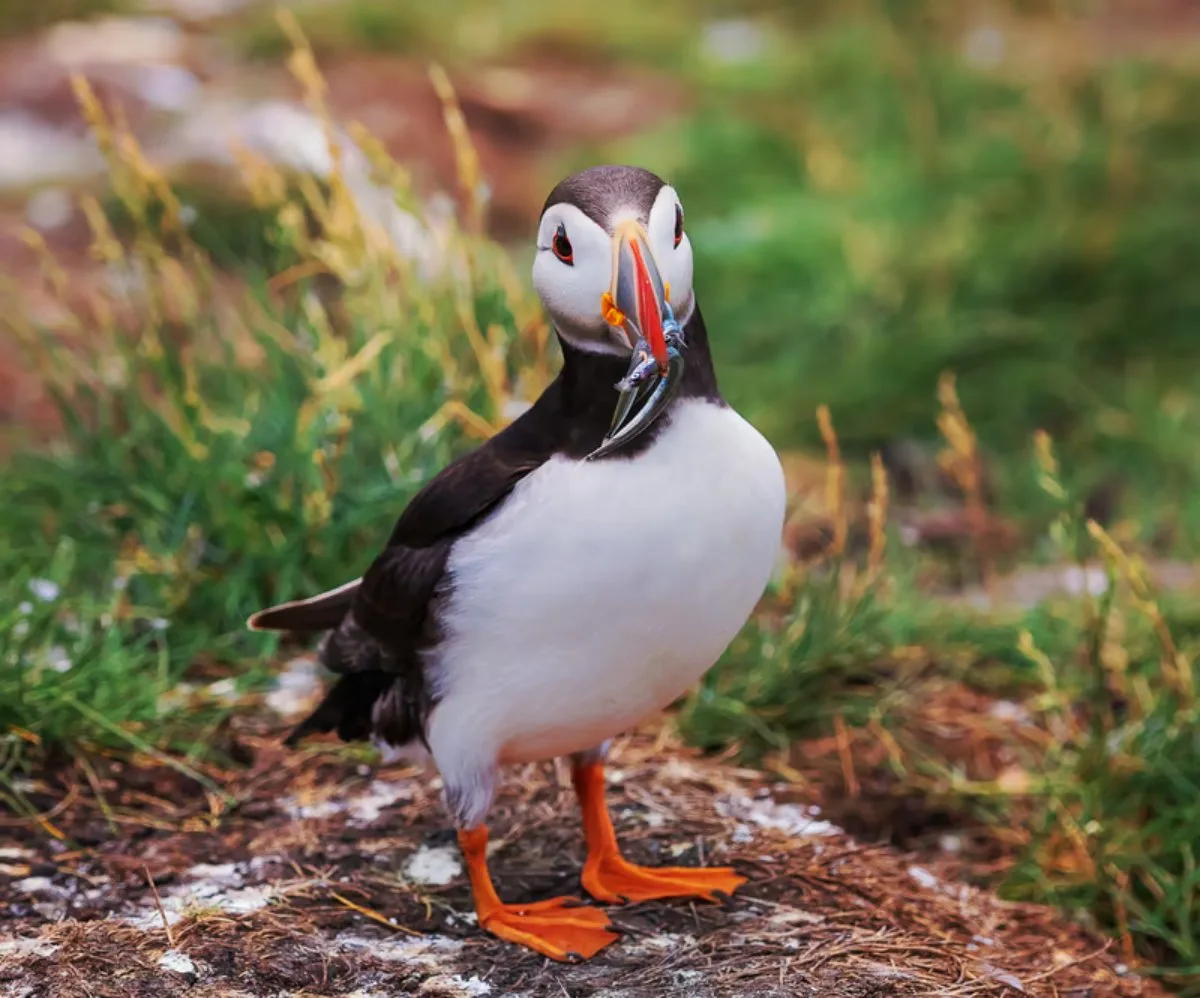
A puffin's beak is a marvel of biological engineering that seems designed by someone who didn't quite believe in the laws of physics. It's laterally compressed, meaning it's much deeper from top to bottom than it is wide, giving it an almost comical profile when viewed from the side. The inside of the mouth features backward-pointing spines and ridges that act like a fish-trapping cage. Once a puffin catches a fish, new ones can be added to the arrangement without displacing the ones already captured. A single puffin can hold 20 or even 30 small fish at once, though 10 to 12 is more typical.
The truly wild part is how they achieve this feat. The beak isn't rigid like human teeth or bird beaks generally. Instead, it's somewhat flexible, with grooves and hinges that let individual segments move independently. When a puffin dives underwater, and they're exceptional divers, reaching depths of 60 meters or more, they use their wings to propel themselves forward with remarkable agility. They snatch prey with precision and speed. The beak's design means they can keep fishing even while their mouth is full, packing additional meals in alongside the ones already caught. It's less like catching fish and more like arranging a tiny silvery bouquet.
Yet this same beak that makes them such efficient hunters also gives them a waddling, off-balance quality when they walk on land. They can look almost drunk, which probably doesn't help their dignity as they lumber back to their burrows.
Burrows, Colonies, and Crowded Neighborhoods
Atlantic puffins don't nest in trees or on open cliffs like some seabirds. They're burrowers, digging underground tunnels that can extend a meter or more into soft soil or turf. They'll use burrows that abandoned rabbits or shearwaters have left behind, or they'll excavate their own with their feet and beaks, kicking backward to clear loose earth. These burrows are their castles, their safe havens from predators and harsh weather. A single burrow might be used for decades, passed down through generations of puffin families.
The islands where puffins breed can hold tens of thousands of birds in remarkably confined spaces. The colony on Vestmanna in Iceland supports around a million birds. Imagine a city block where every square meter hosts a nesting puffin, and you're getting close to the chaos and noise and cacophony of a puffin colony in summer. The air fills with their calls, peculiar grunting vocalizations that sound rather like small motorboats struggling to start. The ground is riddled with burrows, some connected, some ending in dead ends. There's something almost medieval about it, a kind of organic warren.
Life in these colonies is surprisingly violent. Puffins are fiercely territorial. They'll attack neighbors who venture too close, leaping at each other with both beaks and wings. Breeding pairs share a burrow with jealous intensity. If a partner dies, a surviving puffin might not breed again for years, despite being surrounded by potential mates. The social world of puffins is complicated and often unforgiving.
How endangered is this animal?
The Puffling Crisis and the Rescue Mission
Every August, on the Icelandic island of Heimaey, something wonderful and surreal happens. Young puffins, called pufflings, leave their burrows for the first time under cover of darkness. They're drawn to the moonlit ocean, their instincts pulling them toward the sea where they'll spend the next few years growing and maturing. The problem: the island's lights disorient them. Pufflings become confused by street lamps, porch lights, and car headlights, mistaking artificial light for moonlight on water. Instead of heading toward the ocean, they waddle into towns and get hopelessly lost.
In the 1970s, locals began noticing exhausted pufflings on doorsteps and sidewalks come August. Some would have walked miles from the cliffs, completely disoriented. The mortality rate was devastating. In 1973, the first organized rescue operation began. Volunteers locals who'd grown up on the island, would spend August evenings collecting confused pufflings and placing them in boxes. During the day, they'd carry the birds to the ocean and release them. It sounds simple, but thousands of pufflings have been saved this way.
The operation has become almost ceremonial. Tourists now visit to participate. Schoolchildren collect pufflings as part of their summer routine. The rescue has probably saved hundreds of thousands of birds over the decades, and it's turned puffins into a kind of living emblem of local pride. Though here's the sobering part: climate change is making things harder. The waters around Iceland are warming, pushing fish populations further north. Young puffins are struggling to find enough food, and rescue efforts can only do so much when the real problem is an ocean that's changing.
Survival and Setback
Atlantic puffins faced an existential crisis in the twentieth century. Commercial fishing removed vast quantities of their food sources. Introduced predators like rats devastated breeding colonies. By the 1970s, populations had crashed across much of their range. The species isn't going to vanish anytime soon, but they've been relegated to smaller and smaller strongholds.
The good news is that protection efforts seem to be working. Some colonies are recovering slowly. The Faeroes have implemented hunting regulations. Iceland takes its puffins seriously, both as a cultural symbol and as an economic resource (bird tourism brings in millions annually). But climate change casts a long shadow. The North Atlantic is warming faster than most ocean regions, and puffins are creatures of cold water. If their food sources continue to shift northward and the breeding season continues to destabilize, all the burrow protection in the world won't save them.
Quick Facts About Atlantic Puffins
- Brilliant orange-red beak appears only during breeding season, then fades to duller colors
- Can dive to depths of 60 meters and remain submerged for up to 30 seconds
- Hold up to 30 small fish in their beak simultaneously through backward-pointing ridges
- Spend 8–9 months of the year at sea, returning to land only to breed
- Average lifespan is 20–25 years, with the oldest known wild puffin living 41 years
- Only around 1–2 million breeding pairs remain globally, with Iceland hosting roughly 60% of the population
Sources
Overview
Also Known As
Common puffin, Sea parrot (Fratercula arctica)
Size
26–29 cm length; wingspan 47–63 cm
Distribution
North Atlantic; Iceland, Norway, UK, Canada, northeastern US
Habitat
Open sea; breeds on clifftops and grassy headlands of islands
Food / Diet
Small fish (sand eels, herring, sprats), crustaceans
Lifespan
20–25 years
Help us save the oceans
by surfing the web!
.png)
.png)
.png)

.png)
.png)
.png)
.png)
.png)
.png)