

If you've been to an aquarium in the past two decades, you've probably encountered a tank full of clownfish. Orange and white striped, adorably round-faced, and impossibly cute—they're the gateway fish for ocean lovers everywhere. But here's the thing: what most people know about clownfish comes from a 2003 animated movie, and that film got the biology spectacularly wrong. The actual lives of these little fish are far stranger, more strategic, and infinitely more interesting than anything Pixar could have dreamed up.
Clownfish belong to the subfamily Amphiprioninae, and they're found exclusively in the Indo-Pacific, from the Great Barrier Reef to the coasts of Japan and East Africa. There are thirty recognized species, though the orange and white clownfish is by far the most famous thanks to its Hollywood status. What makes these fish truly remarkable isn't their appearance—it's their relationships. They've built an entire existence around a partnership so intimate and dependent that it makes human friendships look casual.
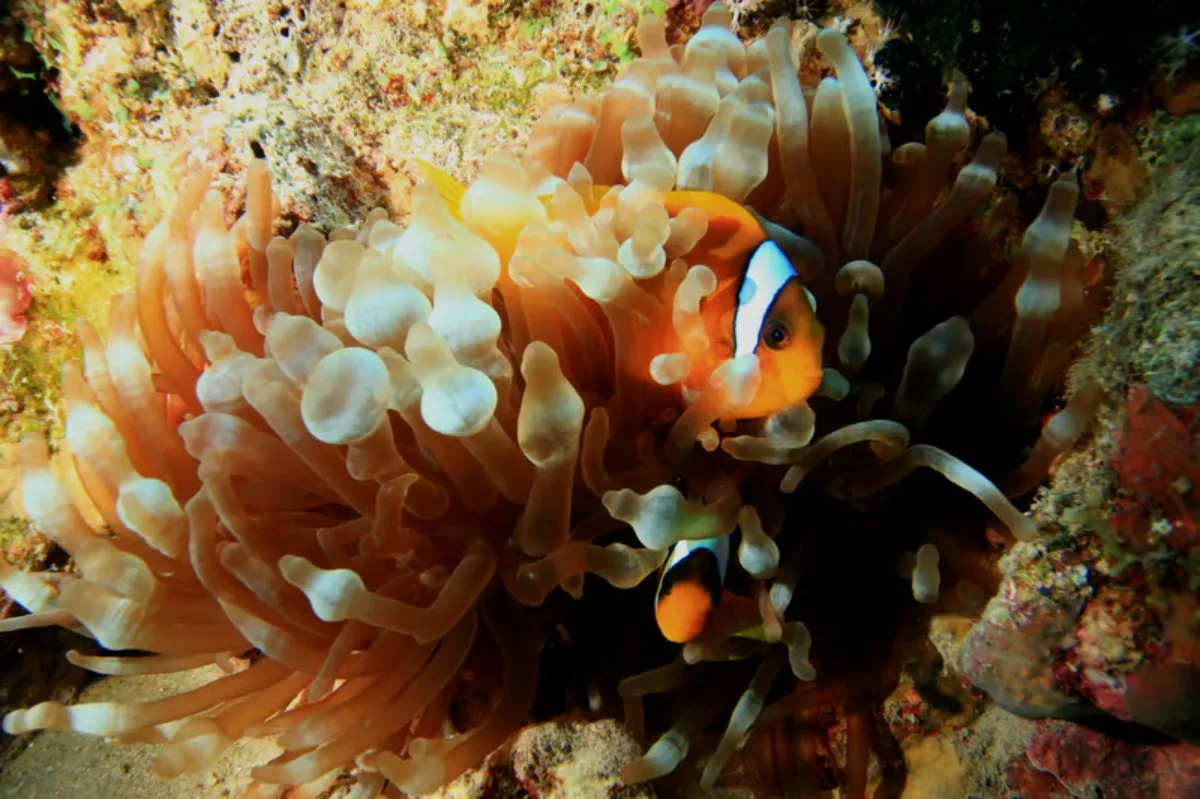
The Sacred Alliance: Clownfish and Anemones
The partnership between clownfish and sea anemones is one of nature's most textbook examples of mutualism, which is a fancy way of saying both parties benefit enormously. Sea anemones are soft-bodied animals with stinging tentacles called nematocysts that fire harpoon-like structures to paralyze passing prey. For the anemone, the arrangement is simple: a clownfish living inside its tentacles gets scraps of food from the anemone's meals while simultaneously defending it from predators and parasites.
But here's where it gets clever. Clownfish are immune to anemone stings—not because they have thick skin, but because they're covered in a special mucus layer that prevents their bodies from triggering the anemone's stinging cells. Scientists aren't entirely sure how they develop this immunity. When young clownfish first enter an anemone, they acclimate gradually, touching the tentacles with their fins and mouth, essentially training the anemone to recognize them as harmless. Within days, the mucus coating makes them invisible to the anemone's defense system. It's like gaining a password to an exclusive club, except the password is written in slime.
The clownfish gets protection from predators who won't risk the anemone's sting, a safe place to lay eggs, and easy access to food scraps. The anemone gets a live-in housekeeper that removes parasites, chases away predators, and even improves water circulation through the anemone's tentacles with its constant movement. Some research suggests the anemone's zooxanthellae—the symbiotic algae that help it photosynthesize—might actually benefit from the improved flow. It's win-win, except the clownfish gets the better deal.
The Bizarre Sex Life Nobody Expected
Now it gets weird. Every clownfish colony lives in a rigid social hierarchy built around a single fact that violates most fish rulebooks: all clownfish are born male. The largest and most dominant individual in each anemone colony undergoes a sex change and becomes female. She's the breeding adult, the only one that reproduces. Below her is the breeding male, and below him are smaller, younger, completely sterile male clownfish that are just... waiting.
When the female dies, something extraordinary happens. The breeding male doesn't sit around mourning—he literally transforms into a female. His reproductive system develops, his body becomes larger, and within weeks he's the breeding matriarch of the colony. The next male in line moves up to take his place as breeding male. The younger males are finally activated, developing reproductive capability once more. It's called sequential hermaphroditism, and it's nature's insurance policy against being stuck with the wrong sex ratio.
Why does this system exist? Scientists still aren't entirely sure, but the leading theory involves breeding rights. In a confined space like a single anemone, only one breeding pair makes sense. Smaller males would just waste energy fighting over a female they can't reproduce with anyway. So instead they wait, and when opportunity arrives, they're ready. It's less a democracy and more like an arranged line of succession, except everyone involved is technically waiting for the person ahead of them to either leave or die.
The Finding Nemo Effect: When Movies Change Evolution
Here's something nobody could have predicted: a children's movie would nearly crash wild clownfish populations. Before 2003, clownfish weren't particularly rare, but they weren't heavily collected for the aquarium trade either. After Finding Nemo was released, that changed overnight. Suddenly, every aquarium hobbyist wanted their own Nemo—or better yet, their own Marlin and Nemo pair. The fishing pressure became intense. In the Philippines and Indonesia, which supply most aquarium fish, clownfish catches increased dramatically. Some estimates suggest juvenile clownfish collection increased up to 40 times during the peak years.
The problem is worse than simple overfishing. Many wild clownfish live in just a handful of anemones on small patches of reef. A single collector can deplete entire populations in the space of an afternoon. Young fish are preferentially collected because they're smaller and cuter, which disrupts population structure. And here's the thing that would have delighted marine biologists if it wasn't so tragic: it turned out that catching breeding females was often worse than catching juveniles, since a single female represented the entire reproductive output of a colony.
The good news is that aquaculture has improved dramatically. Most clownfish in the aquarium trade these days are bred in captivity, which has actually taken pressure off wild populations. The bad news is that wild clownfish are still vulnerable to other threats—bleaching events that kill their host anemones, pollution, and climate change. At least we learned that lesson before it was too late.
Life Inside the Anemone Colony
Daily life for a clownfish is oddly structured. They're not particularly fast swimmers—in fact, they're kind of clumsy in open water, which is why they stick so close to their anemone home. They spend their days defending territory against intruders, picking parasites and algae from their anemone partner, and darting between the tentacles in what seems to be play. They're curious fish, monitoring their territory for food and threats. When they're not actively feeding or defending, they rest inside the tentacles, surprisingly social even in their downtime.
Spawning happens monthly around the new moon. The female lays eggs on a rock near the anemone base, and the male fertilizes them. For the next nine days, one of the parents is almost always hovering over the eggs, fanning them with their fins to maintain water flow and picking away debris. On the night the larvae hatch, they drift off into the open ocean, completely alone. Most don't survive—fish larvae have an incredible mortality rate. The survivors spend a few weeks drifting as part of the plankton before settling back on a reef, where they either find an anemone with space or perish trying. It's a lottery, and the odds aren't good. But for the ones that make it, they've found themselves a home that could last their entire lifespans—clownfish can live twenty years or more in captivity, and possibly just as long in the wild, assuming the reef doesn't collapse first.
Quick Facts
- Clownfish can only live in anemones of certain species; they're picky about their partners—specific Amphiprion species prefer specific anemone species
- A 2004 study in Coral Reefs documented a 15.4% annual decline in wild clownfish populations in some Indo-Pacific locations during peak post-Nemo collecting years
- The breeding female clownfish can lay hundreds of eggs in a single spawn, but the larval survival rate in the wild is likely less than 1%
- Their stripes serve as identification markers; researchers can identify individuals by their unique stripe patterns, rather like fish fingerprints
How endangered is this animal?
Sources
Overview
Also Known As
Anemonefish, Clown anemonefish (Amphiprioninae subfamily)
Size
7–17 cm depending on species
Distribution
Indian Ocean, Red Sea, western Pacific; warm tropical waters
Habitat
Coral reefs; live within host sea anemones
Food / Diet
Algae, plankton, copepods, small crustaceans
Lifespan
6–10 years
Help us save the oceans
by surfing the web!
.png)
.png)
.png)

.png)
.png)
.png)
.png)
.png)
.png)