

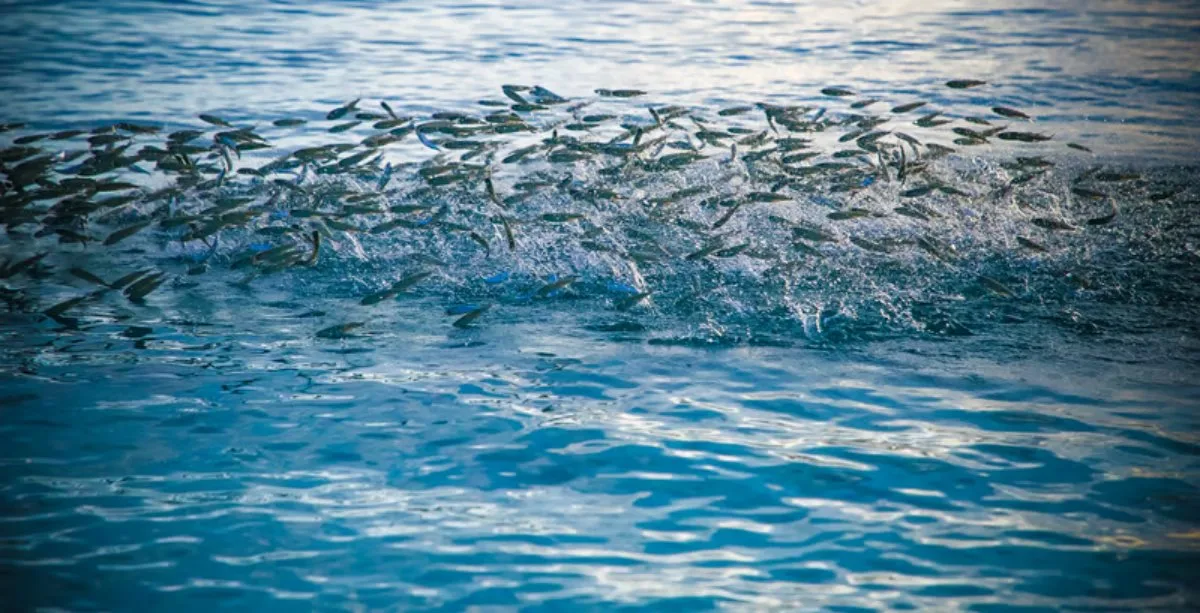
If you've ever watched a flying fish burst from the ocean, you've seen something that shouldn't exist. A creature that's evolved for life underwater suddenly choosing to leave the water entirely, extending enormous pectoral fins and gliding above the surface like a living kite. It's the kind of thing that makes you question whether you saw it right. But they're real, they're more common than most people realize, and they're better flyers than their underwater cousins are swimmers.
Flying fish are found in tropical and subtropical oceans worldwide. There are around 64 species, divided into two main groups: those with four wings (two sets of enlarged fins) and those with two wings (just the pectoral fins enlarged). Most species are relatively small, typically 7 to 15 centimeters long, though some reach up to 45 centimeters. They're built like compressed racehorses—streamlined, muscular, and designed for sustained speed bursts through water.
The Physics of Fleeing
Flying fish don't actually fly in the way birds fly. They don't flap their fins. They glide. The mechanics work like this: when a flying fish is being chased by a predator—usually a tuna or dolphin—it accelerates to top speed in the water, around 35 to 40 kilometers per hour. As it reaches the surface, it extends its enlarged pectoral fins (and in four-winged species, its pelvic fins too). These fins act as hydrofoils and ailerons simultaneously. The fish launches out of the water at an angle, often 30 to 40 degrees above horizontal. Once airborne, gravity immediately starts pulling it back down, but the fins provide lift against that downward force.
Here's the clever part: the air provides much less resistance than water. While the fish is in the water, friction and drag are enormous. In the air, those forces drop dramatically. The fish's tail is still moving through the water for the first part of the flight, and this movement generates additional thrust. Some species actually dip their tails back into the water mid-flight to gain extra speed. They're using the water like a paddle, pushing off to keep themselves airborne longer.
Different species have different strategies. Some fly in straight lines. Others maneuver mid-air, adjusting their body angle and fin position to change direction. A few species have been observed making what can only be described as turns, banking through the air as if piloting a small aircraft. The eye adjusts for the difference in light refraction between water and air during takeoff—something that would require real-time neurological adjustment that we're still not entirely sure how they manage.
Distance and Duration: How Far Can They Go?
Flying fish can cover remarkable distances while airborne. The average flight lasts about 30 to 40 seconds, during which the fish might travel 40 to 200 meters depending on the species and conditions. Some fish have been documented going 400 meters in a single flight. In still water, that's genuinely impressive. In reality, flying fish usually take off with the wind and the waves, so they're being helped along by air currents they navigate with surprising precision.
The records are uncertain because observing flying fish in their natural habitat is difficult. Most data comes from fishermen's observations or scientists on research vessels. Some early naturalists claimed flying fish could stay airborne for ten minutes, which is almost certainly an exaggeration. The actual maximum is probably around two minutes for a really exceptional flight, during which the fish might cover half a kilometer or more.
What's remarkable is that flying fish can maintain altitude for surprisingly long. They're not just gliding downward until they hit water again. They're actively maintaining lift through proper fin positioning and body angle. Some species seem to have an almost intuitive understanding of aerodynamics. Whether it's instinct, learning, or some combination of both remains unknown.
Why Flee to the Air?
The obvious answer is predators. Flying fish are prey for larger pelagic fish—tunas, jacks, mackerels—and marine mammals. When a predator is closing in for the kill, the flying fish's best escape route is upward. The predator is built for water. It can't follow into the air. Most predators come at their prey from below, so launching upward is a logical escape vector.
But there's probably more to it. Flying fish have been observed launching even when there's no obvious predator nearby. Maybe it's a migration strategy. Maybe they're traveling between foraging areas, using their gliding ability to cover distance faster than swimming would allow. Maybe they're fleeing areas where water conditions are bad—low oxygen, high temperature, or swarms of parasites. Nobody really knows for sure.
What scientists do know is that flying fish spending time in the air are vulnerable in new ways. They can be hit by seabirds mid-flight. They can misjudge their glide and crash into boats or driftwood. Some species land in ships fairly regularly, which has made them a traditional food source in various parts of the world. The risk of flying seems worth it to the fish, or else evolution would have selected against the behavior. But the cost-benefit calculation remains unclear.
Navigation and the Difficulty of Leaving Water
One thing that's surprisingly difficult about flying is navigation. In water, flying fish have sensory organs adapted to aquatic life. Their lateral line helps them detect water movements. Their eyes are evolved for underwater vision. Once they leave the water, most of those systems become useless. How do they judge distance? How do they navigate? How do they know whether they're flying toward something dangerous or safe?
Early research suggested flying fish might use visual cues—they can see in air as well as water, though it requires neurological adjustment. More recent work suggests they might be following the waves. The pattern of the surface tells them where they are relative to the trough of the waves they launched from, and they can steer accordingly.
It's worth noting that flying fish eyes are positioned higher on their head than most fish, and they can see above the waterline even while underwater. This might give them an aerial reconnaissance advantage. They might be able to see surface conditions before they launch. Whether that helps them navigate their flights remains an open question.
The Eggs That Drift: Reproductive Strategy in Open Water
Flying fish are broadcast spawners. They gather in areas where water conditions are right—usually off continental shelves in warm water—and release eggs into the current. The eggs drift with the currents, developing as they go. The larvae that hatch are so different from the adults that, again, early naturalists didn't realize they were the same species.
This reproductive strategy ties flying fish to ocean currents. Their spawning areas, their nursery grounds, and their adult feeding grounds are all connected by currents. Some populations have annual migrations that follow predictable current patterns. When the currents change—due to seasonal shifts or climate patterns—the flying fish populations shift with them.
Climate change is beginning to affect flying fish distributions. Warming oceans are shifting current patterns, changing water chemistry, and altering the abundance of planktonic food sources that flying fish larvae depend on. Some populations are moving poleward, following their preferred temperature ranges. Other populations are declining. The exact impacts are still being studied, but it's clear that flying fish are sensitive to oceanographic changes.
How endangered is this animal?
Historical Abundance and Modern Populations
Flying fish were vastly more abundant in the past. Historical accounts describe flights of flying fish so dense they darkened the sky. Modern flying fish populations are fractions of what they were a few hundred years ago. The causes are multiple: commercial fishing targeting flying fish themselves, fishing targeting their predators (which cascades effects), ocean acidification affecting their larvae's ability to develop properly, warming waters pushing them out of traditional ranges.
There's also a bycatch component. Flying fish are caught in nets meant for other species. They're caught in trawls, in purse seines, in gillnets. It's not intentional most of the time, but the impact is real. Some species have declined by over 50% in the past few decades.
The other issue is that flying fish are difficult to study. Most research is incidental—observations made while studying other fish. Dedicated flying fish research is rare. We don't have reliable population estimates for most species. We don't know what the sustainable catch level is. We're basically managing a resource we don't understand very well, which has historically not worked out great for ocean species.
Quick Facts
- Flying fish can reach speeds of 40 kilometers per hour in water and can glide through the air at speeds around 50 kilometers per hour, meaning they actually move faster in air than in water due to reduced drag
- Some four-winged flying fish (Exocoetus species) have pelvic fins almost as large as their pectoral fins, giving them additional lift surfaces and allowing longer flight durations than two-winged species
- Flying fish eyes can adjust their focus when transitioning from water to air—a neurological adaptation that requires real-time sensory recalibration happening during takeoff
- A single flying fish can lay hundreds of thousands of eggs in its lifetime, with eggs drifting in the open ocean for weeks before hatching, and larvae bearing almost no resemblance to adults
- Some Pacific Island cultures have historically caught flying fish by placing rafts and lights in the water at night, attracting flying fish that launch toward the light and land on the rafts—a sustainable fishing method used for millennia
Sources
Overview
Also Known As
Flying fish (Exocoetidae family; ~70 species)
Size
15–50 cm depending on species
Distribution
Tropical and subtropical ocean waters worldwide
Habitat
Open ocean surface; 0–200 m depth
Food / Diet
Plankton, small crustaceans, fish larvae
Lifespan
5 years
Help us save the oceans
by surfing the web!
.png)
.png)
.png)

.png)
.png)
.png)
.png)
.png)
.png)