

Walk along a tropical beach somewhere in the Indo-Pacific or Caribbean, and you're probably walking on parrotfish poop. That white sand beneath your feet? Much of it was created by parrotfish biting hunks of coral, grinding the skeleton to powder in their throats, and excreting it as sand. It's the kind of fact that sounds like a joke at first but becomes genuinely astonishing once you really think about it. Parrotfish don't just eat coral reefs—they reshape them, grain by grain, into entirely new geography.
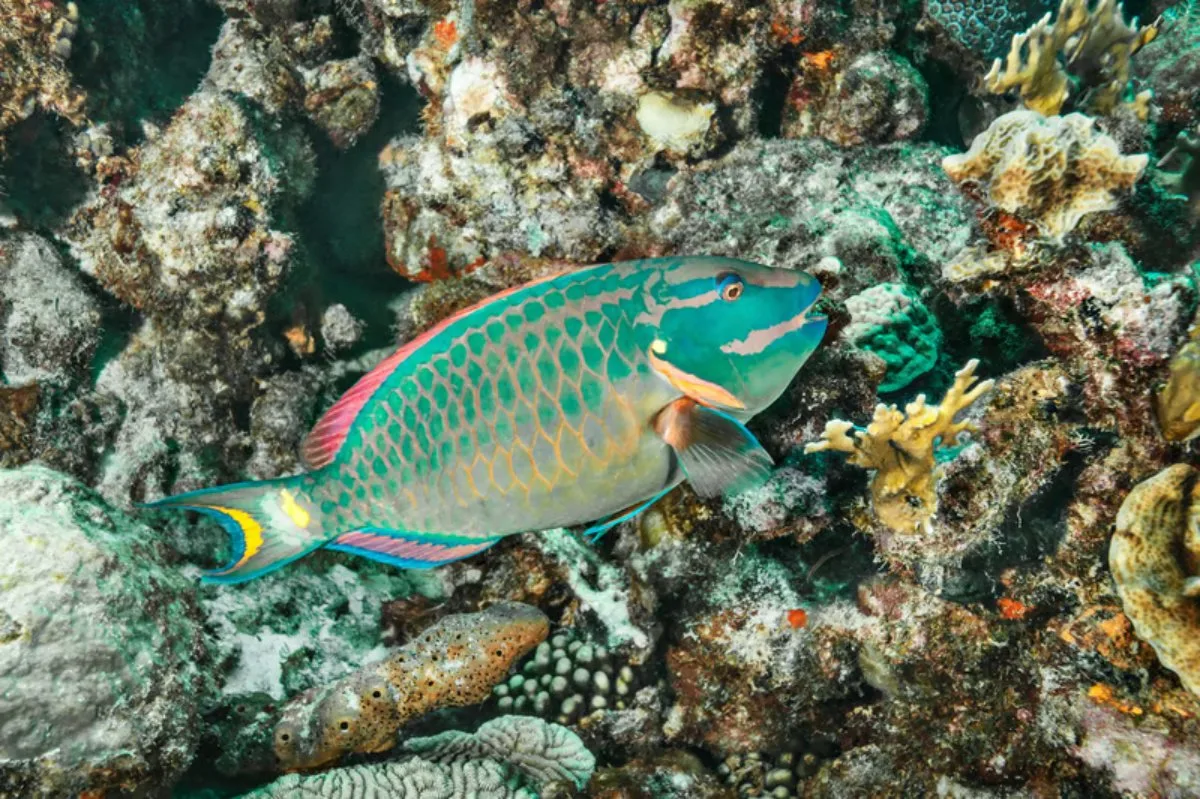
Parrotfish belong to the family Scaridae, and there are roughly 90 species found in tropical oceans worldwide. Most are reef dwellers, ranging in size from small species around 10 centimeters to large species reaching over 1.2 meters. They're famous for their coloration, which varies wildly by species, age, and sex. Some parrotfish display colors so vibrant—electric blues, hot pinks, lime greens—that you'd swear they were painted by an overly enthusiastic artist. Others are more subdued. But they're all recognizable by their most distinctive feature: the beak.
The Beak That Reshapes Reefs
A parrotfish's mouth isn't really a mouth in the traditional sense. The front teeth are fused into a beak structure that looks startlingly like a parrot's beak, which is where the family gets its name. Behind that beak, in the throat, sits another grinding structure called the pharyngeal mill—essentially a stone crusher made of bone and grinding teeth that can pulverize coral rubble into sand. The entire system is perfectly designed for one job: eating coral.
When a parrotfish feeds, it uses its beak to bite chunks of coral and the limestone skeleton underneath. It crunches the coral, breaks the limestone, and grinds everything into powder. Some of that powder is absorbed by the fish's digestive system—parrotfish can extract nutrients from coral tissue and algae living on the coral's surface. Most of it, though, just passes right through. That's the sand that ends up as beaches.
The amount of sand a parrotfish can produce in a day is staggering. A single large parrotfish might produce hundreds of kilograms of sand annually. On a healthy reef with good parrotfish populations, the sand-producing capacity of all the fish combined is enormous. Research on Hawaiian reefs has found that parrotfish are responsible for the majority of sand formation. Take away the parrotfish, and you lose the beaches. It's that simple.
Sex, Color Changes, and Unexpected Complexity
Parrotfish are sequential hermaphrodites, meaning they can change sex under certain circumstances. Unlike clownfish, where the change is somewhat predictable and structured, parrotfish sex change seems to happen more fluidly. An individual fish might be female, lay eggs, and then change to male later in life. Or it might stay female. The triggers for the change aren't entirely understood, but social dominance seems to matter. In groups of parrotfish, the dominant individual might be a male, or it might be a female. If the male dies, a female might change sex to take his place. If the female dies, a male might change and become female. Scientists still aren't sure exactly how the decision gets made.
Color change is related but separate from sex change. Some parrotfish species have multiple color morphs—some individuals are always one color, others always another. Others change color gradually as they age, or change rapidly based on mood and social context. Males during spawning season might display completely different coloration than outside of spawning season. A single fish might look dramatically different in three photographs taken six months apart. This makes species identification difficult and confuses anyone trying to photograph parrotfish for guides or documentation.
What's becoming clear to researchers is that parrotfish social life is complex in ways nobody appreciated until recently. They're not just solitary grazers. They congregate, sometimes in large groups. They establish feeding territories. They perform courtship displays. Some species are known to form spawning aggregations at specific times and places. It turns out parrotfish have personalities. Some individuals are bold feeders; others are cautious. Some take risks; others play it safe. There's individual variation in everything from feeding behavior to social tolerance.
The Sleeping Bag: A Mucus Cocoon in the Dark
Parrotfish are nocturnal. They spend their days feeding on coral, but as the sun sets, they retreat into crevices and holes in the reef to sleep. Before they settle in for the night, many parrotfish species do something remarkable: they secrete a mucus cocoon around themselves. This thin, translucent envelope of mucus completely envelops the fish, covering everything except maybe a small opening near the mouth.
Why? The leading theory is protection from parasites. The mucus barrier might interfere with parasitic sea lice trying to attach to the fish during vulnerable sleep hours. Another theory is olfactory camouflage—the mucus barrier might contain chemical compounds that mask the parrotfish's scent, making it harder for nocturnal predators to locate sleeping fish. Both mechanisms probably contribute.
The mucus cocoon is metabolically expensive to produce. A parrotfish is basically building a night-gown out of its own body fluids. But it survives the night, escapes the attention of nocturnal predators, and wakes up with fewer parasites. It's probably worth the energetic investment. Some research suggests that the mucus cocoon might also help the parrotfish rest more effectively, by providing sensory dampening or by reducing the cognitive load of staying vigilant while sleeping. It's like how humans pull blankets over their heads—it makes you feel safer.
Reef Building, Reef Destruction, and Delicate Balances
Here's the complicated part: parrotfish eat coral. While they're making beautiful sand and presumably keeping parasites off themselves, they're also reducing the coral structure. In moderation, this is fine. Coral grows, parrotfish bite, equilibrium is maintained. But when other stressors enter the picture, parrotfish grazing becomes problematic.
Coral bleaching events kill large portions of reef—sometimes up to 50% of the coral in an area dies in a single bleaching year. Without living coral to feed on, parrotfish have to shift to other food sources. They start feeding more on dead coral and algae-covered rubble. They graze harder. And here's the problem: they're not preventing new coral from growing, because the dead coral isn't getting a chance to recover. The reef becomes dominated by algae, and without living coral, the reef's structural complexity collapses.
Parrotfish that were ecosystem engineers become, in effect, reef destroyers. Not intentionally—they're just doing what parrotfish do. But the context has changed. With healthy coral, parrotfish are beneficial. With bleached coral, they're destructive. Scientists have started focusing on protecting parrotfish in the hope that healthy parrotfish populations can help reefs recover from bleaching events. It's a last-ditch effort, basically. If you remove the grazing pressure from algae and give coral a chance to regrow, parrotfish feeding on algae becomes less destructive.
The Ecosystem in a Single Fish
What makes parrotfish extraordinary isn't just that they're beautiful or interesting. It's that they're ecosystem engineers whose effects cascade through the entire system. Their grazing affects algae abundance, which affects herbivore populations, which affects the distribution of predatory fish. Their sand production affects coastal communities and tourism. Their reef modification affects the structure available for other species to live in. Remove parrotfish from a reef, and seemingly everything changes.
Climate change, overfishing, disease, and pollution all threaten parrotfish populations. As parrotfish numbers decline, the effects cascade outward. It's like pulling a critical support beam out of a building—the consequences aren't localized. Everything is interconnected. The parrotfish, beautiful and strange as it is, might be one of the most important fish in the ocean. We're only now realizing how much reefs depend on them, and probably only after we've already damaged populations too much to recover easily.
Quick Facts
- A single large parrotfish can produce approximately 200 kilograms of sand annually through eating and excreting coral, meaning that parrotfish are responsible for the majority of sand found on many tropical beaches
- Parrotfish undergo sex changes based on social hierarchy and availability of mates, with a female being able to change into a functional male if the dominant male dies, and potentially changing back if circumstances warrant
- The mucus cocoon that parrotfish secrete at night is composed of specialized proteins and lipids that likely provide protection against parasitic copepods while also offering olfactory camouflage against nocturnal predators
- Caribbean coral reefs have experienced catastrophic declines in parrotfish populations—some areas have lost up to 95% of parrotfish biomass in the past 40 years due to overfishing and disease
- The pharyngeal mill (throat-crushing structure) of a parrotfish is so powerful it can generate bite forces exceeding 4,000 Newtons, enough to reduce solid coral to sand in mere seconds
How endangered is this animal?
Traditional Medicine and Emerging Threats
Parrotfish have been used in traditional Chinese medicine for centuries. They're also harvested for food in many parts of the Indo-Pacific and Caribbean. The hunting pressure has increased as human populations have grown and fishing technology has improved. Some parrotfish populations have declined dramatically over the past few decades.
This is particularly concerning because the loss of parrotfish directly impacts reef health and sand production. Caribbean reefs, in particular, have lost enormous numbers of parrotfish due to overfishing. Combined with disease and coral bleaching, this has led to phase shifts where entire reef ecosystems transition from coral-dominated to algae-dominated. Once a reef is algae-dominated, it's very difficult to flip it back. The algae prevents coral recruitment. The reef structure degrades. Sand production plummets. The beaches that depend on parrotfish sand start to disappear.
Sources
Sources & Further Reading
Overview
Also Known As
Steephead parrotfish, Bumphead parrotfish (Scarinae subfamily; ~95 species)
Size
30 cm–1.3 m depending on species
Distribution
Tropical and subtropical reefs; Indian Ocean, Pacific, Caribbean
Habitat
Coral reefs, seagrass beds, rocky shorelines
Food / Diet
Coral (algae scraped from it), algae, invertebrates
Lifespan
5–20 years depending on species
Help us save the oceans
by surfing the web!
.png)
.png)
.png)

.png)
.png)
.png)
.png)
.png)
.png)