

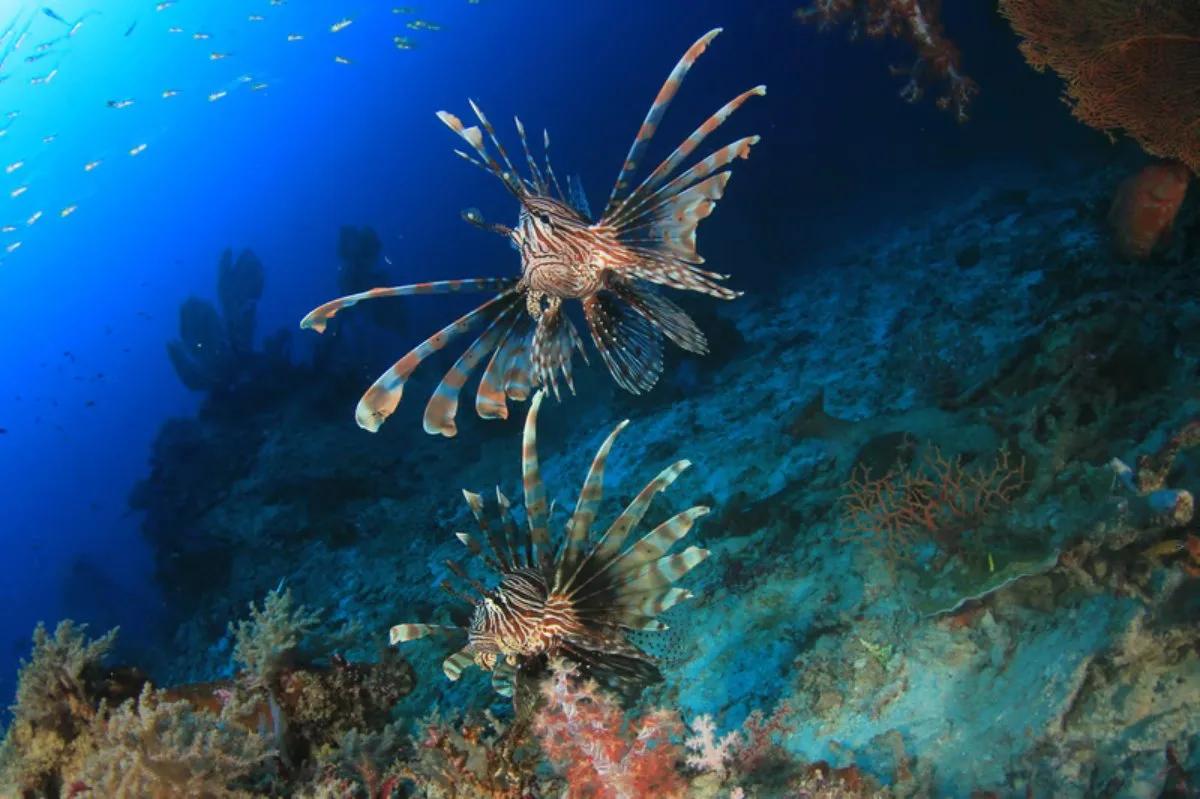
There's a fish so beautiful it seems almost impossible that it could cause ecological catastrophe. Elaborate, fan-like pectoral fins streaked with bold stripes. A body colored in brilliant reds and whites. Graceful, almost balletic movement through the water. It's hard to look at a red lionfish and think "invasive species nightmare." But that's exactly what it is. The red lionfish, , has become one of the most destructive marine invasions in recorded history, and it got to the Atlantic through a combination of aquarium trade accidents and the fact that it's an incredibly successful predator with essentially no natural enemies.
Lionfish are native to the Indo-Pacific, ranging from the Red Sea to Australia and up to Japan. There are around fifteen species, most of which are relatively innocuous members of their native reef communities. The red lionfish and closely related species are large, spectacular predators, and they've been popular in the aquarium trade for decades. They're beautiful, relatively hardy, and impressive to watch. The problem is that beautiful aquarium fish sometimes escape, and sometimes people intentionally release them. That's how lionfish ended up in the Atlantic.
Not Poisonous, But Definitely Venomous
Let's clear up a common misconception first: lionfish are venomous, not poisonous. There's a difference. Venomous means they inject toxins through a bite or sting. Poisonous means the toxin is absorbed through ingestion. Lionfish deliver their toxin through venomous spines. The spines run along the dorsal, anal, and pelvic fins. A single spine can contain enough venom to kill a human, though actual deaths from lionfish stings are relatively rare because people tend to avoid them after getting stung once.
The venom itself is a protein-based toxin that causes intense pain, numbness, and sometimes more serious effects like cardiovascular complications. The pain can last for hours or days. Early naturalists who encountered lionfish spine injuries reported that the pain was almost unbearable. Modern medical management involves immersion in hot water, which denatures the proteins and reduces pain significantly. But the sting itself is never pleasant.
In their native Indo-Pacific habitat, lionfish spines are a defensive adaptation. Local predators know to be careful around lionfish. Local prey species recognize the distinctive stripes and fan-like fins as a warning sign. The lionfish is saying "don't eat me, I'm dangerous." Predators and prey have coevolved with this defense system. They respect it. In the Atlantic, everything was different.
Why Native Predators Won't Eat Them
You might think that simply allowing natural predators to eat the lionfish would solve the problem. Sharks eat them. Groupers eat them. Eels eat them. But these native predators aren't eating enough lionfish to control the population. Why?
There are probably several reasons. One is that the natural predators evolved to eat fish that don't have venomous spines. Learning to eat a lionfish requires overcoming the instinctual wariness that the spines create. Young sharks might learn this by trying and getting stung, then figuring out how to eat the lionfish safely. But many individuals just decide it's not worth the effort. It's easier to eat harmless fish.
Another reason is that lionfish are not the easiest prey. They move slowly, which makes them easy to catch initially, but they're not defenseless. The spines are a real threat. A native predator that gets stung might be injured badly enough that it dies or becomes unable to hunt effectively. The cost-benefit calculation for eating a lionfish might just not work out for many potential predators.
There's also the simple issue of predator abundance. In places where lionfish are abundant, native predators are often depleted due to fishing or habitat loss. There simply aren't enough sharks or groupers to provide meaningful predation pressure on the lionfish population. Some regions that have tried to control lionfish by restocking native predators have seen modest successes, but it's a slow, expensive process.
How endangered is this animal?
The Invasion: How They Got Here
The earliest lionfish sightings in the Atlantic were in the early 1980s in the Florida area. The prevailing theory is that a few individuals were released from a damaged aquarium during Hurricane Andrew in 1992, though some lionfish predated that event, so perhaps multiple accidental releases happened. There are also anecdotal accounts of an aquarium owner releasing his fish deliberately, though that's never been verified.
Once a few lionfish were in the Atlantic, things escalated rapidly. The fish thrived. The Atlantic is warm enough in many areas for lionfish to survive year-round. There's plenty of food in the form of smaller fish. And here's the crucial part: the Atlantic fish had no defense against lionfish and no evolutionary history with them. A small grouper or snapper that might instinctively avoid a lionfish in the Indo-Pacific would see an Atlantic lionfish and think, "Oh, here's something I might be able to eat." By the time it realized its mistake, it was dead.
Lionfish also appear to have few natural predators in the Atlantic. Sharks eat them, but sharks aren't abundant enough to provide significant control. Groupers can eat them if the grouper is large enough, but that requires the right size match. For the most part, adult lionfish in the Atlantic are apex predators with essentially nothing hunting them. Juvenile lionfish suffer higher predation, but not enough to control the population growth.
The lionfish population exploded. Within twenty years, lionfish were found throughout the Atlantic, the Caribbean, and the Gulf of Mexico. By 2010, they were established in areas from North Carolina to Brazil. The population growth was exponential. Each fish can produce tens of thousands of eggs per year. Each new female that recruited into a population meant exponential increase in the next generation. The invasion was unstoppable.
Ecological Catastrophe: The Herbivore Collapse
The devastating effect lionfish have on native communities is their appetite for small fish. This might not sound immediately catastrophic, but consider what most of those small fish are: juvenile herbivores. Young parrotfish, surgeonfish, damselfish—the reef grazers that keep algae in check. Lionfish eat them. They eat them in enormous numbers. They eat so many that herbivore populations have collapsed in some areas.
With herbivores gone, algae blooms. The reef becomes overgrown with macroalgae and turf algae. Living coral gets smothered. The reef structure falls apart. Fish communities shift to species that don't need herbivorous predecessors. The entire ecosystem reorganizes around the absence of the species that were preyed upon. In some Caribbean reefs, the lionfish invasion has led to phase shifts where the ecosystem transitions from coral-dominated to algae-dominated. Some of those shifts might be permanent.
Lionfish are indiscriminate hunters. They don't just eat the abundant species. They eat everything they can fit in their mouths, which is a lot of fish. This might work fine in the Indo-Pacific, where there are native competitors and predators and an evolutionary history of coexistence. In the Atlantic, it's catastrophic. The Atlantic fish didn't evolve alongside lionfish. They're naive to the threat. Lionfish fill a predator niche that nothing fills in the native community, and they fill it with tremendous enthusiasm.
The Bounty Programs and Why They're Not Working
In response to the lionfish invasion, various governments and organizations have created lionfish bounty programs. Fishermen are paid to catch lionfish and bring them in. The idea is that increased fishing pressure will control populations. It sounds logical. It's also basically not working.
The problem is scale. The number of lionfish in the Atlantic is enormous—estimates suggest tens of millions. To meaningfully impact the population, you'd need to remove hundreds of millions of fish. The fishing effort required would be phenomenal. A bounty program removes some fish, but not nearly enough to reverse the invasion or even slow it significantly. It's like using a bucket to bail out a sinking ship with a hole the size of a car. You can remove water, but you're not solving the underlying problem.
Bounty programs do serve other purposes. They raise public awareness. They provide some economic incentive for fishing communities. They remove some local populations in specific areas, which can provide temporary relief. But as a population control strategy, they're a drop in the bucket. The lionfish population continues to grow or remains stable at devastated levels. There's no evidence that any Atlantic region has successfully reversed the lionfish invasion through fishing alone.
The Future of an Invaded Ocean
The lionfish invasion represents a fundamental challenge in marine conservation. It's one of the most successful biological invasions ever documented, and nobody has figured out how to stop it. The best strategy right now is damage control: catch and remove lionfish in protected areas where populations can be closely managed, accept that most areas are now invaded, and hope that native ecosystems eventually adapt to the new predator.
Some research suggests that native fish might be slowly evolving anti-lionfish behaviors. Fish in areas with established lionfish populations show more avoidance behaviors than fish from areas without lionfish. Over many generations, fish populations might develop instinctual wariness toward lionfish. But that requires the selective pressure to be strong enough to drive evolution, and it requires enough generations to pass. We're probably talking decades or centuries, not years.
The broader lesson is that biological invasions are extremely difficult to reverse once they're established. The lionfish should never have been in the Atlantic in the first place. But once they were there, once they established a population, once they began reproducing, the window for control closed. Now we're left with a permanently altered ecosystem, and no clear path forward besides learning to live with lionfish.
Quick Facts
- Red lionfish venom is protein-based and is heat-labile, meaning submersion in hot water (40-45 degrees Celsius) rapidly denatures the proteins and reduces pain significantly—the most effective treatment for a lionfish sting
- A single female lionfish can produce over 30,000 eggs per spawning event, with multiple spawning events per year, enabling explosive population growth in favorable conditions with minimal natural predation
- Lionfish arrived in the Atlantic probably through aquarium releases, with the first documented sightings in the early 1980s, and population establishment becoming irreversible by the early 2000s
- In some Caribbean reefs, lionfish density has reached levels of up to 400 individuals per hectare, compared to perhaps 1 to 4 individuals per hectare in their native Indo-Pacific habitat
- Native herbivorous fish populations in invaded areas have declined by 50% to 95%, depending on location, directly causing phase shifts toward algae-dominated reefs due to predation pressure on juvenile grazers
Sources
Overview
Also Known As
Red lionfish, Turkeyfish, Firefish (Pterois volitans)
Size
25–38 cm; up to 47 cm (18.5 in)
Distribution
Native: Indo-Pacific; Invasive: Atlantic, Caribbean, Gulf of Mexico
Habitat
Coral reefs, rocky crevices, artificial reefs; 1–300 m depth
Food / Diet
Fish, shrimp, crabs
Lifespan
10–15 years
Help us save the oceans
by surfing the web!
.png)
.png)
.png)

.png)
.png)
.png)
.png)
.png)
.png)