

The Ocean Sunfish: Evolution's Strangest Masterpiece
Overview
Imagine a fish so large that it weighs as much as three grand pianos stacked on top of each other. Now imagine that fish looks like someone started designing a normal fish and then got wildly distracted partway through the project. That's the ocean sunfish, or mola, and it's the largest bony fish in the world. It's also basically a freeloading disaster wrapped in skin, covered in parasites, and yet somehow wildly successful.
The ocean sunfish,
, is found in temperate and tropical oceans worldwide. Adults typically weigh between 1,000 and 2,000 kilograms, though specimens over 3,000 kilograms have been recorded. For perspective, that's about the weight of a small car, but with fewer organs than one would expect. The sunfish is often mistaken for a baby whale, or a drifting island, or occasionally an alien spacecraft by people who encounter them near the surface—which they do regularly, for reasons we'll get to in a moment.
The Fish That Looks Incomplete
Here's the thing about sunfish that nobody can quite explain without sounding judgmental: they look unfinished. Their bodies are shaped like a dinner plate viewed from above—wide, flat, circular. They have enormous dorsal and anal fins that stick straight up and down like an accordian being played by a very large and very drunk musician. They have no caudal fin—no tail in the traditional sense. Instead, they have a rough, crinkled structure called the clavus, which is basically just modified tissue that waves around in the water. They look like somebody took the blueprint for a fish and then removed half the components before building it.
This body plan is actually incredibly efficient for what sunfish do, which is mostly sitting in the water column eating jellyfish and drifting with currents. The flat shape presents minimal resistance to water movement. The large fins provide stability without requiring much muscular effort. The body is low-density, packed with gelatinous tissue and oil, so it's naturally buoyant. The sunfish doesn't have to work hard to stay where it is. It just kind of... exists.
The sunfish's mouth is unusual too. It's small, almost comically small relative to its body size, and filled with pharyngeal teeth rather than the traditional biting teeth you'd find in most fish. Its esophagus is lined with backward-pointing spines that prevent its jellyfish prey from escaping back out the way they came. Once something goes into a sunfish's mouth, that's it. There's no going back.
Sunfish Spas: The Floating Phenomenon
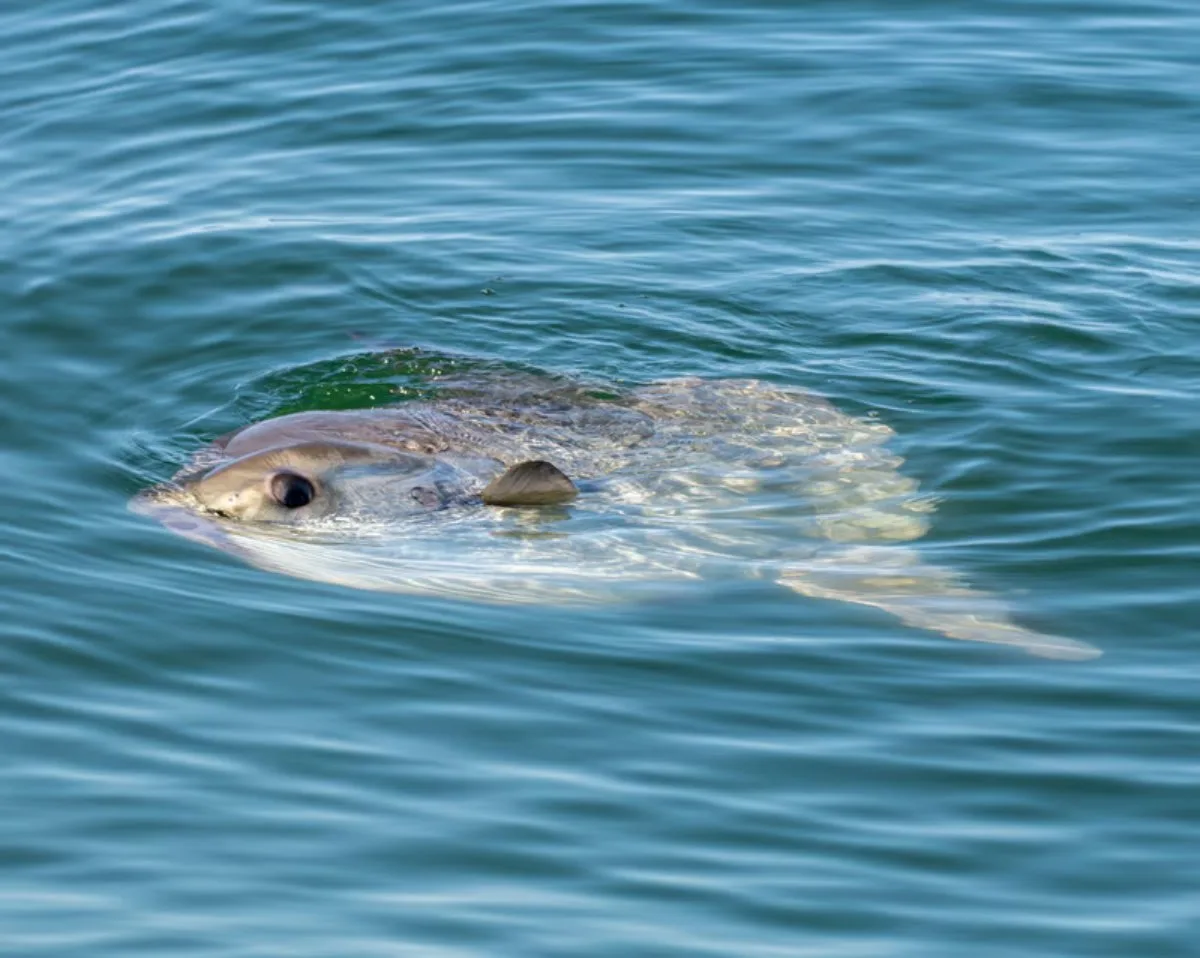
Sunfish are famous for another behavior that nobody fully understands: they float at the ocean surface, apparently sunbathing. Early naturalists who saw this behavior assumed the fish were dying, washing ashore to perish. But sunfish do this regularly, sometimes in groups, and they seem perfectly healthy. Modern researchers have a few theories.
The most compelling is the parasite-removal hypothesis. Sunfish are covered—and I mean absolutely covered—in parasites. They host over 50 different species of parasites regularly, including copepods, sea lice, and various other creatures that have made a living drilling into fish skin and feasting on blood. A sunfish can have so many parasites that its skin looks diseased. So sometimes, the sunfish floats to the surface and apparently allows seabirds to land on it and pick the parasites off. It's a symbiotic relationship, albeit one that involves a very large fish being used as a grooming platform by much smaller birds.
Another theory is thermoregulation. Sunfish might float at the surface to warm up, soaking in the sun's energy to maintain body temperature. Sunfish are ectothermic—they rely on external heat to maintain their metabolic rate—and the water column where they spend most of their time is cold. Regular warm-up sessions might be necessary to maintain normal function.
A third theory is simply that they're resting. Sunfish don't migrate long distances or maintain territories. They just drift, following currents and jellyfish distributions. Maybe floating is rest. Maybe it's just what they do when they're not actively eating.
A Jellyfish-Eating Catastrophe
Sunfish eat jellyfish. Almost exclusively. They'll eat gelatinous sea squirts and other soft-bodied prey, but jellyfish are by far their preferred diet. A single sunfish can eat thousands of jellyfish per day. This is actually crucial information for understanding sunfish, because jellyfish are nutritionally terrible. They're maybe 5% protein and 95% water. Eating thousands of jellyfish to meet daily caloric requirements is like trying to stay full by eating lettuce. You can do it, but you have to eat absolutely ridiculous amounts.
This diet has consequences. Sunfish probably get very little nutrition from what they eat, which might explain their seemingly lethargic behavior. They're not lazy—they're malnourished. They're basically sustained by the sheer volume of jellyfish they process. A sunfish's digestive system is probably running on fumes most of the time.
The jellyfish connection is important for another reason: as jellyfish populations boom due to overfishing of their predators and ocean acidification, sunfish populations apparently respond positively. More jellyfish means more potential food. It's turned sunfish into an accidental beneficiary of human-caused ocean changes. They're not thriving because the ocean is healthier—they're thriving because it's less healthy for everything else.
The Reproductive Mystery
Sunfish reproduction is almost completely unknown. They're assumed to be broadcast spawners—the female releases millions of eggs into the water, males fertilize them, and that's that. Eggs drift away and develop into larvae. But nobody has ever observed a wild sunfish spawning event. No spawning ground has been identified. The larval stage is so different from the adult that early researchers didn't realize they were the same species. The larvae are spherical and covered in spines, looking like tiny pufferfish. How they transform into the bizarre adult form remains mysterious.
What we know is that sunfish reach sexual maturity around 15 years of age and probably spawn in specific locations at specific times of year, likely following some kind of temperature trigger. A single female can produce up to 300 million eggs, which is one of the highest fecundities in the animal kingdom. The larvae survival rate is presumably incredibly low, though nobody knows the actual number. A tiny fraction of those 300 million eggs become adult sunfish. Those that do grow very quickly, gaining hundreds of kilograms over the first few years of life.
Parasite Central: The Sunfish as Biological Reservoir
As mentioned, sunfish are basically parasite hotels. The leading theory is that sunfish get covered in parasites because they move slowly and spend so much time in the surface waters where parasitic copepods and sea lice are abundant. They're not particularly good at removing parasites themselves—their body shape doesn't lend itself to aggressive scratching or rubbing. So parasites accumulate.
A healthy sunfish can host thousands of individual parasites without dying. This is actually kind of impressive from a physiological perspective. Most fish would be devastated by such parasite loads. Sunfish seem to tolerate it. Whether it affects their growth rate, lifespan, or reproductive success is unknown—researchers haven't managed to study enough wild sunfish to determine the true impact of parasitism on populations.
Some researchers think sunfish might actually benefit slightly from their parasites in certain cases. Some parasites might stimulate immune responses that help fight off worse infections. It's a stretch, and probably not true, but the point is that the relationship is complex. Sunfish and their parasites have coevolved together for millions of years. They're not perfectly matched—sunfish would probably be better off with fewer parasites—but they work.
Mistaken Identity: Sunfish as Sea Monsters
Throughout history, sunfish have been responsible for numerous sea monster reports. They're found in coastal waters worldwide, they're enormous, and they frequently wash ashore. There's a long historical record of sunfish being identified as unknown creatures, strange leviathans, or evidence of ocean mysteries. This is actually less about sunfish being weird and more about humans being bad at identifying things when we only encounter them once, under difficult circumstances, possibly dead.
The largest sunfish specimen ever recorded was about 3.1 meters tall and weighed an estimated 2,300 kilograms. A creature that large, drifting in the ocean, would definitely seem mysterious to someone who'd never seen one. Add to that the fact that sunfish change shape and coloration as they age and encounter different water conditions, and you've got a recipe for misidentification.
Today, sunfish are relatively well-known, at least in marine biology circles. But they remain understudied. Their population trends are unknown. Their actual dietary breadth is poorly understood. The details of their life cycle are mostly guesswork. They're enormous, abundant fish that we barely understand. In a way, they're living proof that the ocean still has mysteries hiding in plain sight.
Quick Facts
- An ocean sunfish can produce up to 300 million eggs in a single spawning event, making it one of the most fecund vertebrates on Earth, yet recruitment to adulthood remains almost completely unknown
- Sunfish can weigh as much as 2,300 kilograms but maintain neutral buoyancy through oil-filled tissues that comprise most of their body mass, rather than a swim bladder like most fish
- A single sunfish can host over 50 different parasite species simultaneously, with some individuals carrying thousands of individual parasites embedded in their skin
- Sunfish larvae are called "tholichthys" and look completely different from adults—they're spherical, spiny, and have eyes adapted for deep-sea vision, only later transforming into the plate-like adult form
- The sunfish's clavus (tail-like structure) is created by fusion of the dorsal and anal fin rays, making it technically not a true caudal fin but a modified fin structure unique to the species
How endangered is this animal?
Sources
Sources & Further Reading
Overview
Also Known As
Mola, Common mola (Mola mola)
Size
2.5–3 m height; weight up to 2,300 kg (5,071 lb)
Distribution
Tropical and temperate oceans worldwide
Habitat
Open ocean (epipelagic and mesopelagic); surface to 600 m
Food / Diet
Jellyfish, salps, squid, fish, crustaceans
Lifespan
10–23 years
Help us save the oceans
by surfing the web!
.png)
.png)
.png)

.png)
.png)
.png)
.png)
.png)
.png)