

There's a little fish that defies convention on almost every level. It moves like a caricature of itself, swaying through seagrass at speeds that would embarrass a sloth. It's monogamous in an ocean where promiscuity is the rule. And the male gets pregnant. These are seahorses, and they're living proof that evolution doesn't have a master plan—it just improvises based on what works in your neighborhood.
Seahorses belong to the genus, and there are around 50 species scattered across the world's oceans and coastal waters. They're technically fish—they have gills, they lay eggs, they've got fins—but they look so much like something a medieval cartographer invented that it's easy to forget they're real. Most species are tiny, ranging from the pygmy seahorse at just 1.5 centimeters to larger species reaching 35 centimeters. They're found in seagrass beds, mangroves, and coral reefs, always in shallow water, always anchored to something. They don't exactly move into a neighborhood so much as claim a small patch and defend it for life.
The Slowest Fish in the Ocean
Seahorses are legendarily slow. The slothful dwarf seahorse,
, moves at about 1.5 meters per hour when it's really trying. For context, that's slower than continental drift. Some sources claim it's the slowest fish ever recorded, though the speed varies depending on the temperature of the water and the individual horse's mood. It's hard to imagine a hunting strategy slower than this, and honestly, that's the point—seahorses aren't hunters in any conventional sense.
Instead of cruising the ocean floor looking for prey, seahorses are ambush predators. They hang on to seagrass with their prehensile tails and wait. Their eyes can move independently of each other, so one can watch for threats while the other scans for food. When a small crustacean—usually copepods or small shrimp—drifts within range, the seahorse's head accelerates in a fraction of a second. Its mouth pops open to create a tiny vacuum, and boom: dinner acquired. The prey doesn't even know what hit it.
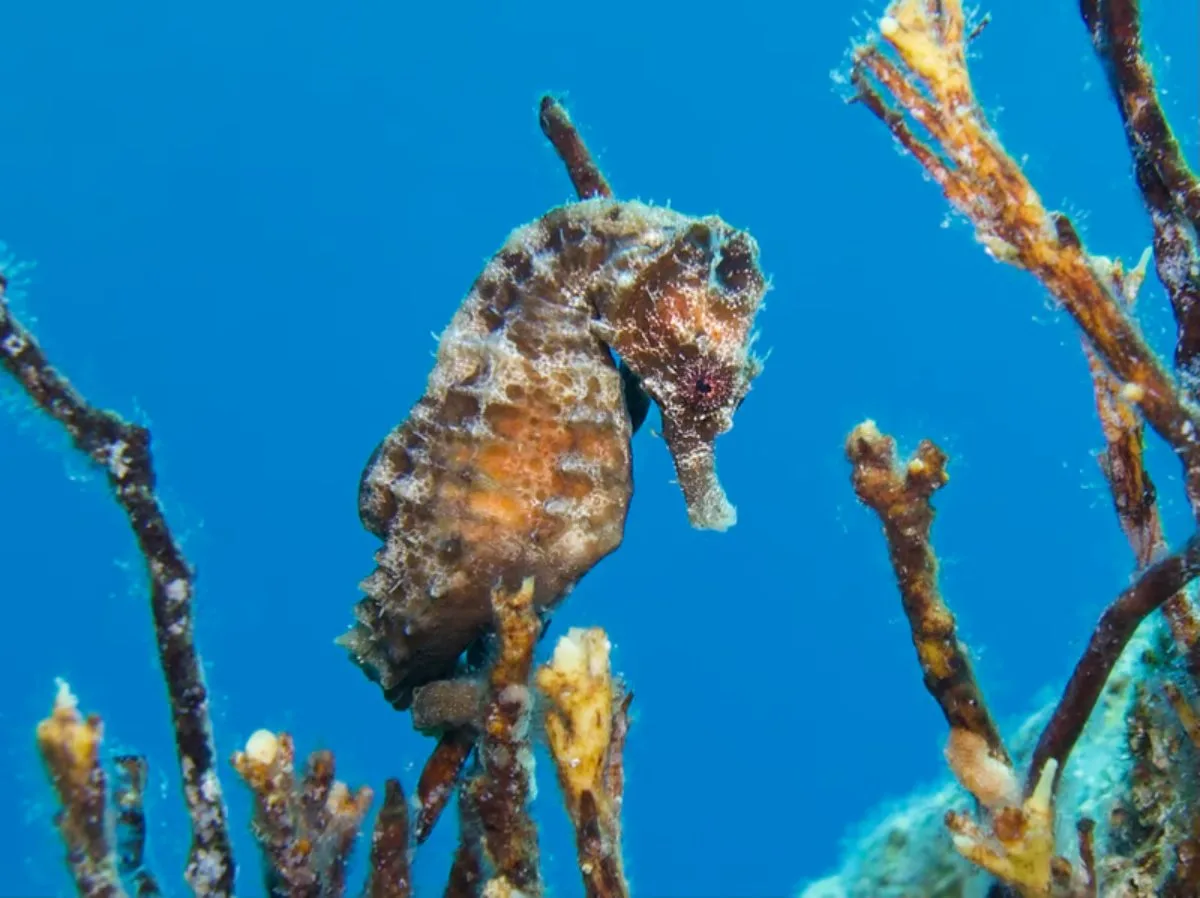
This ambush strategy works because seahorses are practically invisible in their native habitat. Their bodies are adapted to blend in perfectly with their surroundings. Most species can change color and pattern relatively quickly, shifting from pale to dark to match the seagrass, kelp, or coral they're hanging on. Some species have leafy extensions on their bodies that add to the camouflage. You could be swimming through a kelp forest full of seahorses and never know it. They're masters of hiding in plain sight.
The slowness is an energy-saving strategy, pure and simple. There's no reason to be fast when you're a stationary ambush predator in a place where food—though sparse—regularly drifts past. Speed costs calories. Calories are precious in the shallow waters where seahorses live, where competition for food is intense and seasons change dramatically.
The Peculiar Pregnancy
Here's what gets all the attention: seahorses have reversed the usual reproductive script. The female produces the eggs, but the male carries them. Not in his body temporarily, but in a specialized pouch that functions almost exactly like a mammalian uterus. He carries them there, keeps them safe, maintains the proper salinity and oxygen levels, and nurtures them until they're ready to be born. It's male pregnancy, and it's the only fish group where this happens regularly.
The mechanics work like this: the male and female go through an elaborate courtship dance, drifting through the water column together, often linked tail-to-tail. It's genuinely beautiful to watch, and they perform these dances repeatedly over several days before actually mating. When the female is ready, she deposits her eggs into the male's pouch. He fertilizes them and keeps them there, providing oxygen and nutrients through special tissues that function remarkably like a placenta. The eggs develop in the pouch for around two to three weeks, depending on the species and water temperature.
When the babies are ready—they're called fry, like in most fish—the male goes into labor. His pouch contracts and opens, expelling hundreds of tiny, fully-formed seahorses into the ocean. They're completely on their own immediately. No parental care after the birth. They have to find food, avoid predators, and find a place to anchor themselves all by themselves, immediately. The survival rate is abysmal. Probably less than one in a thousand make it to adulthood.
Scientists still aren't entirely certain why seahorses evolved this arrangement. It's metabolically expensive for the male—he's basically running his own biological life support system. The leading theory is that it gives the male control over which mates he reproduces with and how many offspring he cares for. If conditions are bad, he can reabsorb some of the eggs rather than investing in full development. He can choose to invest more in some pregnancies than others. He's not stuck with whatever the female produces. It's control, and control translates to evolutionary advantage in unpredictable environments.
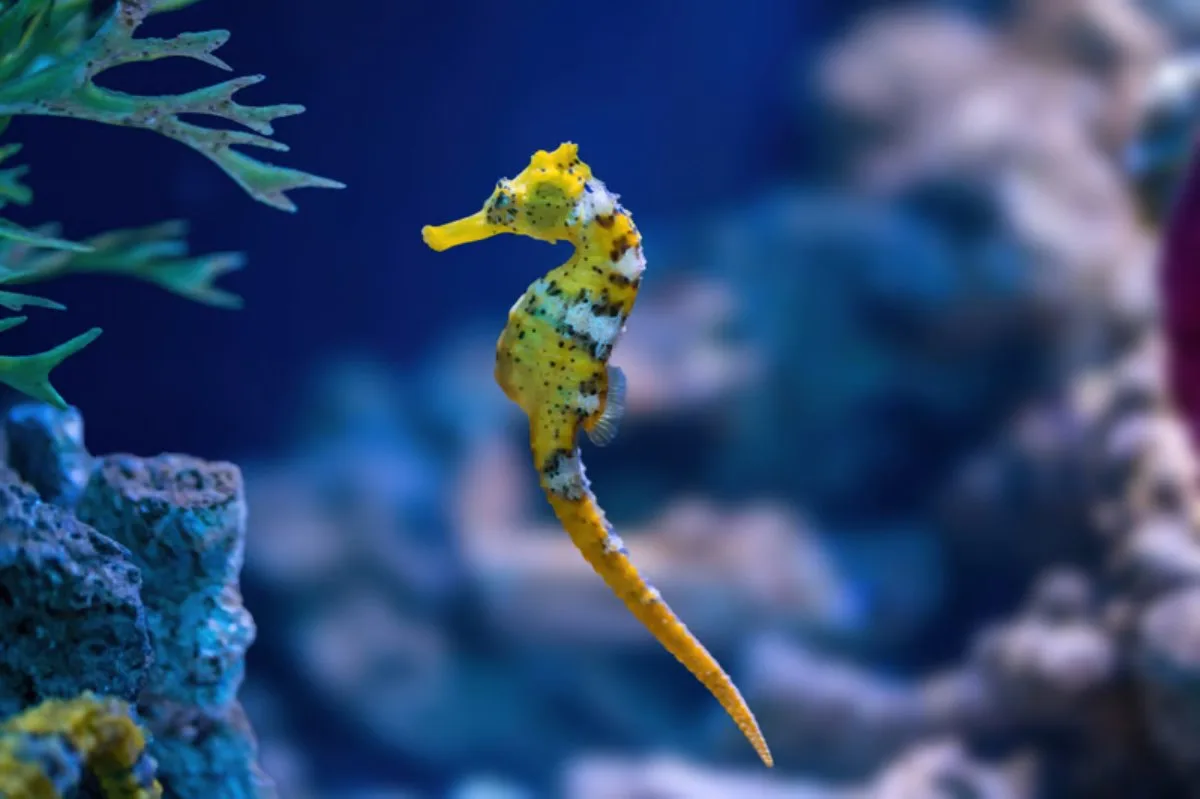
Love in a Shallow World: Monogamy Among Fish
Most seahorse species are monogamous or at least serially monogamous, meaning they pair up for at least a season, sometimes for life. This is genuinely unusual among fish. Fish tend toward explosive, anonymous reproduction—males don't know which eggs are theirs, females don't care who fertilized them, everyone's doing their own thing. Seahorses don't work that way.
A pair of seahorses will establish a small territory together, anchoring themselves near each other in the seagrass. They'll perform their courtship dance regularly, even after mating. Some researchers interpret these dances as a way of keeping the bond strong, reassuring each other of continued commitment. Others think it's more about maintaining synchronization—making sure both partners are in reproductive condition at the same time.
If one partner dies, the surviving seahorse doesn't immediately go looking for a new mate. It'll stay in the territory for a while, as if mourning. It's probably not actual mourning in an emotional sense—seahorses' brains are tiny and relatively simple—but the behavior looks that way. Eventually, if a new potential partner shows up and both horses are interested, they'll go through the whole courtship process again. There's no guarantee a new partnership will form. Sometimes the surviving horse just stays alone.
This monogamy might be a consequence of seahorse lifestyle more than an intentional strategy. Seahorses are relatively sedentary. They don't range far. If you're anchored in a small patch of seagrass with limited mobility, you're probably going to encounter the same potential mates over and over again. Maybe it's easier to just commit to one partner rather than compete constantly. Or maybe monogamy is simply the path of least resistance when you can't go very far to find alternatives.
The Hydrodynamic Head and Hidden Design
Take a close look at a seahorse's head sometime. It's shaped like a horse's head, obviously, which is where the name comes from. But it's not just shaped that way for show. The specific geometry of the seahorse's head—the curve, the angle, the way the snout extends—actually reduces drag in the water. When researchers at the University of Texas designed mechanical models of seahorse heads and ran them through fluid dynamics tests, they found that the horse-head shape creates tiny vortices that actually help guide prey into the mouth. It's a predatory adaptation hiding in plain sight within a name.
The tail is equally clever. It's prehensile, obviously, but the way it's muscled allows for precise grip without needing the seahorse to flex its whole body. The tail has a square cross-section, which gives it better stability when gripping round seagrass stems. The riding fins along the tail provide balance. It's all very intentional, very elegant. Seahorses look delicate and whimsical, but they're actually quite sophisticated predators and parents.
Quick Facts
- The male seahorse's pouch maintains precise salinity levels similar to the surrounding seawater, and ion exchange occurs across the pouch wall to regulate osmotic balance—essentially a biological filtration system
- A single male seahorse can carry as many as 1,500 fry in his pouch during a pregnancy, though the actual number varies widely by species
- The pygmy seahorse, at just 1.5 centimeters long, is found exclusively in coral reefs and is so well camouflaged that it wasn't scientifically described until 1969
- Seahorse pair bonds can last years or even a lifetime, with some pairs remaining together until one partner dies, making them among the most reliably monogamous fish in the ocean
- The seahorse's eyes can move independently, like a chameleon's, allowing one eye to watch for threats while the other scans for food—a huge advantage for an ambush predator
How endangered is this animal?
The Traditional Medicine Problem
Seahorses have been used in traditional Chinese medicine for centuries. Ground seahorse powder, seahorse soup, seahorse wine—these remedies supposedly treat everything from sexual dysfunction to asthma. There's no credible scientific evidence that any of this works, but that doesn't matter much when you're dealing with cultural traditions spanning millennia. Demand is enormous, and wild seahorse populations have paid the price.
Over 20 million seahorses are caught annually, mostly for the traditional medicine trade. Some species have declined by 90% in their native ranges. They're now protected under CITES (the Convention on International Trade in Endangered Species), but enforcement is weak, especially in developing countries where seahorses are primarily caught. Fishing methods are often destructive—entire seagrass beds are raked up to get the seahorses living there. The bycatch is enormous.
There's a small bright spot: seahorse farming is becoming more viable. Several facilities have successfully bred seahorses in captivity for the medicinal trade, which takes pressure off wild populations. It's not a complete solution, but it's something. The real solution would be reducing demand for seahorse medicine, but that's a cultural change that takes time.
Sources
Overview
Also Known As
Sea horse (Hippocampus genus; ~46 species)
Size
1.5–35 cm depending on species
Distribution
Tropical and temperate coastal waters worldwide
Habitat
Seagrass beds, coral reefs, mangroves, estuaries
Food / Diet
Small crustaceans, zooplankton, fish larvae
Lifespan
1–5 years
Help us save the oceans
by surfing the web!
.png)
.png)
.png)

.png)
.png)
.png)
.png)
.png)
.png)