

Imagine being a master artist who's colorblind. You can't perceive your own palette, yet you produce works that are indistinguishable from those created by someone with perfect color vision. This is the bewildering world of the cuttlefish. These creatures can change their coloration in less than a second, matching their surroundings with stunning accuracy. Researchers have discovered they can even mimic textures—producing three-dimensional bumps and ridges on their skin that replicate the rocks or coral nearby. Yet their eyes lack the color receptors that humans rely on. They can't see red. They can't see green. By all accounts, they should see in shades of gray, like an old black-and-white photograph. The fact that cuttlefish are among the most accomplished camoufleurs in the ocean poses a biological puzzle that scientists have been trying to solve for decades. How do they do it?
The Illusion of Invisibility
The cuttlefish's skin contains roughly 200 million chromatophores per square inch. These are specialized cells filled with pigment—usually melanin, which produces browns and blacks, but also yellow, red, or orange pigments depending on the species. Each chromatophore is connected to a nerve fiber. When the octopus wants to change color, it sends electrical signals that cause these cells to expand or contract, revealing or hiding the pigment inside. The transformation isn't gradual—it's nearly instantaneous.
But chromatophores alone aren't enough. Beneath them are iridophores and leucophores, reflective cells that bounce light around. These give cuttlefish the ability to produce shimmering, iridescent effects and subtle variations in brightness that make their camouflage nearly perfect. Observe a cuttlefish long enough and you'll see something remarkable: the animal moving across a complex background—patches of sand, scattered rocks, bits of seaweed—will remain virtually invisible despite lacking any obvious way to perceive the colors it's matching.
Some researchers believe the cuttlefish perceives color through its skin itself. The skin might contain photoreceptive proteins that allow it to sense light wavelengths without sending that information to the brain. It's a startling idea: imagine your arms being able to see color independently of your eyes. Testing this hypothesis has proven difficult. The skin appears to contain proteins related to light-sensing, but whether these actually function in color detection or serve some other purpose remains unclear.
Hypnotic Waves: Hunting by Distraction
Cuttlefish don't just hide. They hunt with an arsenal of behavioral tricks that seem tailored to overwhelm prey and observers alike. One particularly unsettling tactic is the passing cloud display—a dark wave that flows across the cuttlefish's body from head to tail. When a cuttlefish spots prey, it'll sometimes produce this wave while approaching slowly. The movement seems to tranquilize the prey, creating an almost hypnotic effect. The prey becomes fixated on the undulating pattern and doesn't flee.
Scientists studying this behavior have observed small fish and crustaceans becoming perfectly still as the wave approaches. Then, just as the dark wave passes over them, the cuttlefish strikes. The prey never sees the attack coming because it's been distracted by the display—like a magician drawing your eye to the wrong hand.
These displays aren't always predatory. Cuttlefish use color changes to communicate with each other. A male seeking a mate will produce rapid pulses and stripes. Some males adopt a female-like appearance to sneak past larger territorial males and mate without competition. It's deceptive, calculated, and speaks to a level of social sophistication rare in invertebrates.
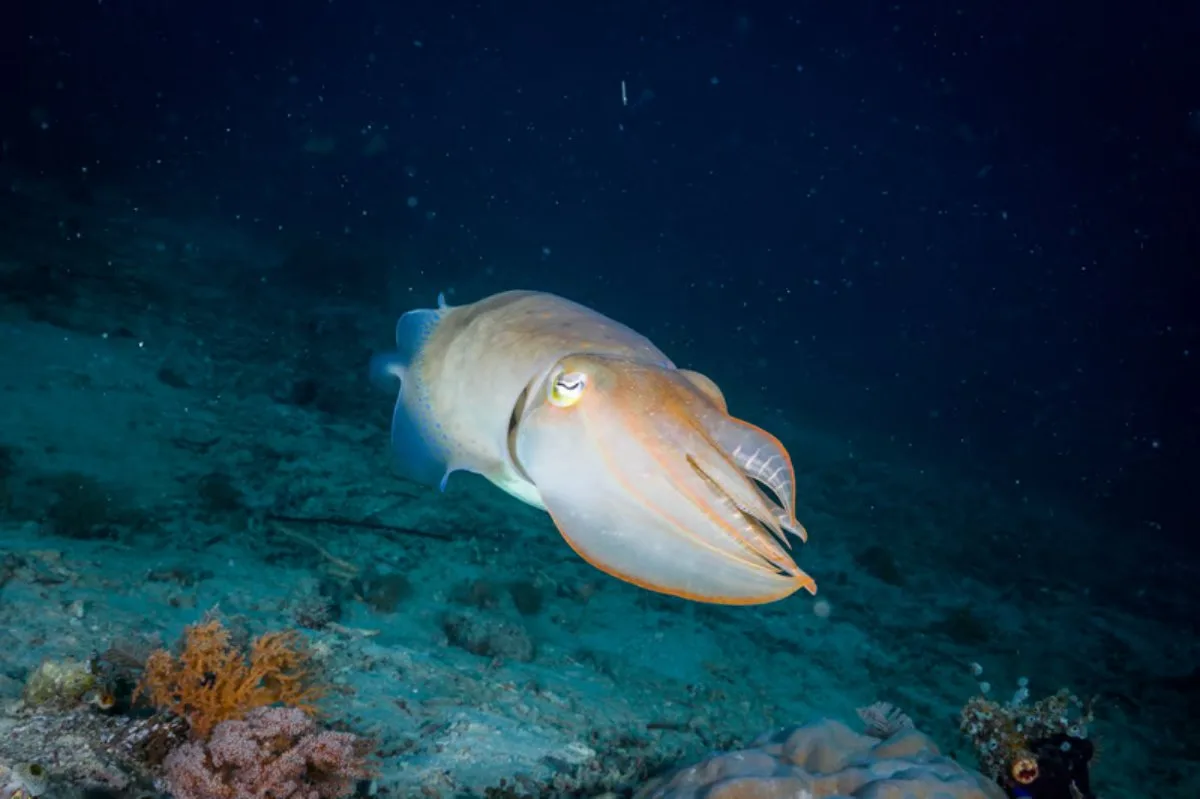
The Cuttlebone: A Submarine's Ballast Tank
Inside every cuttlefish is a cuttlebone—a shell composed of calcium carbonate with a structure similar to a stack of tiny plates. This internal buoyancy device is what separates cuttlefish from their cousins the octopuses and squids. The cuttlebone contains hundreds of small gas-filled chambers that the cuttlefish can fill or empty by secreting or reabsorbing fluid. By adjusting the amount of gas in these chambers, the cuttlefish achieves neutral buoyancy—it can hang motionless in the water without expending energy swimming.
The cuttlebone demonstrates an engineering principle that humans didn't fully grasp until we invented submarines. In fact, naval architects have studied cuttlebone structure to better understand pressure resistance and buoyancy control. The cuttlebone can withstand the pressure changes that come with the cuttlefish moving between shallow and deeper waters. If a cuttlefish needs to descend quickly, it can flood the chambers with fluid and sink like a stone. To ascend, it pumps the fluid back out, inflating the chambers with gas produced in its tissues.
This system is so effective that cuttlefish have become the primary method of staying at a specific depth without moving. An octopus, lacking a cuttlebone, must swim constantly to maintain position. A cuttlefish can simply drift, conserving energy for hunting and reproduction.
Intelligence and Play
Cuttlefish possess one of the largest brains relative to body size of any invertebrate. In laboratory settings, they've demonstrated the ability to open jars, navigate complex mazes, and recognize individual human researchers. They seem to enjoy playfulness—approaching glass tanks with apparent curiosity, investigating novel objects placed in their enclosures, even appearing to "toy" with prey in ways that don't strictly serve a hunting purpose.
One particular study documented a cuttlefish that repeatedly propelled itself at a human researcher's face, squirting water. The cuttlefish had no reason to do this. The human posed no threat. The only explanation was that the cuttlefish was engaging in something analogous to play—testing boundaries, experimenting with social interaction. It turned out the cuttlefish had learned that this behavior would get attention.
Their short lifespan—typically one to two years—means that cuttlefish don't have time to learn from older generations. All their complex behaviors appear to be instinctive, which raises questions about how such sophisticated predatory and social tactics evolved. What selective pressures produced an invertebrate capable of sophisticated problem-solving?
### Quick Facts
- Cuttlefish have W-shaped pupils, a visual adaptation that helps them detect polarized light
- They possess a type of hemocyanin blood protein instead of hemoglobin, making their blood blue
- Most cuttlefish species are solitary and only interact during mating season
- The cuttlebone has been used as a polishing agent and calcium supplement for pet birds for centuries
- Cuttlefish are found in every ocean except the coldest polar waters, with greatest diversity in the Indo-Pacific
How endangered is this animal?
Sources
Overview
Also Known As
Common cuttlefish, Cuttles (Sepia officinalis; Sepiida order ~120 species)
Size
15–50 cm mantle length; weight up to 4 kg
Distribution
Eastern Atlantic, Mediterranean, Indo-Pacific
Habitat
Shallow coastal waters, coral reefs, seagrass beds; 0–600 m
Food / Diet
Fish, crabs, shrimp, other cephalopods, worms
Lifespan
1–2 years
Help us save the oceans
by surfing the web!
.png)
.png)
.png)

.png)
.png)
.png)
.png)
.png)
.png)