

In 1998, marine biologist Roy Caldwell was conducting research in Indonesia when he observed something that shouldn't have been possible. An octopus was changing not just its color but its entire body shape, flattening its body and holding certain arms in a posture that perfectly mimicked a venomous lionfish. Caldwell watched as the creature shifted again, this time into the form of a banded sea krait - a highly venomous sea snake. Then it became something else again. The octopus was a shape-shifter, an impersonator so skilled it could convince predators that it was something far more dangerous. Nobody had documented this behavior before. The scientific community didn't even have a name for this species yet. Caldwell's discovery led to the identification of , the mimic octopus, now recognized as one of the most cognitively advanced invertebrates on Earth, capable of something that biologists had thought impossible: learned, strategic mimicry.
The Art of Becoming Someone Else
The mimic octopus doesn't just change color. It alters its body texture, modifies the shape of its arms, adjusts how it swims, and changes its behavior to match whatever species it's imitating. A lionfish swim involves waving the arms in a particular pattern, presenting that intimidating mane of venomous spines. The mimic octopus reproduces this motion with startling accuracy. A sea krait's swimming pattern is different, sinuous and undulating. The mimic octopus adopts that pattern too.
What's truly astounding is that the mimic octopus can apparently decide which animal to impersonate. The decision seems deliberate, strategic. When encountering a specific predator, the octopus will adopt the form of something that particular predator fears or avoids. When facing a different threat, it might shift to a different mimicry entirely. It's not random. It's not instinctive like the fixed displays of most animals. It's adaptive problem-solving applied to survival.
Scientists have identified at least 15 different species that mimic octopuses impersonate: flatfish, lionfish, sea snakes, and various species of brittle stars and sea urchins. The octopus adjusts its performance to the situation. The specificity is stunning. When confronted with a predator that hunts flatfish, the mimic octopus won't impersonate a lionfish. It becomes a flatfish, because that's what that particular predator will recognize and avoid.
The Mystery of Decision-Making
Here's where things get philosophically uncomfortable. How does the mimic octopus know which animal to imitate and when? Some researchers theorize that the octopus develops these motor patterns through observation or learning. Others believe there's an instinctive component—the octopus is programmed with templates for various body shapes and behaviors, and it simply selects the one most appropriate to the current threat.
What we don't have is certainty. The mimic octopus's brain is small, less than an inch across. Yet inside that tiny neural mass is something capable of pattern recognition, threat assessment, and tactical decision-making. Scientists still aren't sure whether the octopus is thinking through its choice or operating on something closer to instinct. Perhaps the distinction between thinking and instinct is blurrier than we imagine, especially in an animal whose distributed nervous system allows individual arms to make decisions independently.
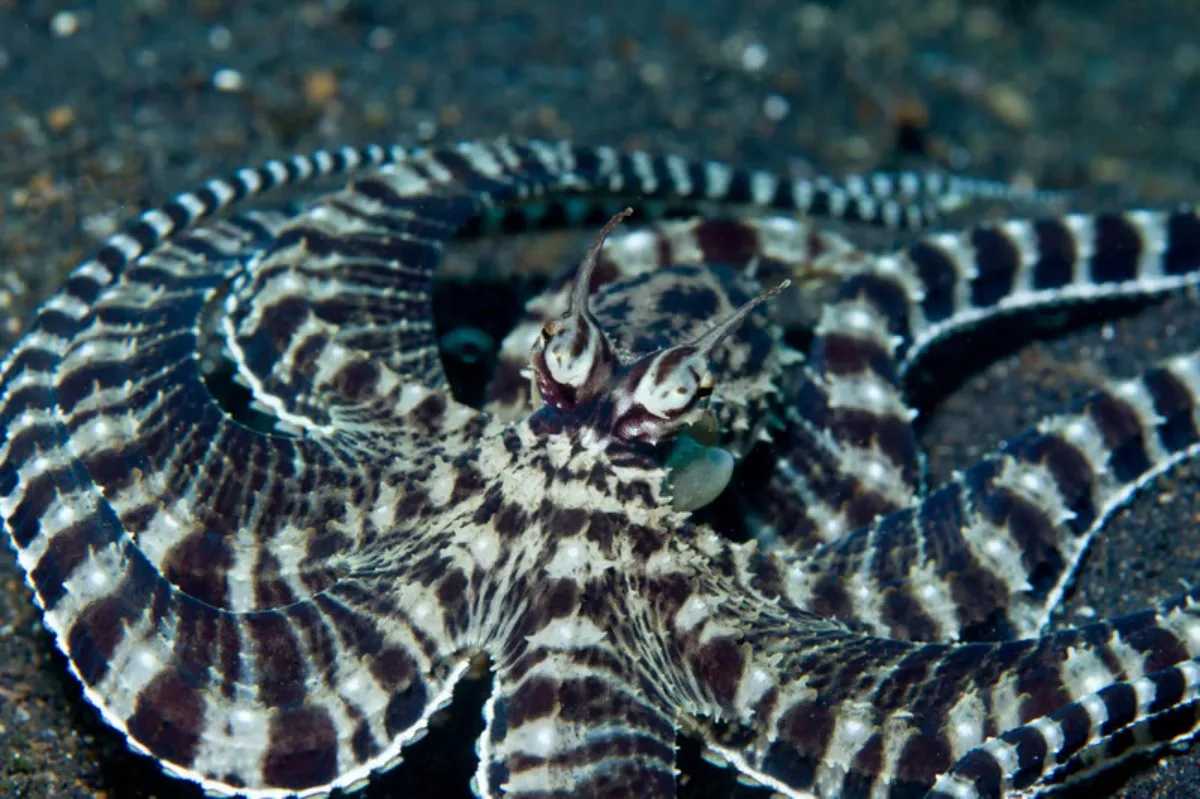
In 2006, researcher Mark Norman documented a mimic octopus displaying different forms to different predators. When encountered by a damselfish (which hunts octopus), the octopus became a lionfish. When confronted with a grouper fish (which also hunts octopus but specifically avoids sea snakes), the octopus shifted into sea snake form. The adaptability was immediate and context-specific. This wasn't coincidence. This was deliberate choice.
Where They Live and How They Survive
Mimic octopuses inhabit the Indo-Pacific region, particularly around Indonesia and the Philippines. They live in shallow waters, often in muddy or sandy areas where they can use mimicry to hide among the benthic community. Unlike many octopus species that hide in crevices and dens, mimic octopuses are active foragers, moving across open ground where they're exposed to predators. This vulnerability may be what drove the evolution of such sophisticated mimicry.
They hunt small fish and crustaceans, using their mimicry primarily as a defense against predators rather than as a hunting strategy. Their diet consists of organisms that are abundant and accessible nothing requiring the elaborate camouflage skills used in hunting. The mimicry exists almost entirely to improve survival odds, to convince predators that the octopus is something dangerous and therefore not worth the risk of attacking.
This strategy works. Predators consistently ignore mimic octopuses when they're in mimicry display. Once the display breaks down or the octopus is caught off-guard, predators attack. But the mimicry buys time and reduces the frequency of predatory encounters.
Intelligence and the Question of Consciousness
The mimic octopus raises unsettling questions about the nature of consciousness and intelligence. This is an animal with approximately 500 million neurons—fewer than the 86 billion in a human brain. Yet it engages in behavior that suggests genuine understanding, strategic planning, and what might be called deception or cunning. It makes choices that aren't predetermined. It adapts to novel situations.
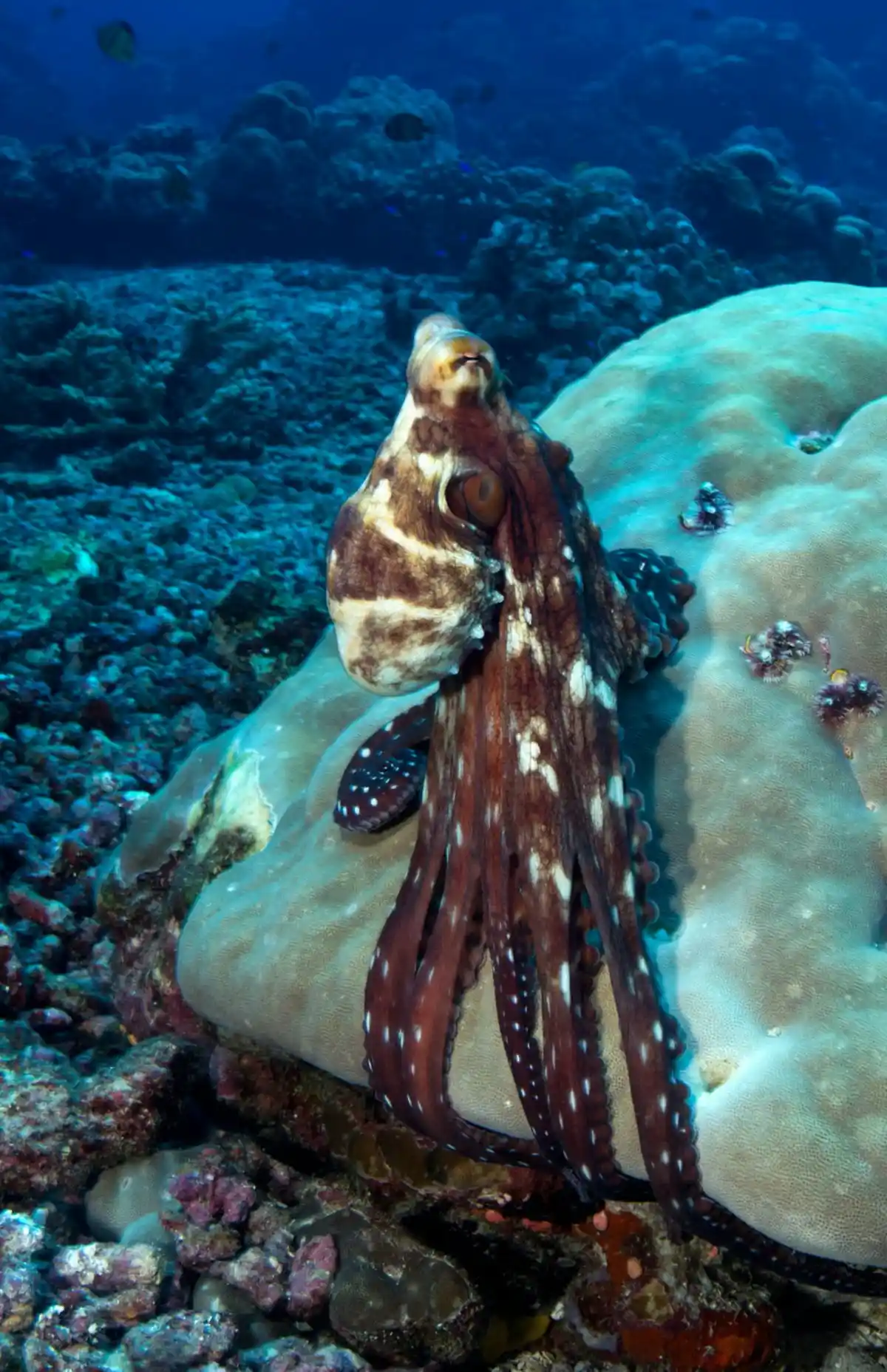
Some researchers argue that mimic octopus behavior indicates a form of consciousness—not identical to human consciousness, but nonetheless a subjective experience, an awareness of self and surroundings that allows for deliberate action. Others maintain that consciousness requires certain neural structures that octopuses lack. The debate continues, unresolved.
What isn't debatable is that the mimic octopus is intelligent, plastic in its thinking, and capable of something close to what humans would call learning. It observes. It adapts. It solves problems. It transforms itself not through instinct alone but through something that looks remarkably like choice.
### Quick Facts
- Mimic octopuses can change their body shape by changing their posture, not through morphing; they reshape themselves through muscle control
- They were only formally identified as a distinct species in 1998, making them one of the most recently discovered cephalopod groups
- Mimic octopuses are venomous themselves, but they never display their venom as a defense; instead they impersonate other venomous animals
- Their lifespan is extremely short likely less than one year, meaning all their knowledge of predators and mimicry appears to be instinctive
- The number of different species mimic octopuses can imitate continues to grow as researchers spend more time observing them
How endangered is this animal?
Sources
Overview
Also Known As
Mimic octopus (Thaumoctopus mimicus)
Size
60 cm total arm span; body about 5 cm
Distribution
Indo-Pacific; Indonesia, Philippines, Papua New Guinea
Habitat
Shallow tropical seas, sandy river mouths, estuaries; 0–37 m
Food / Diet
Small fish, crustaceans, worms
Lifespan
9 months–2 years
Help us save the oceans
by surfing the web!
.png)
.png)
.png)

.png)
.png)
.png)
.png)
.png)
.png)