

Most of us will never see the bottom of the ocean. It's too deep, too dark, too hostile to human life. The deepest parts of the sea exist in perpetual night, under pressure that would crush most animals instantly. Yet life thrives there. In 2009, a remotely operated vehicle descending into the Mariana Trench—the deepest part of any ocean—captured footage of something unexpected: an octopus hovering just above the seafloor at nearly 23,000 feet below the surface. The creature had large fins that flapped gently, like ears, giving it an appearance vaguely reminiscent of the Disney character Dumbo. Thus the common name was born. But the reality behind that cute nickname is far stranger and more alienating than any animated elephant. These octopuses exist in a realm so extreme, in conditions so inhospitable, that they represent evolution taking shape in an environment humans can barely fathom.
The World of Extreme Depth
The dumbo octopuses belong to the genus
, a group comprising roughly 18 recognized species living in the hadal zone—the deepest parts of the ocean, typically deeper than 13,000 feet. At those depths, pressure measures nearly 1,200 atmospheres—the equivalent of having a thousand people standing on your head simultaneously. The water temperature hovers just above freezing. Sunlight has never reached this far down. Oxygen concentrations are barely sufficient to support aerobic life.
Yet dumbo octopuses thrive there. They've adapted with such precision to these conditions that they'd perish in shallower, warmer water. Their bodies are soft and gelatinous, optimized for low energy expenditure. They move slowly, conserving metabolic resources. They hunt methodically, without the speed or aggression displayed by shallower octopus species. Everything about them screams efficiency in an environment where energy is desperately scarce.
The pressure at dumbo habitat depth would crush a human instantly. Yet these octopuses seem perfectly content, drifting across the seafloor as if it were the most natural thing in the world.
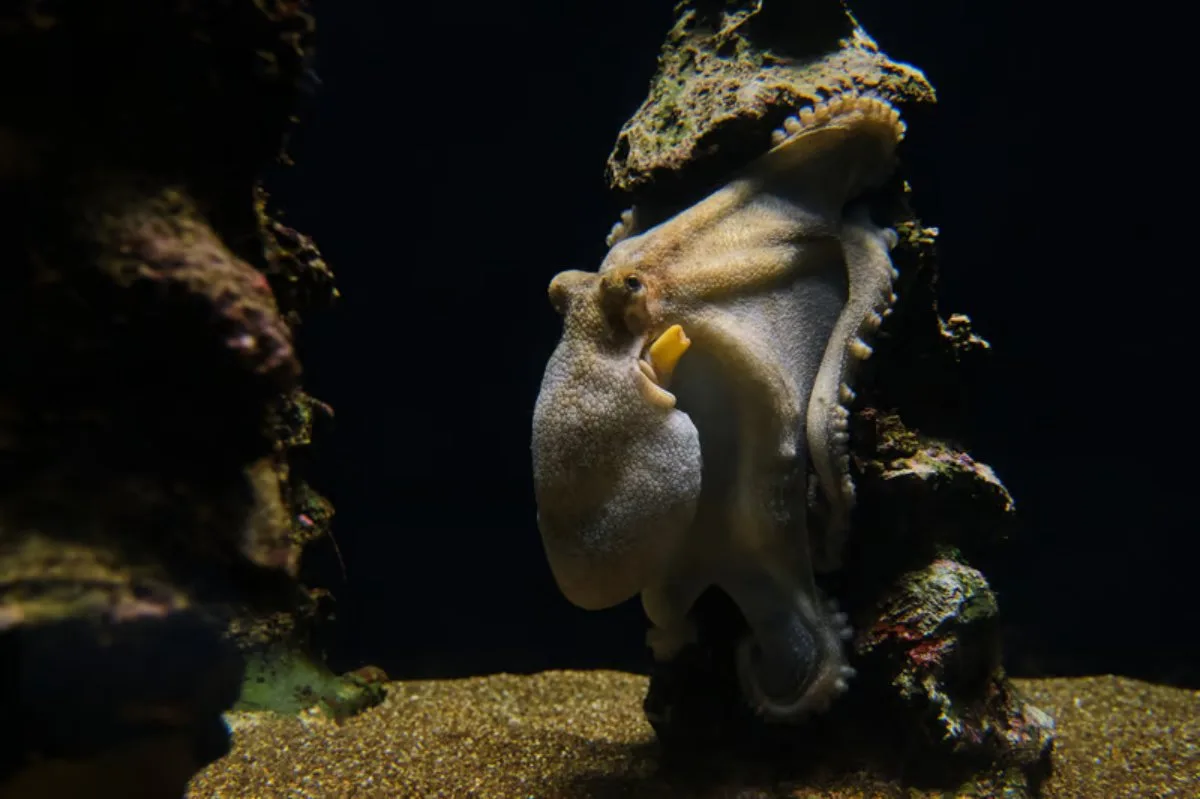
Ear-Like Fins: Nature's Solution to Weightlessness
The most distinctive feature of dumbo octopuses is their ear-like fins—the trait that inspired their common name. These fins, one on each side of the mantle, flutter and undulate as the octopus moves. They serve as the primary propulsion mechanism. By rippling these fins, the octopus achieves locomotion with minimal effort.
In an environment where food is scarce and energy must be conserved, this is brilliant engineering. An octopus propelling itself through muscular contractions of its arms or siphon would expend more energy than a dumbo octopus spending less energy on such elaborate fin movements. The dumbo octopus has traded the dexterity and speed of other cephalopods for efficiency in the abyss. It glides rather than darts. It drifts rather than swims. Every movement is measured and purposeful.
The fins also serve a secondary purpose—they help the octopus remain stable at its preferred depth. In the abyssal realm, an organism needs to stay at its ecological level or risk encountering conditions its body can't endure. The fins provide just enough lift to maintain position without expending excessive energy.
A Gentle Predator of an Alien World
Dumbo octopuses are sediment feeders and scavengers. They cruise slowly across the seafloor, hunting amphipods, copepods, and other microscopic invertebrates that make their home in the mud. They also consume larger dead organisms when they encounter them—the bodies of fish or other creatures that drift down from above. This reliance on scattered, unpredictable food sources has shaped their entire physiology.
Unlike octopuses that hunt actively, dumbo octopuses have a fundamental constraint: they can't catch anything that can move quickly. Their speed is too limited, their reflexes too slow. They're not hunters in the aggressive sense but rather grazers and scavengers. When food appears, they approach methodically. They feed. They move on. There's no urgency, no sudden strikes. Just slow, patient consumption.
Their arms lack the powerful suckers of shallower octopuses. Instead, they have weak suckers adapted for feeling and manipulating tiny food items. The beak is small and delicate. The whole creature looks fragile, almost vulnerable—which is surprising given that it lives in perhaps the harshest environment on Earth. Yet in that extreme environment, vulnerability becomes irrelevant. There are so few large predators at those depths that the dumbo octopus's apparent fragility is actually perfect adaptation.
Rarely Seen, Barely Studied
We know remarkably little about dumbo octopuses. Most of what we understand comes from specimens captured in deep-sea trawls or observed by remotely operated cameras. We don't know their lifespan. We don't know their reproduction patterns in detail. We don't know how long they take to mature or whether different species have fundamentally different ecologies.
In 2013, a deep-sea expedition managed to capture a dumbo octopus alive. This was extraordinarily rare. When brought to the surface, it died quickly—the change in pressure and temperature too extreme for its body to withstand. Scientists have attempted to maintain dumbo octopuses in pressurized aquariums, but the effort has proven extremely difficult. These creatures evolved for an environment so specialized that simulating it requires extraordinary technology.
Occasionally, footage emerges. A remotely operated camera descending into the hadal zone captures a dumbo octopus drifting across the landscape like a ghost. The footage is grainy, often monochromatic or rendered in false color. It's haunting in a way that footage of shallower creatures never is—the sense that you're watching something utterly alien, something from a different world. Then the vehicle moves on, and the octopus vanishes back into the darkness.
Life in Conditions We're Only Beginning to Understand
The deepest ocean is a frontier that humans are only now beginning to explore seriously. Every expedition reveals organisms adapted to conditions so extreme they seem impossible. The dumbo octopus is one of the most extreme examples—a creature so specialized to its environment that it's become almost unimaginable to surface dwellers.
Yet dumbo octopuses are likely abundant. There may be thousands of them or millions, slowly grazing on the abyssal seafloor. Scientists have no way to estimate population sizes. They barely know how many species there are. More species keep being discovered. More specimens keep being encountered. The dumbo octopus reminds us that vast portions of our planet remain genuinely unknown, inhabited by creatures perfectly adapted to conditions that would instantly kill any human.
### Quick Facts
- Grimpoteuthis lives deeper than any other known octopus species, with some species dwelling below 23,000 feet
- Their body composition is approximately 99 percent water, making them incredibly buoyant in the dense deep-sea environment
- The ear-like fins can comprise nearly a third of the octopus's total body length
- Some dumbo octopus species have bioluminescent light organs, though the purpose remains unknown
- A single specimen captured in 2013 set a record as the deepest-living cephalopod ever brought to the surface alive
How endangered is this animal?
Sources
Overview
Also Known As
Grimpoteuthis (genus); named after Disney's Dumbo
Size
20–30 cm average; up to 1.8 m (6 ft) recorded
Distribution
All oceans worldwide; extraordinary depths
Habitat
Deep ocean floor; 3,000–7,000 m depth
Food / Diet
Worms, crustaceans, bivalves, copepods on the seafloor
Lifespan
3–5 years (estimated)
Help us save the oceans
by surfing the web!
.png)
.png)
.png)

.png)
.png)
.png)
.png)
.png)
.png)