

You could hold one in your hand. It wouldn't even fill your palm. The blue-ringed octopus belongs to the genus, and specimens typically measure no more than five to eight inches in total length. They're among the smallest octopuses in the world. They're also among the most dangerous animals on Earth—more deadly, gram for gram, than any snake or spider. A single blue-ringed octopus carries enough venom to kill 26 humans in minutes. There's no antidote. No hospital treatment will save you. Once the venom enters your bloodstream, your fate is largely determined. The cruel irony is that the octopus isn't aggressive. It doesn't want to bite you. The rings, those brilliant sapphire circles that appear when the creature is threatened, are warnings that nobody notices until it's too late. This is a story about how something so small and so beautiful can pack a destructive punch that begs the question: what evolutionary arms race produced such a potent weapon in such a tiny package?
Tetrodotoxin: A Poison So Perfect It's Terrifying
The venom is tetrodotoxin, or TTX, the same neurotoxin found in pufferfish. The octopus doesn't manufacture it. Instead, bacterial colonies in its body—specifically in the salivary glands and other tissues—produce it as a metabolic byproduct. The octopus has evolved a symbiotic relationship with these bacteria, providing them shelter in exchange for a chemical weapon of extraordinary power.
Tetrodotoxin works by blocking sodium channels in nerve and muscle cells. Sodium is essential for generating the electrical impulses that allow your nervous system to communicate with your muscles. Without it, paralysis sets in. The victim remains conscious throughout. They can feel themselves suffocating as their diaphragm stops working. They're aware of their own death, fully alert and terrified, as their body goes limp. Most human deaths from blue-ringed octopus stings occur when the victim can't be reached by a mechanical ventilator within the first few minutes. If you can get someone on life support fast enough, they'll survive—but only because machines breathe for them while the toxin slowly metabolizes and leaves their system.
The lethal dose for humans is microscopic. A quantity smaller than a grain of salt can kill an adult. A single octopus carries enough venom to paralyze 20 or 30 times that amount. It's overkill in the truest sense of the word, yet evolution has repeatedly selected for this redundancy.
The Warning Colors That People Ignore
Blue-ringed octopuses aren't normally blue. Their base coloration is a bland golden-brown, with yellow or reddish undertones depending on the species and individual. They're camouflaged to blend into rocks and sandy bottoms. The rings are hidden, appearing only when the octopus is disturbed or frightened. Within seconds of a threat, iridescent blue or cyan circles seem to illuminate across the skin, pulsing with an almost hypnotic rhythm. Each ring is produced by specialized chromatophores—pigment-containing cells—that can be activated and deactivated in precise patterns.
This is an honest warning signal. The octopus is essentially saying: "Don't touch me. I'm dangerous." Most marine animals recognize this signal and leave the octopus alone. Predators have learned through generations of painful encounters that blue rings mean poison. But humans don't have that instinctual knowledge. They see something small and beautiful. They want to pick it up, take a photograph, maybe hold it for a moment. This misunderstanding has cost lives.
In 2010, a 23-year-old swimmer in Australia was bitten on the leg by a blue-ringed octopus while wading in the shallows. The bite itself felt like nothing—just a slight pressure, easily ignored. Twenty minutes later, he began to feel lightheaded. By the time he realized something was wrong, he couldn't move. He died within hours. The autopsy confirmed tetrodotoxin in his system. He'd never even seen the octopus clearly.
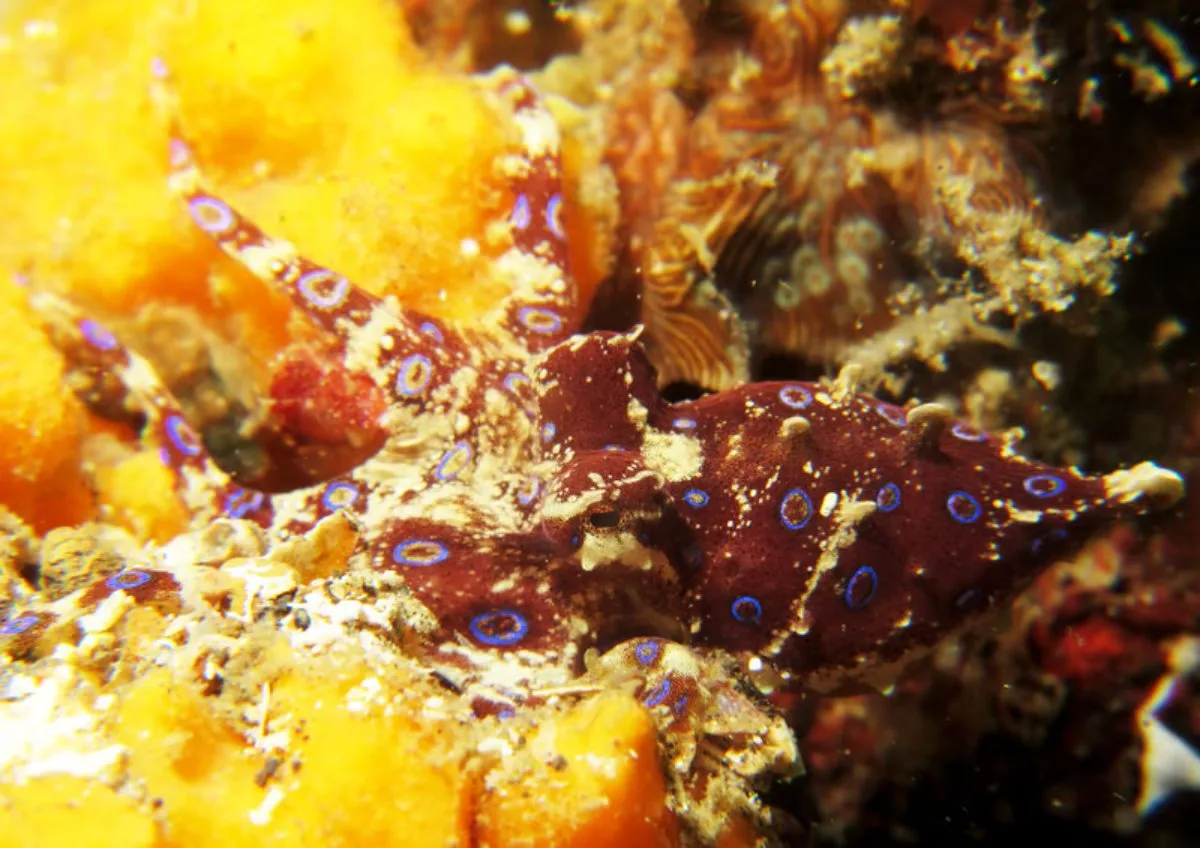
Venom Delivery: A Bite That Feels Like Nothing
The bite is a tiny puncture wound made by the octopus's beak—a hard, parrot-like structure located at the center where all eight arms converge. Because the octopus itself is small, the beak is small, and the wound is often completely painless. The venom is injected directly into the tissue through the puncture. A victim might not even realize they've been bitten until symptoms begin.
The timing of onset varies. Sometimes paralysis begins within minutes. Other times it takes an hour or more. Once it starts, the progression is inexorable. Tingling at the site of the bite spreads to the surrounding area. Numbness creeps upward. The victim might feel dizzy or nauseous. Then the major muscle groups begin to fail. Difficulty swallowing comes first. Then respiratory muscles begin to weaken. If the victim reaches a hospital or has access to CPR and mechanical ventilation, survival is possible. Without it, breathing simply stops.
The cruel truth is that there's no specific antidote to tetrodotoxin. Once it's in your system, medicine can't neutralize it. Doctors can only support your body and hope you survive long enough for your kidneys to filter it out—a process that typically takes hours to days.
Small Predators With Big Ambitions
Despite their size, blue-ringed octopuses are voracious hunters. They eat crustaceans, small fish, and other invertebrates—anything they can catch and fit into their mouth. They're not passive creatures; they actively search the rocky shallows where they live, turning over stones and peering into crevices. They're intelligent, too. They've been observed learning to open containers and navigate mazes in laboratory settings, displaying problem-solving abilities that suggest genuine curiosity.
The venom isn't just a defensive weapon. Octopuses use it to subdue struggling prey. A tiny shrimp injected with tetrodotoxin will be paralyzed long before it reaches the octopus's beak. This gives the octopus a massive advantage in hunting—the equivalent of a human having a tranquilizer dart built into their mouth.
### Quick Facts
- Three species of blue-ringed octopus are recognized, all found in tide pools and shallow coral reefs across the Indo-Pacific region
- The tetrodotoxin in a single blue-ringed octopus is 1,200 times deadlier than cyanide
- Blue-ringed octopuses are cannibals and will eat other blue-ringed octopuses if given the opportunity
- The rings don't always indicate imminent danger—the octopus sometimes displays them in a more relaxed context
- No human deaths from blue-ringed octopus bites have been recorded since 2010, largely due to increased public awareness
How endangered is this animal?
Sources
Overview
Also Known As
Greater blue-ringed octopus (Hapalochlaena; 4 species)
Size
12–20 cm total length; weight 10–100 g
Distribution
Indo-Pacific; Japan to Australia, especially tropical reefs
Habitat
Coral reefs, tide pools, sandy seafloor; 0–50 m depth
Food / Diet
Small crabs, shrimp, fish
Lifespan
1–2 years
Help us save the oceans
by surfing the web!
.png)
.png)
.png)

.png)
.png)
.png)
.png)
.png)
.png)