

The octopus is one of the most fascinating marine invertebrates, known for its intelligence, problem-solving ability, and remarkable physical adaptations. Found in oceans worldwide, octopuses belong to a group of animals that evolved very differently from vertebrates, yet developed complex behaviors often associated with mammals and birds.
Octopuses play an important role in marine ecosystems as both predators and prey. At the same time, their short lifespans, sensitivity to environmental change, and increasing interaction with humans make them a key species for understanding ocean health and conservation challenges.
Scientific Classification
Octopuses are not a single species but a diverse group within the class Cephalopoda.
- Kingdom: Animalia
- Phylum: Mollusca
- Class: Cephalopoda
- Order: Octopoda
- Family: Multiple families (e.g. Octopodidae)
- Genus: Octopus (and others such as Enteroctopus, Thaumoctopus)
- Species: Over 300 described species
Physical Characteristics
Size and Appearance
Octopuses vary greatly in size depending on species. Small species may have an arm span of less than 30 cm, while the giant Pacific octopus (Enteroctopus dofleini) can reach over 4 meters from arm tip to arm tip and weigh more than 40 kg.
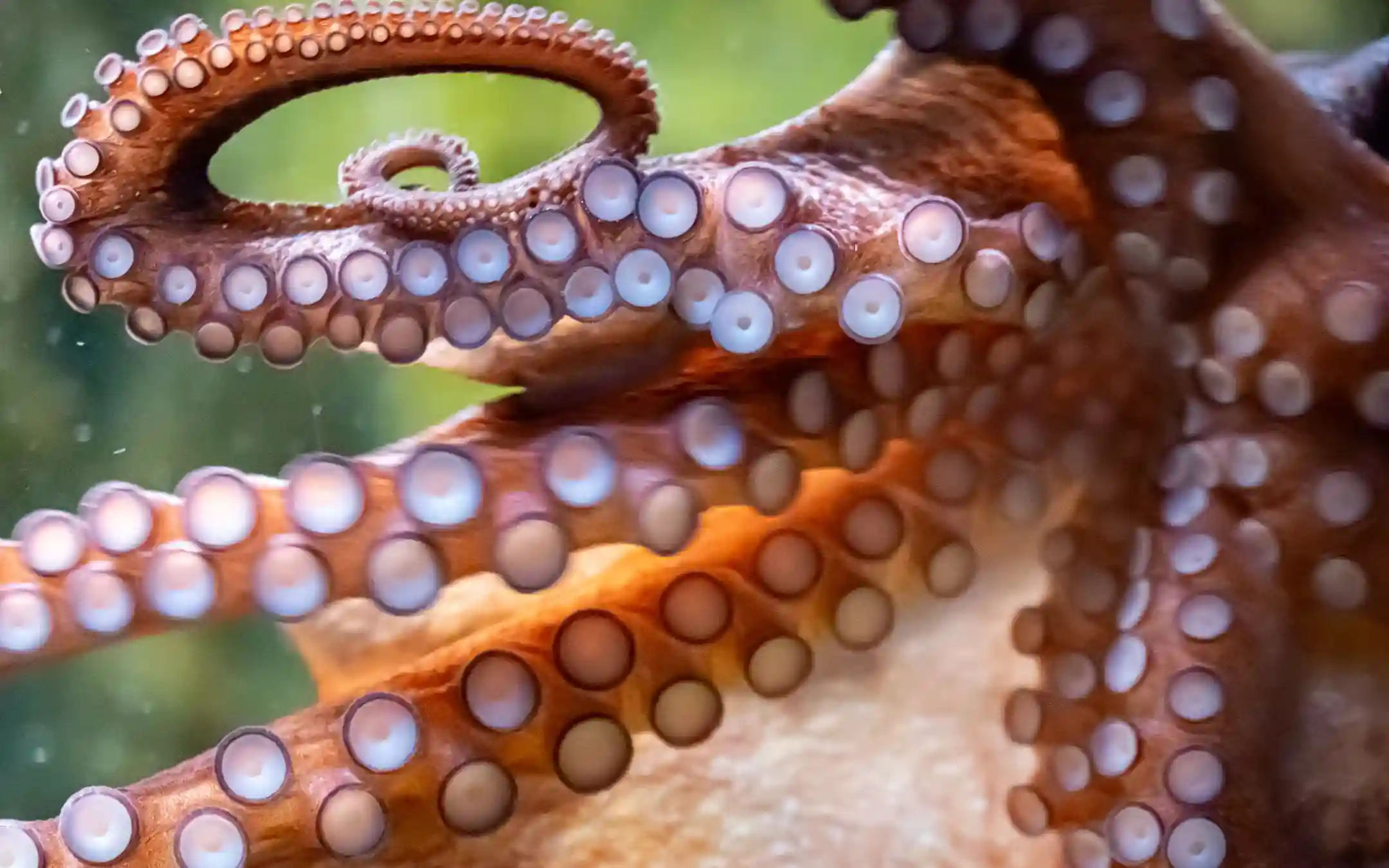
All octopuses have eight arms lined with suckers, a soft, flexible body, and a large head with well-developed eyes. Unlike many animals, octopuses have no internal or external skeleton, allowing them to squeeze through extremely small openings.
Unique Adaptations
One of the most remarkable adaptations of the octopus is its ability to change color, texture, and body shape within seconds. This is made possible by specialized skin cells called chromatophores, iridophores, and leucophores.
Octopuses also have:
- Three hearts
- Blue, copper-based blood (hemocyanin)
- Highly developed nervous systems, with more neurons in their arms than in their central brain
They can eject ink to confuse predators and use jet propulsion for rapid escape.
Habitat and Distribution
Octopuses are found in all oceans, from shallow coral reefs to the deep sea. Most species live on or near the seafloor and prefer environments where they can hide in crevices or burrows.
Habitats include rocky reefs, coral reefs, seagrass beds, sandy bottoms, and deep-sea environments. Some species live at depths exceeding 3,000 meters, while others remain in shallow coastal waters.
Because octopuses are highly sensitive to temperature, oxygen levels, and water chemistry, their distribution is closely tied to stable ocean conditions.
Behavior and Diet
Feeding Habits
Octopuses are carnivorous predators. Their diet typically includes crabs, shrimp, molluscs, and fish. They use their arms to capture prey and a hard, beak-like mouth to break shells or tear flesh.
Some species inject venom to paralyze prey before consumption. Evidence shows octopuses can learn hunting techniques and remember successful strategies.
Social Behavior and Intelligence
Octopuses are mostly solitary animals, interacting with others mainly for mating. Despite this, they display advanced cognitive abilities, including problem-solving, tool use, and learning through observation.
Laboratory and field studies have shown octopuses opening jars, navigating mazes, and recognizing individual humans. Their intelligence has made them a central subject in animal cognition research.
Role in the Marine Ecosystem
Octopuses play a critical role as mid-level predators, helping regulate populations of crustaceans and small fish. In turn, they are prey for sharks, marine mammals, large fish, and seabirds.
By controlling prey populations and serving as a food source for higher predators, octopuses help maintain balance within marine food webs. Their burrowing and den-building behavior also influences seafloor habitats.
Because of their sensitivity to environmental change, octopus populations can act as indicators of ecosystem health.
Conservation Status
IUCN Status
The conservation status of octopuses varies widely by species. Many are listed as Least Concern or Data Deficient on the IUCN Red List, largely due to limited population data. However, regional declines have been observed.
Interesting Facts About Octopus
- Octopuses have three hearts and blue blood.
- Each arm can move and react independently.
- Most octopus species live only 1–3 years.
- Octopuses can taste with their suckers.
- Some species use tools, such as coconut shells, for shelter.
Conclusion
The octopus is a unique marine invertebrate that challenges traditional ideas about intelligence, behavior, and evolution. Its advanced cognitive abilities, flexible body, and ecological importance make it one of the most studied animals in the ocean.
Protecting octopuses means protecting the habitats they depend on, from coral reefs to deep-sea environments. Sustainable fishing practices, pollution reduction, and climate action are essential for ensuring their continued survival in a changing ocean.
How endangered is this animal?
Human activity affects octopuses through overfishing, habitat degradation, pollution, and climate change. Octopuses are increasingly targeted by commercial fisheries, driven by global seafood demand.
Ocean warming may alter growth rates, reproduction, and survival, particularly for species adapted to narrow temperature ranges. Ocean acidification can impact early life stages and prey availability.
Plastic pollution and chemical contaminants also pose risks, as octopuses can ingest debris indirectly through prey.
Sources
National Wildlife Federation – Octopus
https://www.nwf.org/Educational-Resources/Wildlife-Guide/Invertebrates/Octopuses
Natural History Museum - Octopuses keep surprising us – here are eight examples how
https://www.nhm.ac.uk/discover/octopuses-keep-surprising-us-here-are-eight-examples-how.html
National Geographic – Octopus Facts
https://www.nationalgeographic.com/animals/invertebrates/facts/octopus
Overview
Also Known As
Octopus, common octopus (for Octopus vulgaris)
Size
From 30 cm (12 in) to over 4 m (13 ft) arm span, depending on species
Distribution
Worldwide, in all oceans
Habitat
Coral reefs, rocky seabeds, seagrass beds, sandy bottoms, and deep-sea environments
Food
Crabs, shrimp, molluscs, fish
Lifespan
Typically 1–3 years; some species live slightly longer
Help us save the oceans
by surfing the web!
.png)
.png)
.png)

.png)
.png)
.png)
.png)
.png)
.png)