

For centuries, sailors returned from the open ocean with stories of impossibly large tentacled creatures that could swallow ships whole. They described arms thick as tree trunks and eyes the size of wagon wheels. The scientific community largely dismissed these tales as myth, the product of sleep deprivation and too much rum. Then, in 2004, something remarkable happened: a Japanese research team led by marine biologist Tsunemi Kubodera captured the first-ever video footage of a living giant squid in its natural habitat, 3,000 feet below the surface off the coast of Japan. The creature wasn't pulling a ship or terrorizing whalers. It was hunting in the darkness, going about its business like any other animal. What that footage revealed was that the sailors' stories, while certainly exaggerated, contained kernels of truth that made the reality almost as stunning as the legends.
Size: Bigger Than We Thought, But Not Godzilla-Sized
The name
literally means "ruling squid," and giant squids do deserve their title. Adults typically reach lengths of 35 to 45 feet, though some exceptional specimens have exceeded 55 feet from the tip of the mantle to the end of the longest tentacles. One specimen washed ashore in Newfoundland in 1878 with tentacles measuring 49 feet. That's roughly the length of a school bus stretched lengthwise.
But here's where it gets tricky: size measurements are often misrepresented. The longest tentacles contain suckers and sensitive tissue, so they don't feel as substantial as the shorter feeding arms. When you actually encounter a preserved giant squid specimen, it can feel oddly underwhelming compared to the photographs. The body itself—the mantle—is relatively compact, like a bloated torpedo. A 45-foot giant squid might weigh only 600 to 750 pounds. Compare that to a sperm whale, which can weigh 50,000 pounds and reach 65 feet in length. The giant squid is long, yes, but it's not the ocean's heaviest predator. That title belongs to the whale it often encounters in the abyss.
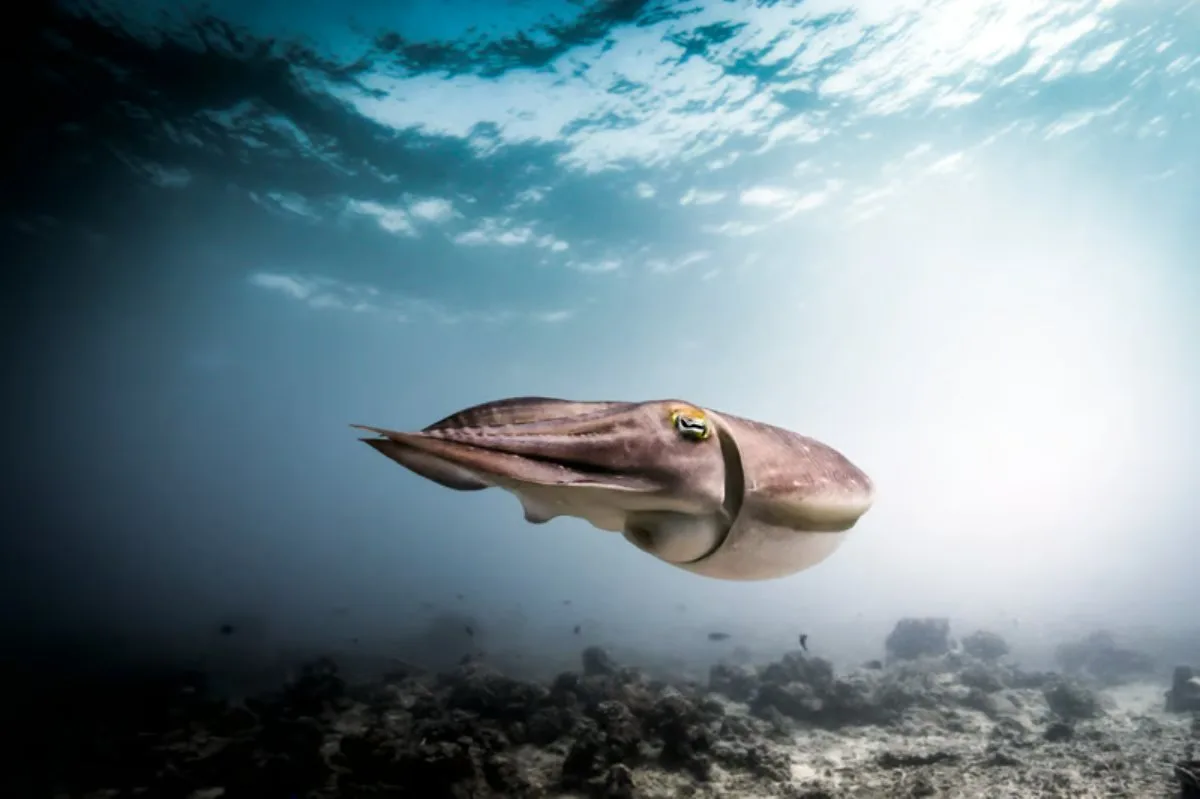
What the giant squid lacks in bulk, it makes up for in pure strangeness. Its arms are covered with hundreds of suckers, each one capable of leaving circular scars when applied to prey—or to larger animals.
Battle Scars: The Evidence of an Ancient Rivalry
The most compelling evidence for the existence and behavior of giant squids comes from sperm whales. Whalers for centuries have discovered giant squid beaks inside the stomachs of harvested whales, proof that these creatures weren't myths but actual meals. More haunting are the circular sucker scars found all over the bodies of deep-diving sperm whales. Some whales bear hundreds of these marks, each one a wrestling match with a giant squid in absolute darkness thousands of feet below the surface.
These scars tell a story. The largest ones measure nearly 16 inches in diameter, suggesting that the squid's suckers must be proportionally enormous. Imagine a creature with a mouth on the tip of its arm, using it to grab and pull at a whale fifty times its own weight. In 2007, a 43-foot-long giant squid was found in the stomach of a sperm whale. How did it fit? Scientists hypothesized that the squid hadn't been a meal at all—it had been killed in combat, perhaps struck by the whale's head, and then consumed after death.
The truth is, nobody really knows who usually wins these encounters. Do the whales hunt the squids, or do the squids fight back? Likely both things happen. The ocean's depth makes observation impossible, leaving us to interpret battle scars like archaeologists examining ancient weapons.
Eyes the Size of Dinner Plates
The giant squid possesses the largest eyes in the animal kingdom, bar none. A single eye can measure 10 to 15 inches in diameter—roughly the size of a human head. That's larger than most human brains. These aren't for show; they're essential for hunting in an environment where even light from bioluminescent creatures is scarce and precious.
Here's the striking thing: despite their enormous size, these eyes have a weakness. They lack the lens shape-adjusting ability that mammals use for focusing. The lens is fixed. The squid compensates by rolling its entire eye to aim the light-sensitive cells toward whatever movement catches its attention. It's like having to turn your whole head every time you want to look at something.
The retina of a giant squid eye contains enormous photoreceptor cells, some of the largest ever discovered. This allows the eye to function in nearly total darkness, detecting the faintest traces of light. In the perpetual night of the deep ocean, where even mid-water creatures travel in complete blackness, that advantage is everything.
How endangered is this animal?
Sources
Overview
Also Known As
Architeuthis, Giant squid (Architeuthis dux)
Size
Females up to 13 m; males up to 10 m including tentacles
Distribution
All oceans worldwide; deep sea 300–1,000 m depth
Habitat
Mesopelagic to bathypelagic zones
Food / Diet
Fish, other squid, deep-sea creatures
Lifespan
Approximately 5 years
Help us save the oceans
by surfing the web!
.png)
.png)
.png)

.png)
.png)
.png)
.png)
.png)
.png)