

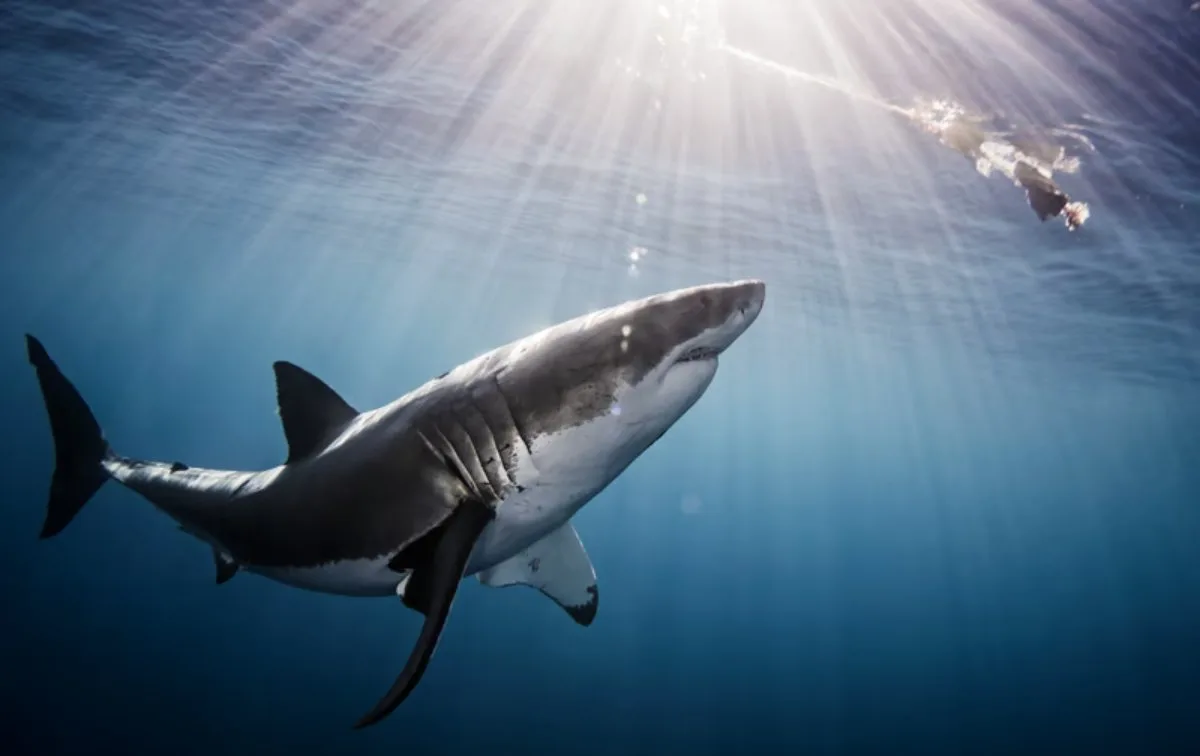
The first time most people see a great white shark, it's in a movie. Steven Spielberg essentially wrote the rules on how we should feel about: terrified. The Jaws effect was so powerful that it took decades for marine scientists to convince the public that great whites aren't mindless killing machines prowling beaches looking for humans. Yet if you've actually watched underwater footage of wild great whites—not the sensationalized documentary kind—you'll notice something odd. They're curious, methodical, sometimes almost tentative. A shark investigating a boat or a diver isn't necessarily attacking. It's assessing. The great white is a superpredator, yes, one of the ocean's most impressive hunters. But the gap between their actual behavior and our collective nightmare about them says more about us than it does about the sharks.
Built for Efficiency
The great white's body is an engineering marvel shaped by hundreds of millions of years of refinement. These sharks can weigh up to 1,100 kilograms—that's a fully loaded car made of muscle and cartilage. The body is streamlined like a torpedo, slightly compressed from side to side, which reduces drag as it cuts through the water. Their teeth are triangular, serrated, and they can have several rows of them, with replacements cycling in throughout their lifetime. A single tooth might measure five centimeters from root to point. But here's what makes the great white genuinely different from other sharks: they're one of the few species that can maintain their body temperature above the surrounding water. This regional endothermy—essentially running their brain, muscles, and digestive organs a few degrees warmer—gives them an edge in cold water and during intense bursts of activity.
Their hunting strategy relies on something that took decades to fully understand. Great whites circle prey below, using the sun to create a blind spot. Then they attack from below, where the prey can't see them coming. The acceleration during this strike is explosive—reaching speeds of 50 kilometers per hour in just a few seconds. That first bite isn't always fatal. The shark bites, withdraws, and waits for the prey to weaken. This behavior, which marine scientists call "exploratory" or "investigative" biting, is where human fatalities occasionally happen. The shark bites a human, tastes something it doesn't recognize as food, and typically swims away. Of course, "typically" doesn't help if you're the one percent who gets the wrong outcome.
The Hunting Reality
What great whites actually eat tells you something important about them. They hunt seals and sea lions, which are fast, agile, and equipped with teeth themselves. They eat other sharks. They eat fish, including tuna. They scavenge whales. A study from Dalhousie University that tracked forty-four wild great whites found that most adults spend their time hunting medium-sized prey like seals rather than going after large marine mammals. The variation in diet is striking. In South Africa's False Bay, great whites have learned to recognize the distinctive silhouettes of cape fur seals. Off California, they've adapted to hunt white sharks and other species based on seasonal availability. These aren't robots following a preset program. They're learning, adapting, making decisions.
The California population offers a sobering case study. In the 1970s, great white numbers off the coast had plummeted due to overfishing. Then protective legislation kicked in, and populations began recovering. Today, scientists estimate somewhere between 7,000 and 20,000 great whites inhabit the Northeast Pacific. That's a stunning recovery from what was nearly extinction, but the range is telling—we're still not entirely sure how many there are. Genetic studies suggest the Atlantic and Pacific populations are distinct groups, which matters for conservation policy. Each population has its own carrying capacity, its own migration routes, its own threats.
Human Encounters and Misconceptions
The statistics on great white attacks are both reassuring and strange. In Australia, where great white attacks are most common globally, you have roughly one fatal attack every ten years. In the United States, it's around one per decade. Meanwhile, roughly 100 million sharks are killed by humans every year—mostly through finning for soup, which is why some shark populations have crashed. The asymmetry is staggering. A great white has more reason to fear humans than we have to fear them, which is the kind of thing that makes you reconsider how these animals got their reputation.
The "man-eater" designation always puzzled marine biologists. In the rare cases where a great white injures a human, scientists have found everything from curiosity to mistaken identity to actual hunger as possible explanations. A shark that's genuinely in hunting mode makes a clean, committed strike. A shark that's investigating something makes tentative approaches. Most human interactions fall into the latter category. That doesn't make them safe—a thousand-kilogram predator investigating you with its teeth is never fully safe—but it means the danger is more nuanced than "apex predator seeks human prey." The New South Wales government's shark drumline program, which kills sharks near beaches, has been controversial partly because data suggests it hasn't significantly reduced human attacks. Some environmental groups argue the money spent on drumlines could fund other safety measures that don't kill protected species.
Conservation at a Crossroads
Today's great white population faces complex threats. Climate change is warming the oceans, pushing their prey species into different ranges. Illegal finning, while declining in some regions due to enforcement, continues to decimate populations in others. Bycatch in commercial fisheries kills an unknown number of sharks annually. Yet in protected areas, populations are rebounding. Australia's marine protection zones have led to measurable increases in great white numbers. The Atlantic population, listed as "vulnerable" rather than "endangered," shows signs of stability where protection is enforced.
Here's the tension: great whites are safe in some regions and in genuine trouble in others. A 2022 study in
found that populations in the Southeast Pacific were particularly vulnerable due to their smaller size and limited range. Meanwhile, the Mediterranean population has crashed to perhaps only a few hundred individuals remaining. Conservation efforts that work in one region—like marine protected areas—require political will and enforcement capacity that many countries lack. The species doesn't need massive intervention so much as it needs the existing laws to be enforced consistently and extended to regions where sharks have no protection at all.
Quick Facts:
Great whites can live 70+ years, making them one of the longest-lived fish species. A single great white can consume 11,000 calories in a single meal and then fast for months. They don't have a stomach in the traditional sense—it's more like a muscular sac that they can turn partially inside out to expel unwanted contents. Australia's South Africa's False Bay has become a hotspot for great white tourism, generating millions in revenue and creating economic incentives for protection. Temperature plays a crucial role in their hunting efficiency, which is why California's coastal upwelling zones attract so many sharks during summer months.
📹 Watch & Explore
Factual America – 14 Must-Watch Great White Shark Documentaries
How endangered is this animal?
Conservation at a Crossroads
Today's great white population faces complex threats. Climate change is warming the oceans, pushing their prey species into different ranges. Illegal finning, while declining in some regions due to enforcement, continues to decimate populations in others. Bycatch in commercial fisheries kills an unknown number of sharks annually. Yet in protected areas, populations are rebounding. Australia's marine protection zones have led to measurable increases in great white numbers. The Atlantic population, listed as "vulnerable" rather than "endangered," shows signs of stability where protection is enforced.
Here's the tension: great whites are safe in some regions and in genuine trouble in others. A 2022 study in
found that populations in the Southeast Pacific were particularly vulnerable due to their smaller size and limited range. Meanwhile, the Mediterranean population has crashed to perhaps only a few hundred individuals remaining. Conservation efforts that work in one region—like marine protected areas—require political will and enforcement capacity that many countries lack. The species doesn't need massive intervention so much as it needs the existing laws to be enforced consistently and extended to regions where sharks have no protection at all.
Quick Facts:
Great whites can live 70+ years, making them one of the longest-lived fish species. A single great white can consume 11,000 calories in a single meal and then fast for months. They don't have a stomach in the traditional sense—it's more like a muscular sac that they can turn partially inside out to expel unwanted contents. Australia's South Africa's False Bay has become a hotspot for great white tourism, generating millions in revenue and creating economic incentives for protection. Temperature plays a crucial role in their hunting efficiency, which is why California's coastal upwelling zones attract so many sharks during summer months.
Sources
Overview
Also Known As
White shark, White pointer, White death
Size
4.6–6 m (15–20 ft); up to 6.4 m recorded
Distribution
Coastal and offshore waters worldwide; common in South Africa, Australia, California
Habitat
Coastal surface waters, open ocean; 0–1,200 m depth
Food / Diet
Fish, marine mammals (seals, dolphins), sea turtles, carrion
Lifespan
70+ years
Help us save the oceans
by surfing the web!
.png)
.png)
.png)

.png)
.png)
.png)
.png)
.png)
.png)