

If the Spotted Eagle Ray is a nimble UFO, the Giant Oceanic Manta Ray (Mobula birostris) is the celestial mothership. Watching one of these glide past you isn't just a wildlife encounter - it’s a spiritual experience. They are the undisputed heavyweights of the ray world, and quite frankly, they make every other fish in the sea look like they’re trying too hard.
While most rays are content to hang out on the seafloor acting like sandy pancakes, the Manta Ray is out here "flying" through the open ocean with a wingspan that could comfortably cover a standard school bus. They are the gentle giants of the deep, and they have some of the biggest brains, and most confusing mysteries in the entire animal kingdom.
They Are the Biggest "Birds" in the Water
First, let’s talk about that wingspan. We’re talking about an animal that can reach 29 feet from tip to tip. For reference, that’s longer than two mid-sized cars parked end-to-end. Unlike stingrays, Mantas don't have a venomous stinger. They don't need one. When you’re the size of a small apartment and move with the grace of a stealth bomber, most things just stay out of your way.
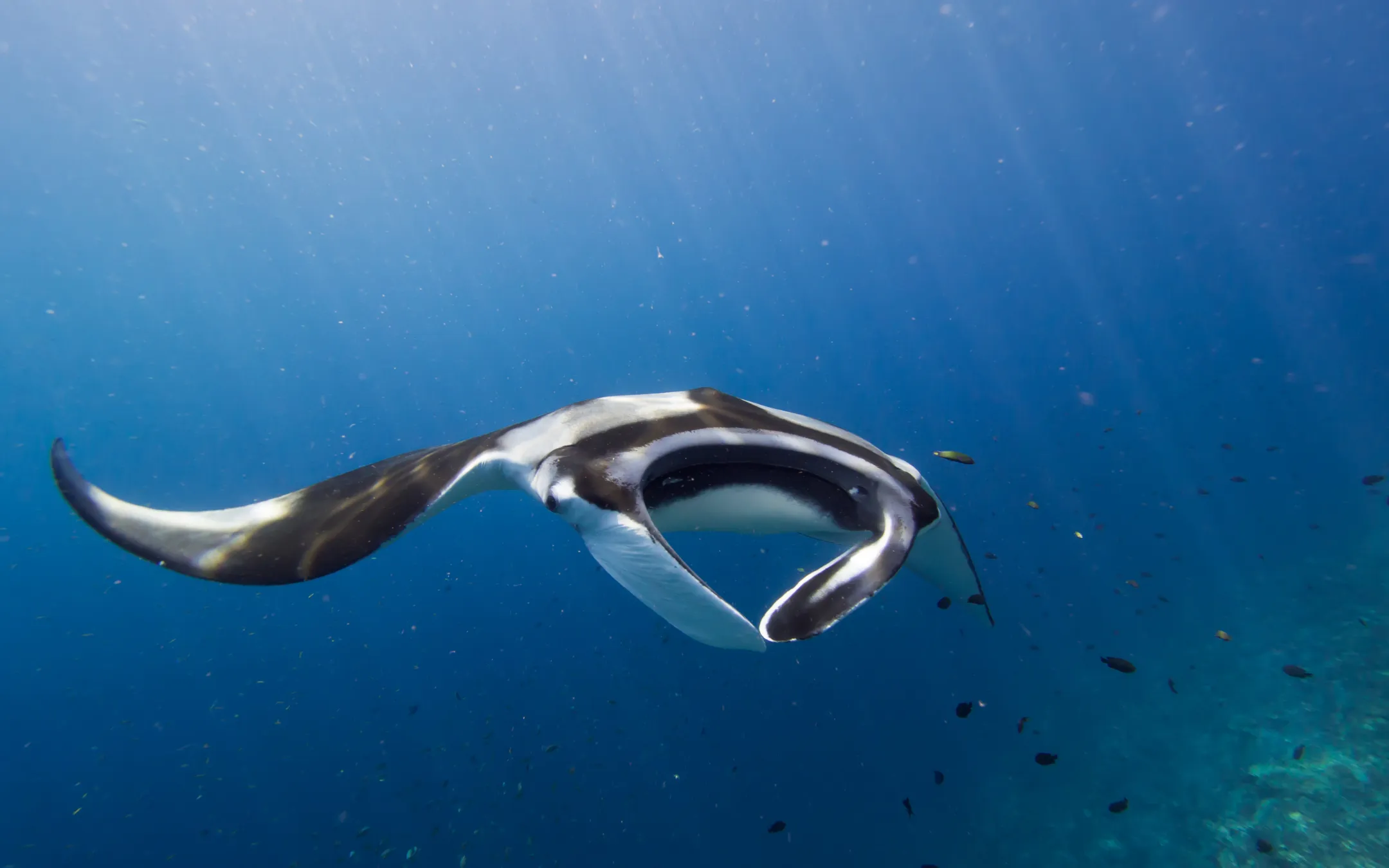
Those "Horns" are Actually Fancy Spoons
You’ll notice two fleshy flaps on a Manta’s face. These are called cephalic fins. When they are just cruising, they roll them up like little horns (which is why sailors used to call them "Devil Rays"). But when it’s dinner time, they unfurl them into massive scoops to funnel plankton-rich water into their mouths.
Much like the Basking Shark, Mantas are filter feeders. They have gill rakers that act like a biological sieve, catching microscopic zooplankton while the water passes back out into the ocean. Imagine eating enough microscopic specks to maintain a 6,000-pound body. It’s basically like a human trying to survive on nothing but sesame seeds.
Scientific Classification
- Kingdom: Animalia
- Phylum: Chordata
- Class: Chondrichthyes
- Order: Myliobatiformes
- Family: Mobulidae
- Genus: Mobula
- Species: Mobula birostris
They Are the Brainiacs of the Sea
Here’s the kicker: Manta Rays have the largest brain-to-body ratio of any cold-blooded fish. They aren't just reacting to things; they are thinking. Scientists have observed Mantas recognizing themselves in mirrors, a feat of self-awareness that only a few animals (like dolphins, elephants, and humans) can pull off.
Scientists are still scratching their heads over just how "smart" they really are. They exhibit complex social behaviors and have been known to approach divers for help in removing fishing lines or nets. They aren't just mindless swimmers; they’re curious, sentient beings that seem to "evaluate" us just as much as we evaluate them.
Precision Camouflage: The Tuxedo Look
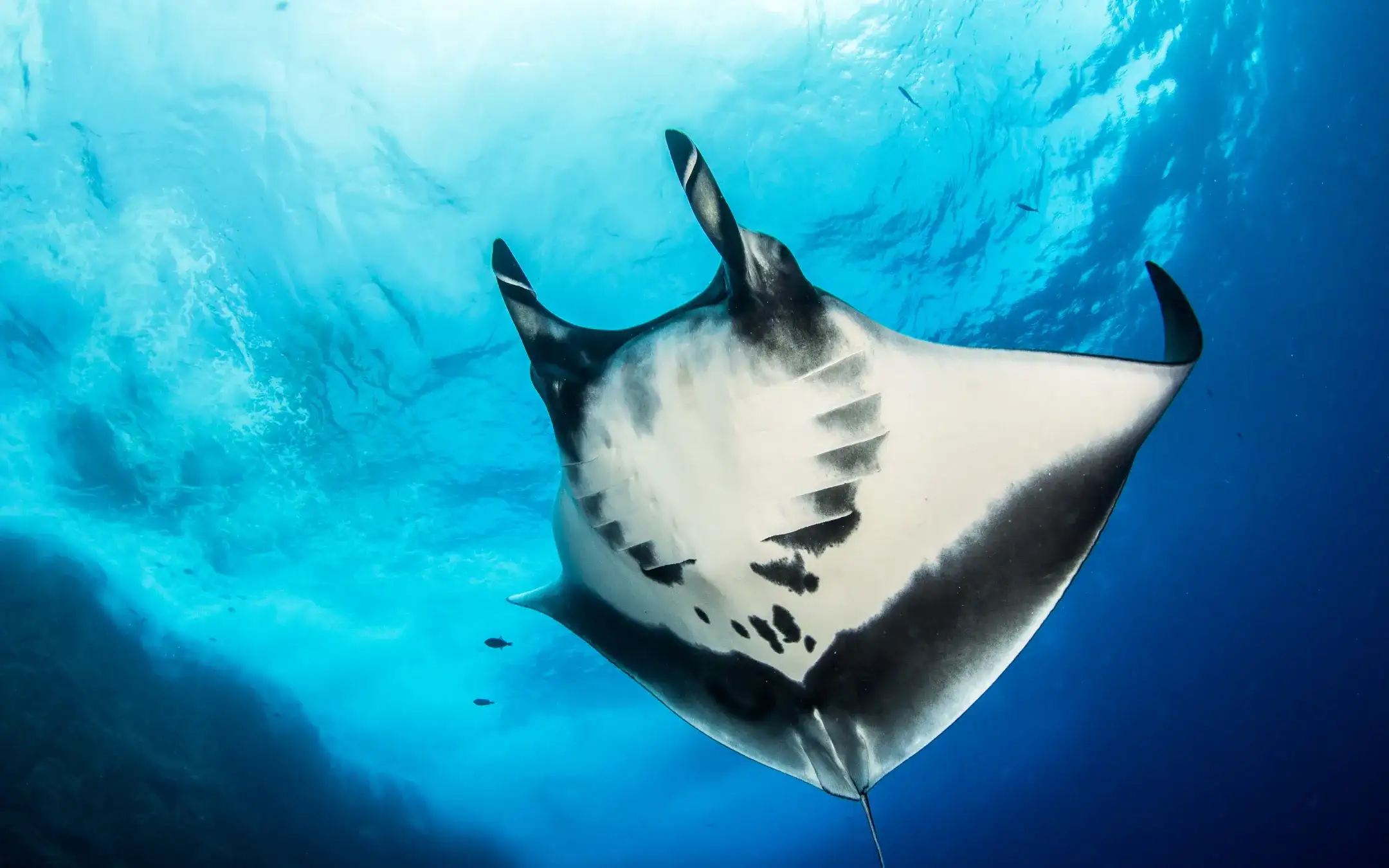
Mantas use a classic stealth move called "countershading." They are dark on top and white on the bottom. From above, they blend into the dark, deep water; from below, they blend into the bright, sunlit surface.
Just like the Spotted Eagle Ray’s spots, every Manta Ray has a unique pattern of black spots on its white belly. No two are the same. Researchers use these "belly fingerprints" to track individuals. Honestly, it’s a genius way for us to tell "Bob" from "Alice" without ever having to touch them.
The Bizarre Case of the "Flying" Manta
Believe it or not, these 6,000-pound tanks love to breach the surface. They launch themselves into the air and slam back down with a thunderous belly flop. Why do they do it? Much like the Basking Shark, we aren't 100% sure. It could be to shake off parasites, communicate with other rays miles away, or it might just be the Manta version of a victory dance. Imagine a school bus doing a backflip that’s the level of power we’re talking about here.
The "Deep Sea" Trivia File
- The Pink Manta: There is a famous, perfectly healthy pink Manta Ray (nicknamed Inspector Clouseau) living near Lady Elliot Island in Australia. He has a genetic mutation that makes his belly bubblegum pink.
- Deep Divers: Despite hanging out near the surface to eat, Mantas can dive over 3,000 feet deep to find cold-water snacks.
- Warm-ish Blood: Mantas have a unique heat-exchange system in their brains, allowing them to regulate their temperature slightly to survive in those deep, freezing dives.
How endangered is this animal?
Now for the reality check. Humans are, once again, the biggest threat to this masterpiece of evolution.
- The Gill Raker Trade: There is a massive market for Manta gill rakers, which are used in some traditional medicines despite having zero proven health benefits.
- Ghost Nets: Because of their "horns" and massive wings, Mantas are incredibly prone to getting tangled in discarded fishing gear.
- Microplastics: Since they are filter feeders, they are essentially vacuuming up the plastic confetti we've dumped into the ocean.
They are currently classified as Endangered in many regions. Because they reproduce so slowly usually only having one pup every few years their populations take a massive hit every time one is caught in a net. We are losing these "thinkers" of the sea faster than they can replace themselves.
Sources
Manta Trust: Giant Oceanic Manta Ray Research
Oceana: Marine Life Encyclopedia: Manta Ray
National Geographic: The Intelligence of Manta Rays
Overview
Also Known As: Giant Oceanic Manta Ray, Atlantic Manta, Giant Manta, or the "Devil Ray" (a name given by terrified sailors of the past).
Scientific Name: Mobula birostris.
Size: Average wingspans of 23 feet, with some monsters reaching up to 29 feet.
Weight: They can tip the scales at a staggering 6,600 pounds.
Distribution: Found worldwide in tropical and temperate latitudes.
Diet: Pure plankton, fish eggs, and larvae.
Lifespan: These legends can live for about 50 years.
Help us save the oceans
by surfing the web!
.png)
.png)
.png)

.png)
.png)
.png)
.png)
.png)
.png)