

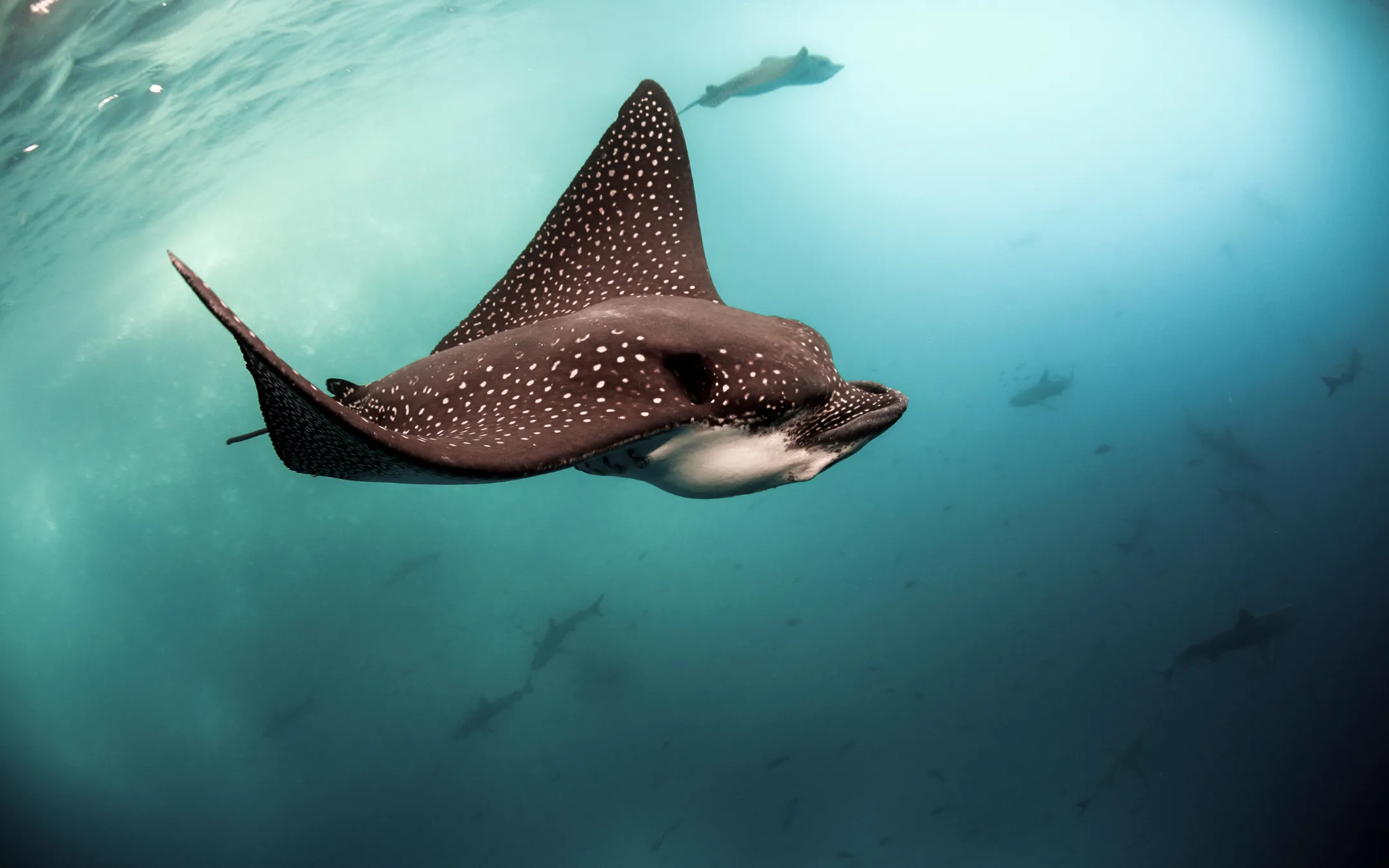
Let’s get one thing straight: the ocean is mostly full of things that look like tubes, blobs, or knives. And then, there is the Spotted Eagle Ray (Aetobatus narinari). If you’ve ever seen one glide past you while snorkeling, you didn’t just see a fish; you saw a whole mood. You saw a 500-pound underwater bird covered in a star map, rocking a face that looks like a shovel and a tail that looks like a medieval weapon.
They are the "main characters" of the reef. Seriously. While other rays are content to bury themselves in the sand like shy pancakes, the Spotted Eagle Ray is out here flying through the water column, breaching the surface like a circus performer, and crushing shells with the force of a hydraulic press.
Grab a drink. We’re going deep into why these guys are the coolest things with gills, and why they might actually be smarter than your dog.
That "Starry Night" Pattern is Actually a QR Code
First off, we have to talk about the coat. Most sharks and rays use "countershading" dark on top, light on the bottom. It’s the classic "I’m a shadow from above and the sun from below" trick. But the Spotted Eagle Ray took that concept and handed it to a high-end interior designer.
Their backs are a deep, inky blue or black, peppered with hundreds of brilliant white spots and rings. Here’s the kicker: nobody actually knows why the patterns are so specific. We know that no two rays have the same pattern. It’s a fingerprint. Researchers actually use photo-identification software (originally designed for mapping stars in deep space, which is incredibly poetic) to track individual rays.
But why the spots? Some think it breaks up their silhouette against the dappled sunlight hitting the reef. Others think it’s a social thing. Whatever the reason, it’s a biological masterpiece. For reference, imagine if every human was born with a unique, high-definition constellation tattooed on their back. It would make finding your friends at a crowded festival a lot easier.
The "Duck-Bill" Excavator
If you look at an Eagle Ray head-on, you’ll notice they don’t have that creepy, underside-mouth situation of a standard stingray. Instead, they have a prominent, protruding snout that looks remarkably like a duck’s bill.
This isn't just for looks. This is a specialized piece of heavy machinery.
Basically, the Spotted Eagle Ray is a professional excavator. They spend their days cruising the sandy flats near coral reefs, using that "bill" to poke, prod, and dig into the sediment. They are looking for "in-fauna" like crabs, clams, and snails that think they are safe because they are buried.
The Sensory Cheat Code: That snout is packed with "Ampullae of Lorenzini." That sounds like a fancy Italian pasta brand, but it’s actually a network of electro-receptors. They can literally sense the heartbeat of a clam buried six inches under the sand. Imagine being able to "smell" electricity. That’s their life. They detect the tiny electrical pulses produced by the muscles of their prey, then use their shovel-face to unearth them like a dog digging for a bone.
Scientific Classification:
Kingdom: Animalia
Phylum: Chordata
Class: Chondrichthyes
Order: Myliobatiformes
Family: Aetobatidae
Genus: Aetobatus
Species: Aetobatus narinari
The Nutcracker Mouth (No, Seriously)
Once they’ve dug up a conch or a thick-shelled clam, they don't just swallow it whole. They don’t have "teeth" in the way we think, no serrated daggers like a Great White. Instead, they have two massive, flat dental plates.
Imagine two pieces of heavy-duty LEGO baseplates made of solid bone.
These plates are designed for one thing: pure annihilation. When the ray closes its mouth, it exerts enough pressure to shatter a shell that you would need a literal hammer to break. They crunch the shell, spit out the hard fragments, and swallow the soft, buttery protein inside.
Wait, what?! Moment: Their "teeth" are constantly being replaced from the back, like a conveyor belt. As the front part of the dental plate wears down from crushing rocks and shells all day, new plate material moves forward. They are effectively swimming around with a self-repairing nutcracker in their skull. Honestly, it's terrifyingly efficient.

The Mystery of the "Flying" Fish
Here is where the Spotted Eagle Ray goes from "cool fish" to "mythical beast." They are world-class jumpers.
It is not uncommon for boaters to see a massive ray launch itself completely out of the water, flapping its pectoral fins in the air like a bird, before slamming back down with a thunderous clap that can be heard for miles.
Why do they do it? Honestly, we’re still guessing. * The Parasite Theory: Some think they jump to "smack" the water hard enough to knock off remoras or skin parasites (the ocean version of a really aggressive itch).
- The "Get Away" Move: Sometimes they jump when being chased by Great Hammerhead sharks (their mortal enemies).
- The Social Flex: They often jump during mating season. It might be the underwater equivalent of a gym bro doing a backflip to get a date.
Regardless of the "why," the "how" is impressive. For a fish that can have a wingspan of up to 11 feet (wider than a U-Haul truck), getting that much air requires a terrifying amount of core strength.
The "Tail of Doom": A 15-Foot Warning Label
If you ever see a Spotted Eagle Ray, the first thing you’ll notice is the tail. It is absurdly long. While a common stingray has a tail that's roughly the length of its body, the Spotted Eagle Ray’s tail can reach over 15 feet in length.
It looks like a thin, elegant whip trailing behind them as they fly. But look closer at the base right behind the pelvic fins.
There, you will find between two and six venomous spines. These aren't just "stings." They are serrated, bone-like daggers covered in a toxic mucus. If a shark tries to bite the ray from behind, the ray can whip that tail around with surgical precision. Unlike the calm, "step-on-me-and-I-sting" behavior of southern stingrays at the beach, Eagle Rays are more active. They don't want to use the spines, venom is expensive to make but if they do, it’s a bad day for everyone involved.
Are They Actually Smart? (Probably)
Most fish have the "blink and you'll miss it" intelligence of a toaster. But rays (and sharks) are different. They are Elasmobranchs, and they have relatively large brain-to-body ratios.
Spotted Eagle Rays are notoriously social. Unlike many other ray species that live solitary lives, these guys are often seen in "schools" or "squadrons." Sometimes you’ll see 50 or 100 of them gliding in perfect formation, like a fleet of starships from a sci-fi movie.
The kicker? Divers have reported that Spotted Eagle Rays seem to show genuine curiosity. They don't just swim away; they often bank their bodies to get a better look at you with those large, expressive eyes. They recognize familiar dive sites. They have "favorite" spots on the reef where they go to get cleaned by smaller fish. They aren't just reacting to things; they are navigating a complex social world. They’ve got personality.
The Long, Slow Road to Parenthood
This is where the biology gets a bit heavy. Spotted Eagle Rays don't lay eggs in the sand and hope for the best. They are "ovoviviparous."
Basically: The eggs hatch inside the mother, and the "pups" grow in the womb. But they aren't fed by a placenta like humans. Instead, the mother produces a nutrient-rich "uterine milk" (yes, really) that the babies drink while they are still inside her.
When they are finally born, they come out as "mini-me" versions of the parents: fully formed, spots and all, and ready to swim.
The Catch: A mother ray will carry her young for about a year, and then only give birth to one to four pups. * For reference: A single snapper or tuna can lay millions of eggs in a year. The Eagle Ray has four.
This "low-and-slow" reproductive strategy is great for survival in a natural world, but it’s a total disaster when humans get involved.

The Reality Check: Why We’re Messing Up the Galaxy
Here’s the part where we get real. We are currently losing Spotted Eagle Rays at an alarming rate, and it’s mostly because we’re sloppy.
- Bycatch: They frequently get tangled in massive fishing nets meant for other fish. Because they need to keep moving to breathe effectively, getting stuck in a net is a death sentence.
- The "Pretty" Tax: Because they are so stunning, they are often targeted for large-scale public aquariums. While some aquariums do great conservation work, the "collection" process from the wild can be brutal.
- Habitat Loss: They rely on healthy coral reefs and seagrass beds to find their "crunchy" snacks. As we bleach the reefs and pollute the coastal waters, we are essentially bulldozing their grocery stores.
They are currently listed as "Near Threatened" (and "Endangered" in some specific regions). Because they only have a couple of pups a year, they can’t just "bounce back" from overfishing. If we kill 100 rays today, it takes a decade to replace them. We're spending their population faster than they can earn it.
Final Thoughts
The Spotted Eagle Ray is a reminder that the ocean isn't just a place where we get sushi; it’s a place where evolution decided to get creative. These are 500-pound, flying, venomous, starry-skinned geniuses that just want to be left alone to crush some clams and do some backflips.
The next time you’re near the ocean, look past the waves. There might just be a squadron of galaxy-patterned UFOs gliding beneath you, wondering why you’re so slow.
How endangered is this animal?
Now, let’s talk about the 500-pound gorilla in the room: Us. Spotted Eagle Rays have been gliding through the oceans for millions of years, but we’ve managed to make their lives a living nightmare in just a few decades. Here’s how we are actually impacting them:
The Ghost in the Machine (Fishing Nets) - The biggest threat isn't that we’re eating them it’s that we’re catching them by accident. This is called bycatch. Huge industrial gillnets and shrimp trawls don't care what they catch. When a ray with an 11-foot wingspan gets tangled in a net, it’s game over. Unlike some fish that can chill out and still breathe, rays need to keep moving to push oxygenated water over their gills. If they get stuck, they essentially drown in the middle of the ocean.
The "Grocery Store" Problem - Eagle Rays are reef-dependent. They need healthy coral and seagrass beds to find their crunchy snacks. Between climate change bleaching the reefs and coastal development dredging up seagrass, we are basically bulldozing their favorite restaurants. No reef, no clams. No clams, no rays.
Plastic Soup - Because they are "benthic feeders" (meaning they dig in the sand), they are highly susceptible to ingesting microplastics. Imagine trying to dig for a clam and swallowing a handful of plastic confetti instead. It clogs their digestive systems and can lead to long-term toxicity.
The slow-motion recovery - Because they only have one to four pups a year, they can’t just "bounce back" from a bad fishing season. If we kill 100 rays today, it takes a decade to replace them. We’re spending their population faster than they can earn it.
Sources
Florida Museum of Natural History: Aetobatus narinari Biological Profile
Oceana: Spotted Eagle Ray Facts and Threats
ResearchGate: Reproductive Biology and Uterine Milk in Mylobatid Rays
NOAA Fisheries: Bycatch Impacts on Shark and Ray Populations
Overview
Help us save the oceans
by surfing the web!
.png)
.png)
.png)

.png)
.png)
.png)
.png)
.png)
.png)