

When you first encounter a brain coral on the reef, you understand immediately why early sailors named it that way. The furled surface of the dominant species in the Caribbean, really does look like the convoluted folds of a mammalian brain, which is both beautiful and deeply unsettling when you're snorkeling within arm's reach of it. But here's the twist: this isn't some clever mimicry designed to fool predators. It's actually a survival strategy millions of years in the making, one that lets the coral maximize its feeding surface while minimizing damage from storms and waves. The brain coral doesn't look like a brain because it wants to. It looks like a brain because that shape works.
Quick Facts
- Brain corals can live for over 900 years, making some colonies older than European nation-states
- The distinctive labyrinthine pattern is called a "septate surface" and provides up to 40% more feeding area than smoother corals
- Diploria labyrinthiformis polyps can measure up to 1 cm across visible to the naked eye unlike many other coral species
- A single brain coral colony can be as large as a parked car, weighing several tons
- Brain corals grow at roughly 3–4 mm per year, among the slowest-growing corals in the Caribbean
- They're currently listed as "Threatened" under the U.S. Endangered Species Act due to bleaching and disease
The Grooves and Ridges That Tell a Story
The brain coral's famous surface isn't random architecture. Each groove—called a septum—represents the radial wall of a polyp's skeleton, and they're arranged in a precise pattern that maximizes the coral's ability to catch food particles suspended in the water. When water flows across that labyrinthine surface, it creates thousands of tiny vortices that slow the current just enough for the polyps to snag passing plankton. It's like having a highly efficient net that works day and night without ever being cast.
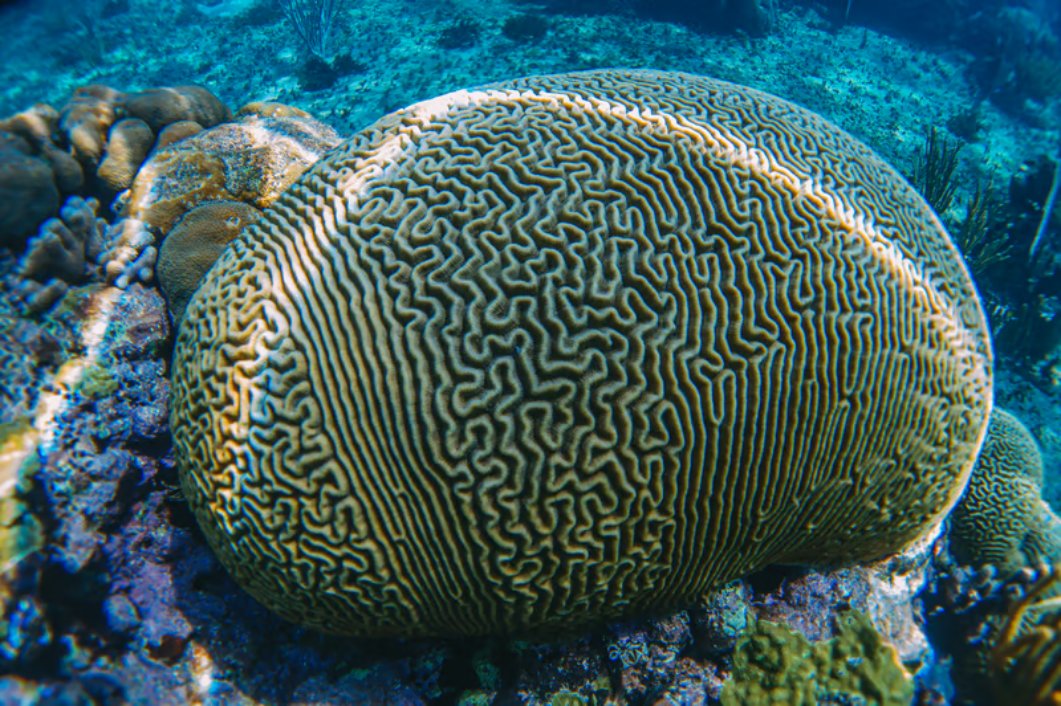
What's remarkable is that this design evolved independently across multiple coral species. Brain corals aren't the only ones who discovered this trick—several other Caribbean species use similar patterns. But the Diploria family perfected it over millions of years, and you can see the difference when you compare them side by side on the reef. The grooves are deepest and most regular in older colonies that've had centuries to express their full genetic potential.
The polyps themselves live at the bottom of these grooves, about 1 cm below the rim, tucked into crevices that provide protection from fish trying to nip at them. It's a defensive architecture as much as a feeding one. The groove design also helps defend against the coral's own predators—corallivorous fish have a harder time extracting polyps from these cramped quarters compared to corals with exposed surfaces.
Living Through Centuries: The Patient Builders
Brain corals are the pensioners of the reef. While many coral species can reach sexual maturity in just three to five years, brain corals take their sweet time—some don't reproduce until they're 25 years old or older. This slow reproduction strategy is tied to their even slower growth rate. A brain coral colony expanding at 3–4 mm annually means it takes roughly 250 years to reach just one meter across.
Scientists have documented individual brain coral colonies that are over 900 years old, with some estimates pushing toward 1,200 years. The researchers at the Smithsonian Institution have used radiocarbon dating to age these giants, and each ring in their skeleton tells a story—years of good feeding when plankton blooms were abundant, lean years when hurricanes smashed the reef and choked the water with sand, droughts when temperatures spiked and the symbiotic zooxanthellae began to abandon ship.
This extreme longevity comes with both advantages and disadvantages. On one hand, a long-lived brain coral is like an oak tree on land—it can weather individual storms and local disturbances by simply waiting them out. On the other hand, slow reproduction means the population can't bounce back quickly from mass mortality events. When disease or bleaching kills a population of brain corals, recovery might take centuries, if it happens at all within a human lifetime. Scientists in places like the Florida Keys have watched brain coral populations decline by 80% since the 1970s, with no sign of rebound.
Reef Architects and Health Indicators
Brain corals serve as structural pillars of the Caribbean reef ecosystem. Their massive colonies create overhangs and crevices that house hundreds of other species—small fish, octopuses, shrimp, brittle stars, and countless others find shelter in the labyrinthine grooves. The brain coral also competes with algae for space on the reef, and where brain corals decline, algae often explodes. In reefs where disease or bleaching has knocked out the brain coral population, you see a phase shift where the reef transitions from a coral-dominated ecosystem to one controlled by seaweed—a shift that happens remarkably quickly, sometimes within just a few years.
Because they're slow-growing, long-lived, and sensitive to water quality changes, brain corals have become important bioindicators for reef health. A healthy reef with abundant brain corals suggests good water conditions, active recruitment of new corals, and effective protection from excessive fishing. A reef where brain corals are declining or absent is usually a reef in trouble. Monitoring programs throughout the Caribbean use brain coral surveys as one of their key metrics for assessing reef state—it's a more reliable indicator than a snapshot of overall coral coverage, because the presence of these slow-growers tells you the reef hasn't just been damaged recently; it suggests chronic, long-term problems.
How endangered is this animal?
The Bleaching Crisis and Warm Water
In the summer of 2005, the Caribbean experienced what coral scientists call the "Year of the Coral." Water temperatures spiked to unprecedented levels—some reefs experienced temperatures 2 to 3 degrees Celsius above their usual summer peak. Brain corals, which had seemed relatively resilient to moderate temperature stress, suddenly began bleaching en masse. The symbiotic zooxanthellae algae that live inside the coral's tissues and provide nutrients through photosynthesis abandoned their hosts en masse. Without them, the coral turns ghostly white, and if the stress persists longer than a few weeks, the polyps starve.
Brain corals are moderately sensitive to bleaching compared to some of their reef mates. Fire corals and some of the branching Acropora species bleach first and most severely. But brain corals don't get off easy. In the worst bleaching years, mortality has reached 40 to 60% in some Caribbean locations. The survivors often bear scars—portions of the colony don't recover their pigmentation, creating dark patches on the white surface as if the coral's been tattooed by stress.
What nobody really knows is why some individual brain coral colonies survive bleaching while their neighbors die. Researchers at the University of Miami have been tagging individual colonies and monitoring them through successive bleaching events, trying to identify which genetic traits or microhabitat features might confer resistance. Early results suggest that colonies in areas with stronger water flow have better odds, possibly because moving water helps flush out heat more efficiently. But even this advantage disappears when temperatures are extreme enough.
The Path Forward
Conservation efforts focused on brain corals include restoration programs where scientists fragment healthy colonies and attempt to grow them in controlled settings before transplanting them back to the reef. These initiatives show promise—success rates are improving as researchers refine their techniques. Some facilities in Florida have successfully raised brain coral larvae from gametes in the lab, a technical achievement that seemed impossible just a decade ago.
But here's the uncomfortable truth: without reducing ocean temperatures, improving water quality, and controlling disease, even the most ambitious restoration efforts remain essentially a holding action. A 900-year-old brain coral represents an incomprehensible investment of biological capital. We're only just beginning to understand what we stand to lose if these ancient builders disappear from our reefs.
Sources
Sources & Further Reading
Overview
Also Known As
Symmetrical brain coral, Boulder brain coral (Diploria labyrinthiformis)
Size
Colony up to 1.8 m diameter; grows ~2 cm per year
Distribution
Caribbean Sea, Atlantic Ocean, Gulf of Mexico
Habitat
Coral reefs; 0–40 m depth
Food / Diet
Zooplankton, organic particles; aided by symbiotic zooxanthellae
Lifespan
Up to 900 years
Help us save the oceans
by surfing the web!
.png)
.png)
.png)

.png)
.png)
.png)
.png)
.png)
.png)