

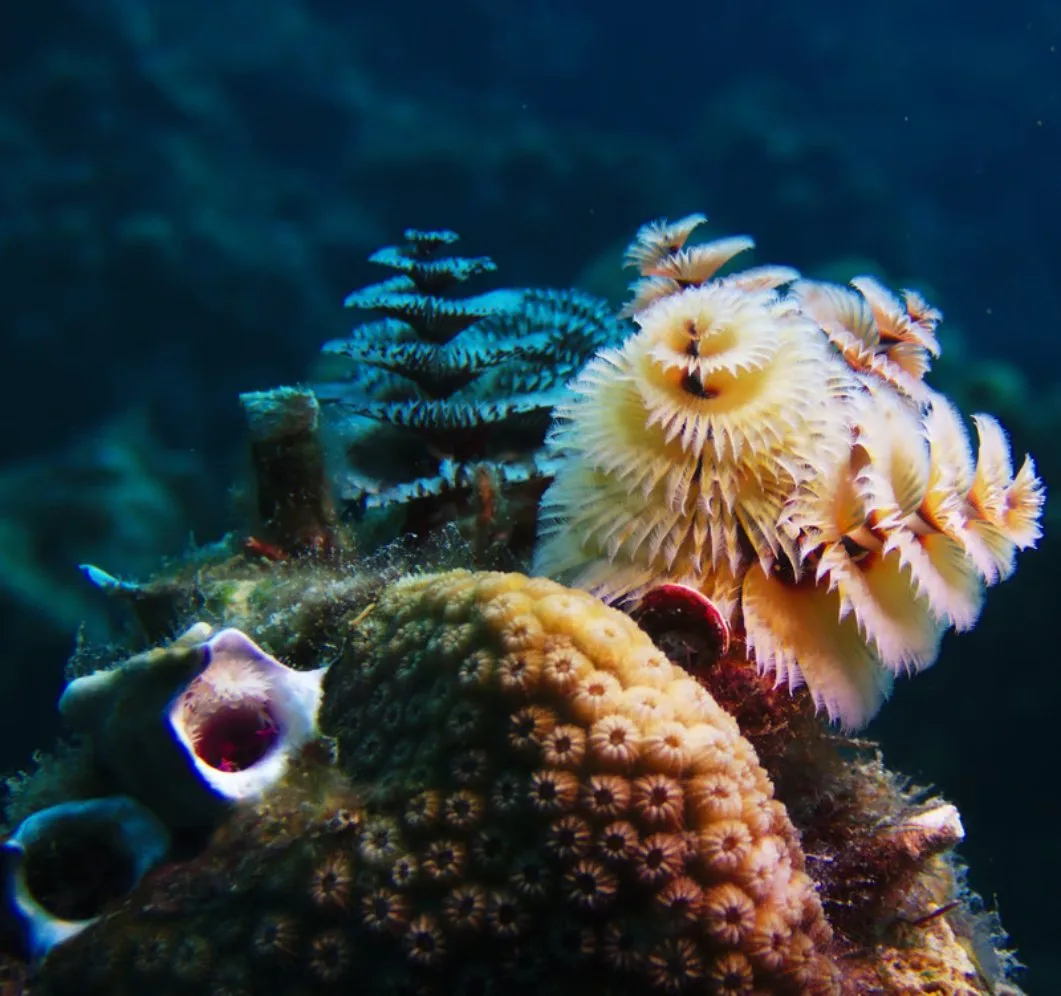
If you've ever seen a photograph of a Christmas tree worm, your first reaction was probably the same as everyone else's: this can't be real. The creature looks like it was designed by a jewelry maker obsessed with symmetry. Two perfect spirals, one red and one yellow, sometimes mixed with shades of blue or purple, arranged with mathematical precision. The spirals are actually feeding crowns, structures packed with ciliated tentacles that filter food from the water. When you approach the worm, the spirals retract in a fraction of a second, disappearing into the reef as if they were never there.
The Christmas tree worm, is a polychaete a marine worm with multiple body segments, each bearing paired bristles. The name "polychaete" means "many bristles," and these bristles, called chaetae, are the most obvious external feature. But what makes the Christmas tree worm special isn't the bristles. It's the feeding crowns, the radioles, which are modified tentacles arranged in a double spiral that would make Fibonacci nod in approval.
The worm doesn't build the spiral structure from scratch. Instead, it secretes a tube of calcium carbonate the same mineral that makes up seashells and coral skeletons and lives inside that tube permanently. The spirals extend out of the tube's opening to feed, but the body remains protected within. If you disturb the worm, it withdraws completely, sealing itself inside a mucus plug. The transformation from open and feeding to closed and hidden happens so quickly—in less than half a second, that you almost can't follow the motion.
Quick Facts
- Christmas tree worm radioles can reach up to 15 mm in diameter across the spirals, providing a large feeding surface for filter feeding
- The worm can live for over 40 years in optimal conditions, surprisingly long for an invertebrate of its size
- The color of the spirals is determined by carotenoid pigments and copper compounds, which may serve protective functions against UV radiation
- The worm embeds itself in coral skeletons and reef rubble, creating a permanent burrow that can last for decades
- Bristles on the worm's body can detach easily when threatened, possibly distracting predators
- Some Christmas tree worms are simultaneous hermaphrodites, producing both eggs and sperm from the same individual
The Engineering of a Filter-Feeding Crown
The Christmas tree worm's spiral structure is one of nature's more obviously beautiful designs. The radioles are arranged in two whorls, with each radiole bearing two rows of cilia, microscopic hair-like structures that beat in waves. These ciliary waves create currents that pull water through the radiole array, and any suspended particles smaller than a certain size are captured and moved toward the worm's mouth. It's passive filter feeding in the extreme—the worm doesn't hunt, doesn't chase, doesn't do anything but sit and wait for the ocean to bring food.
The symmetry of the spirals isn't accidental. It's an optimal design for filter feeding. The logarithmic spiral, the same pattern seen in nautilus shells and spiral galaxies provides maximum surface area for catching food particles while minimizing the structure's resistance to water flow. The worm that deviates from the perfect spiral catches fewer particles. Over many generations, natural selection has refined the worms that built the most symmetrical spirals, creating the precisely geometric structures we see today.
But here's what surprises most people: each spiral is built by different parts of the worm. One radiolar crown builds the left spiral, the other builds the right. They're not coordinated directly. Instead, each part of the crown follows its own genetic program, and the result is two spirals that match so precisely it seems impossible they weren't designed by the same architect. It's a reminder that biological design often emerges from simple rules applied locally, without any global oversight.
The Commitment to a Burrow
Once a Christmas tree worm larva settles onto a reef and begins building its tube, it's committed to that location. The tube is living tissue, continuously secreted and maintained by the worm, but it's also permanent. The worm can't abandon it without losing its protection. This means that a Christmas tree worm's survival depends entirely on choosing the right location in the first place. A worm that settles on a reef in a location with poor water flow will slowly starve. A worm that settles in an area where rock movement and surge will eventually break its tube will die when the tube breaks.
The habitat choice is particularly risky because the larval worm has to decide where to settle before it has any experience. The larvae drift as plankton for days or weeks, eventually sensing chemical cues that indicate "this is a good place for a worm to live." These cues might come from biofilms on the reef, or from specific species of algae, or from reef vibrations. The exact signals remain poorly understood. But what we know is that the larva must make a life-or-death decision based on sensory information it can barely interpret.
Many larvae settle in suboptimal locations and die within months. But the ones that settle well, in locations with strong water flow and stable substrate, can live for decades. A Christmas tree worm that survives the first year has a good chance of reaching old age. Some specimens have been monitored by researchers for 20+ years, continuously inhabiting the same tube, never moving, just feeding and reproducing.
The Colors and Their Purposes
Christmas tree worms come in an astonishing variety of colors. Red, orange, yellow, white, blue, purple, and combinations thereof. The colors come from pigments, primarily carotenoids, which are related to the pigments that make carrots orange, and various copper-containing compounds. These aren't randomly distributed in the worm's tissue. Instead, they're carefully concentrated in the radioles, making the feeding crowns far more colorful than the rest of the body.
Why invest so much in coloration? One hypothesis is that the pigments serve a protective function. The radioles are the worm's most exposed part, and they're constantly in direct sunlight in shallow reef environments. UV radiation can damage cellular structures and DNA. Carotenoid pigments absorb UV radiation, protecting the underlying tissues. The color is essentially a sunscreen, and the worm's investment in colorful radioles is an investment in UV protection.
Another hypothesis involves sexual signaling. The Christmas tree worm is a simultaneous hermaphrodite, meaning any individual produces both eggs and sperm. But for reproduction to happen, individuals need to coordinate their spawning events. If all the worms in a reef population spawn at exactly the same time, their gametes meet in the water column and fertilization happens. But if some spawn a few hours earlier or later, they miss the reproductive window. Color might serve as a signal of reproductive status, a way for worms to communicate their physiological state to their neighbors.
The truth is probably some combination of these factors. The pigments likely serve multiple functions, and their abundance in the worm reflects the importance of UV protection and reproductive success. But scientists still aren't entirely sure, and the exact reasons for color variation between individuals remain unclear.
The Hidden Drama Inside Coral
Christmas tree worms spend their entire adult lives embedded in dead coral skeletons and reef rubble. They don't build the structures they live in—they simply settle in crevices and cavities and secrete their tubes against these surfaces. Over time, the reef around the worm grows and changes. Other organisms settle nearby. Coral polyps may grow around the worm's tube, partially encasing it. Fish carve out shelters in the reef, sometimes literally removing chunks of coral that the worm has attached to.
The worm's response to all this activity is limited. It can retract its radioles for protection, and it can generate chemicals to prevent other organisms from growing on its tube's surface. But it can't move, can't seek shelter elsewhere, can't renegotiate its position. A worm that was exposed to the open water column one year might find itself tucked inside a increasingly enclosed cavity as coral grows around it. The worm must adapt to changing light conditions, water flow, and food availability.
Some Christmas tree worms live in symbiotic relationships with their coral hosts. The coral doesn't appear to be harmed by the worm's presence, and the worm's tube doesn't damage the coral. It's a neutral coexistence, neither helpful nor harmful to either party. But in some cases, other organisms have parasitized Christmas tree worms. Small crustaceans and fish have been observed living inside the worm's tube, feeding on scraps of food the worm captures. The worm tolerates this, possibly because expelling the parasites would require more energy than simply producing excess food.
_11zon_11zon%20(1).webp)
The Vulnerability of Permanence
Because Christmas tree worms are permanently attached, they're vulnerable to disturbances that mobile organisms can escape. A single hurricane that breaks reef structures can kill thousands of worms simply by destroying the physical substrate they depend on. Diseases that affect coral can spread to the worms, particularly if the disease produces substances toxic to the worms' tissues. Sedimentation events that smother the reef can clog the worm's feeding apparatus, preventing it from capturing food.
The impact of human activities on Christmas tree worm populations is therefore substantial. Fishing practices that damage reef structure, coastal development that increases sedimentation, even careless snorkeling that knocks against the reef, all of these harm Christmas tree worm populations. Some reefs that were historically rich with hundreds of Christmas tree worms have seen their populations collapse to just a handful.
Climate change presents a different threat. Warming water stresses corals, leading to bleaching and disease. As coral health declines, the reef structure becomes less stable, and the worms lose their substrate. Additionally, the nutrient composition of the water changes with warming and changes to ocean currents, potentially affecting the availability of food particles. A warming ocean isn't just bad for corals. It's bad for all the creatures that depend on coral reef habitats.
The Overlooked Beauty
The Christmas tree worm rarely makes news. It doesn't have the charisma of a dolphin or the notoriety of a venomous sea creature. But for divers and marine photographers, spotting a Christmas tree worm is often a highlight of a reef visit. The colors are so vivid, the symmetry so perfect, that the worm seems almost unreal. In an age of environmental decline, where so many marine species are disappearing or becoming rarer, the Christmas tree worm stands as a reminder of the ocean's capacity to generate extraordinary beauty.
That beauty is also fragility. The Christmas tree worm depends on healthy coral reefs, stable water conditions, and the absence of the human disturbances that plague modern reefs. The spiral radioles that look like jewelry are engineered to function in a specific type of environment. As that environment changes, as reefs decline, as water chemistry shifts, the worm's future becomes uncertain. For now, Christmas tree worms are still common on healthy reefs. But watching them disappear would be watching one of nature's most obviously beautiful creations fade from the world.
How endangered is this animal?
Sources
Sources & Further Reading
Overview
Also Known As
Spirobranchus worm (Spirobranchus giganteus)
Size
3.8 cm crown diameter; body 6–10 cm
Distribution
Tropical oceans worldwide; Caribbean, Pacific, Indian Ocean
Habitat
Coral reefs; embedded in massive corals; 0–30 m depth
Food / Diet
Phytoplankton, microorganisms (filter feeder via radioles)
Lifespan
10–40 years
Help us save the oceans
by surfing the web!
.png)
.png)
.png)

.png)
.png)
.png)
.png)
.png)
.png)