

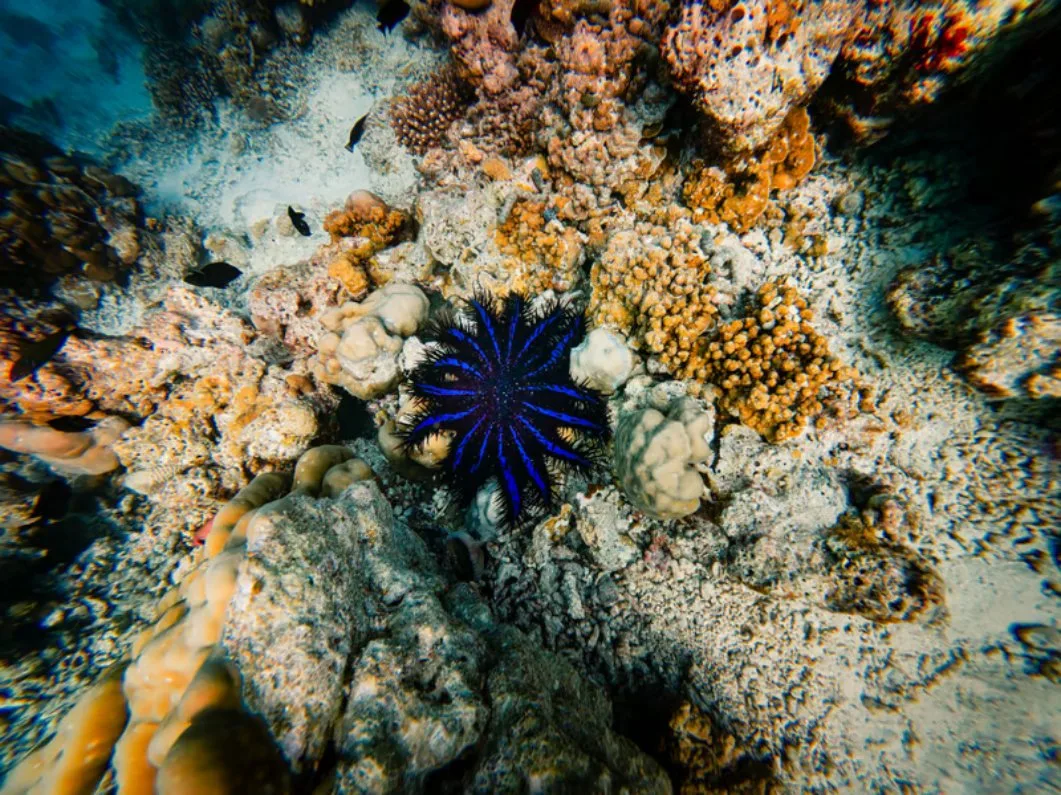
In 1962, researchers surveying the Great Barrier Reef noticed something alarming: enormous populations of crown-of-thorns starfish were moving across the reef, consuming coral at rates that seemed impossible. The starfish,
, appeared in such numbers that they were literally smothering the reef, eating it faster than it could regenerate. Within a few years, large portions of the reef had been bleached white, the coral skeletons exposed where thriving polyps had been weeks before. The event sparked one of the first major coral conservation crises of the modern era, and it raised a question that marine biologists are still arguing about: is the crown-of-thorns population explosion a natural part of reef dynamics, or is it a human-caused catastrophe?
The crown-of-thorns starfish is a sea star, like the purple sea star we discussed earlier, but with a crucial difference: it's carnivorous in a way that the purple sea star—which prefers mollusks—is not. The crown-of-thorns eats coral. It extends its stomach through its mouth, extrudes it onto the coral surface, and digests the live coral tissue directly. A single large crown-of-thorns can consume up to 50 square centimeters of coral per day. In the right (or wrong) conditions, entire colonies can be dotted with dozens of crown-of-thorns starfish, each one systematically devouring the coral.
Quick Facts
- Crown-of-thorns starfish are covered in venomous spines that can pierce rubber gloves and cause severe pain in humans; stepping on one can require medical attention
- A single female crown-of-thorns can produce up to 50 million eggs per spawning event, but typically only a few thousand will survive to adulthood
- Population explosions have occurred on the Great Barrier Reef at least 30 times in the past 50 years, with each outbreak lasting 3-7 years
- The spines are not just venomous; they're covered in bacteria that can cause infection, making wounds from crown-of-thorns particularly dangerous
- The starfish changes color as it ages, from blue or purple in juveniles to reddish or orange in adults, making population surveys easier
- Culling programs have removed millions of crown-of-thorns, but success in controlling populations has been limited and expensive
The Venomous Defense Against Predation
The crown-of-thorns is covered, head to tail, in sharp spines that give it its name. These aren't passive defensive structures. They're venomous—the tips of the spines are coated with a toxin that causes intense pain in humans and can cause localized tissue damage. A person stepping on a crown-of-thorns spine experiences pain that lasts for hours or days, and infections from the wound are common because the spines are difficult to extract completely. Some fragments remain embedded, causing ongoing inflammation.
For the starfish, the spines serve as defense against predation. Few fish will eat a crown-of-thorns because the effort required to navigate around the venomous spines isn't worth the meal. Some species have learned to extract the starfish's soft body tissue without touching the spines, but these specialized predators are relatively rare. For the most part, once a crown-of-thorns reaches adult size, it has few natural predators.
The venom composition varies between populations and even between individuals, and scientists still aren't sure why. Some populations produce venom that's more potent than others. Some individuals are more heavily armed with spines than their neighbors. These variations might relate to the population's history—populations that've experienced heavy predation pressure might evolve more toxic venom. Or it might be environmentally determined, with better-fed individuals producing more elaborate defensive equipment. Research is ongoing.
The Sudden Bloom and the Feeding Frenzy
A typical crown-of-thorns outbreak starts quietly. A few extra starfish are observed on a particular reef or reef section. Within months, their numbers begin increasing. Within a year, you might have dozens on a single reef patch. Within two or three years, you have thousands. The density becomes so high that the starfish literally cover portions of the reef, with multiple individuals stacked on top of one another, all feeding simultaneously.
The exact trigger for these explosions remains controversial. When they first began appearing in such numbers in the 1960s, researchers theorized that the crown-of-thorns was a naturally occurring phenomenon, part of the reef's normal dynamical cycle. Population explosions might occur every few decades, the theory went, clearing out old coral and making space for new growth. But the frequency and intensity of the explosions increased through the 1980s and 1990s, suggesting that something was changing.
One hypothesis involves nutrient enrichment from agricultural runoff. Nitrogen and phosphorus from fertilizer leaching into coastal waters can stimulate the growth of planktonic algae, which feeds the crown-of-thorns larvae. Crown-of-thorns have a planktonic larval phase lasting days to weeks, during which the larvae feed on phytoplankton. If there's a boom in the plankton that feeds these larvae, more of them survive to adulthood. Over several years, this translates to a larger population of adults.
Another hypothesis involves the removal of natural predators. Certain fish species—particularly the triton snail and some groupers—prey on crown-of-thorns. Overfishing has reduced populations of many potential predators, which might allow crown-of-thorns populations to grow unchecked. A study in the 1970s showed that protecting reefs from fishing did result in higher predation pressure on crown-of-thorns, suggesting that this mechanism plays at least some role.
The Great Barrier Reef's Repeated Crises
The Great Barrier Reef has experienced crown-of-thorns outbreaks at least 30 times since the 1950s, according to official records. Some of these outbreaks were small and localized. Others spread across thousands of square kilometers. In the worst years, estimates suggested that the starfish population was consuming coral at rates exceeding the coral's ability to regenerate. In recovery periods between outbreaks, the reef would gradually rebuild, but not to its pre-outbreak levels.
Starting in the 1990s, another threat began competing with crown-of-thorns for the title of reef killer: coral bleaching, driven by warming water temperatures. Now the Great Barrier Reef faces a dual crisis. Coral bleaching weakens the reef's overall health, making it more susceptible to further damage from crown-of-thorns predation. Crown-of-thorns outbreaks then prevent recovery between bleaching events. The combination is potentially catastrophic.
Researchers tracking the Great Barrier Reef have documented a clear decline in overall coral cover over the past several decades, from about 50% in the 1960s to less than 30% today. Crown-of-thorns are part of that story, but so is warming water, acidification, fishing pressure, and other stressors. It's not a simple narrative where one villain explains everything. It's a complex tragedy where multiple factors combine to degrade what was once the world's largest and healthiest coral reef.
The Starfish's Perspective
It's worth remembering that from the crown-of-thorns's perspective, it's simply doing what it evolved to do: feed, grow, and reproduce. The starfish isn't malicious. It has no intention of destroying the reef. It's following its biological programming, which says "eat coral when you encounter it" and "reproduce prolifically when conditions allow." The population explosion is a consequence of that programming encountering environmental conditions—elevated nutrients, reduced predation, perhaps favorable oceanographic patterns—that allow the population to grow explosively.
The ethical question of whether we should cull crown-of-thorns is ultimately a question about what we value in the ocean. Do we value the ecological role that crown-of-thorns might play in natural reef dynamics, or do we prioritize the conservation of coral-dominated reef structures? Do we view the starfish as a pest introduced by human impacts, or as a natural part of the reef ecosystem that we've simply mismanaged? The answer you give shapes your approach to conservation.
How endangered is this animal?
The Culling Controversy
When populations exploded on the Great Barrier Reef in the 1960s and following decades, the response was immediate: let's kill them. Australian authorities organized culling programs where divers and researchers would hunt crown-of-thorns in shallow areas, manually collecting them or injecting them with poison. The programs were resource-intensive but seemed to work—in areas where culling was intensive, population growth slowed.
But here's the problem: the ocean is vast, and the crown-of-thorns population is enormous. A culling program can manage the population in a protected area, but it can't eliminate the starfish. And elimination might not even be desirable. Some scientists argue that crown-of-thorns might be a naturally occurring part of reef dynamics, and attempts to eradicate them represent human overreach. Others argue that the outbreaks are human-caused and therefore we have a responsibility to manage them.
The culling programs are also expensive. A reef survey followed by manual removal of crown-of-thorns costs tens of thousands of dollars and requires specialized training. Scale this up to the entire Great Barrier Reef, and the costs become astronomical. Most culling efforts are therefore confined to small areas of high conservation value, protecting perhaps 5-10% of the reef. The rest is left to the mercy of the crown-of-thorns.
It turns out that culling might also be harming the ecosystem in ways we didn't anticipate. The crown-of-thorns, for all the damage it causes during outbreaks, does provide food for predators. When populations are depressed by culling, those predators go hungry. Additionally, the dead starfish add nutrients to the reef. A culled population might have ecological costs that partially offset the benefits of reef protection. The full picture is complicated.
The Question of Causation
Here's where the science gets contentious. Did human activities cause the crown-of-thorns population explosions? The evidence is mixed. Studies support nutrient enrichment as a contributing factor, but the connection between agricultural runoff and plankton blooms to crown-of-thorns larvae survival is indirect and difficult to measure precisely. The removal of predators through fishing clearly has some effect, but crown-of-thorns have erupted in areas with relatively good predator populations, suggesting that overfishing alone doesn't explain everything.
It's possible that the crown-of-thorns outbreaks are triggered by multiple factors, each individually necessary but none sufficient. The starfish might need nutrient enrichment AND reduced predation AND favorable oceanographic conditions AND low coral predation to explode. If you add three of these conditions together without the fourth, you get moderate population growth but not the catastrophic explosions we've observed.
Nobody really knows the full causal mechanism. Scientists continue studying crown-of-thorns populations, collecting data from outbreaks, analyzing historical records, and designing experiments to test hypotheses. But the pace of change in the ocean is faster than the pace of scientific understanding, and we're making decisions about reef management with incomplete information.
Living with Uncertainty
The crown-of-thorns starfish remains one of the most studied animals in coral reef ecology, and yet many fundamental questions about it remain unsolved. Scientists continue monitoring populations, testing hypotheses about population regulation, and refining management strategies. But the ocean continues changing faster than we can study it, and the reef continues degrading.
What's certain is that crown-of-thorns population explosions represent a major threat to coral reefs, particularly when combined with other stressors like warming water. What's uncertain is whether we'll ever fully understand the mechanisms driving these explosions or whether we'll succeed in managing the starfish while protecting the reef. For now, we're left with partial answers and the uncomfortable reality that some of our best efforts to manage the crown-of-thorns might be addressing symptoms rather than underlying causes.
Sources
Sources & Further Reading
Overview
Also Known As
COTS (Acanthaster planci)
Size
25–35 cm diameter; up to 70 cm
Distribution
Indo-Pacific; from the Red Sea to the eastern Pacific; Great Barrier Reef
Habitat
Coral reefs; 0–30 m depth
Food / Diet
Hard coral polyps (corallivore)
Lifespan
16–22 years
Help us save the oceans
by surfing the web!
.png)
.png)
.png)

.png)
.png)
.png)
.png)
.png)
.png)