

In the 1970s, brown pelicans were basically gone from California. They'd been dying by the thousands, and nobody really understood why at first. Eggshells were shattering before chicks could hatch. Females were producing eggs with shells so thin and fragile that the weight of incubating adults cracked them open. Nesting islands were littered with failed clutches. The population that had numbered in the hundreds of thousands had crashed to just a few thousand birds. Then scientists made the connection: DDT. The pesticide, widely sprayed to control mosquitoes, had accumulated in fish tissues. Pelicans ate the fish. The DDT concentrated further in their bodies, interfering with calcium metabolism and weakening eggshells to the point of uselessness. It was a cautionary tale written across an entire species' body, a story about the hidden costs of chemical advancement.
The Feeding Method That Looks Like Suicide
Brown pelicans don't dive the way gannets do, that's a northern ocean approach. Instead, pelicans feed through a spectacular hunting technique that involves approaching prey at a more moderate angle, then plunging forward with wings still partially spread. The approach is slower than a gannet's near-vertical dive, but it's still violent enough to leave you wincing. The bird's beak slams into the water at full force, the impact pushing the head and neck backward against the body in a way that looks like it should cause catastrophic whiplash.
Yet pelicans are built for this. Their necks are stronger than they look, with reinforced vertebrae and powerful musculature. Their heads contain air sacs that buffer impact forces. Most importantly, they have no external nostrils, they breathe through their mouth, which prevents water from being forced up into the nasal passages and lungs during diving. This is a specific adaptation for feeding that other diving birds have evolved independently, but pelicans are among the most enthusiastic practitioners.
What's surprising when you think about it is that the pelican's famous pouch—the thing people always mention when discussing pelicans—isn't primarily for storing fish. It's not a cargo hold. Instead, it's a scoop net. When the pelican's beak strikes the water and scoops up a mass of water containing small fish, the pouch expands and captures everything. The pelican then drains the water out by tilting its head and contracting the pouch muscles, leaving just the fish. It's more like a filter than a storage container, though the pouch can hold a surprising volume up to about 13 liters of water and fish combined.
The California Comeback
The DDT ban in 1972 marked a turning point for brown pelicans in North America. The chemical stopped accumulating in the environment. Residual DDT lingering in soils and sediments gradually broke down and dispersed. Eggshell thickness began improving almost immediately. Hatching success rose. The population started recovering. By the 1980s, it was clear that the species wasn't going to vanish.
What happened next was almost unprecedented in conservation. The brown pelican was actually delisted from the Endangered Species List in 2009. That means scientists and regulators determined the species had recovered sufficiently that it no longer required federal protection. The recovery wasn't instantaneous—it took nearly four decades of gradual improvement, but it was real and measurable. Young pelicans that would have been doomed to shells too fragile to protect them were now surviving. Breeding colonies that had been decimated began repopulating.
Part of the success came from international cooperation. Both Mexico and the United States protected pelican colonies. Fishing regulations were adjusted. Oil drilling in sensitive nesting areas was restricted. There was genuine political will to let the species recover. It worked. The western population of brown pelicans, which had dropped to around 5,000 birds at its lowest point, has rebounded to over 25,000 birds today. The eastern population, less severely impacted by DDT, has grown even more dramatically.
A Bird of Caribbean and Western Waters
Brown pelicans are year-round residents of warm coastal waters from the southeastern United States through the Caribbean and down to northern South America, with a separate population on the Pacific coast from California through Central America. They're birds of shallower waters, preferring bays and lagoons and protected inlets over the open ocean. They're highly social, fishing in loose flocks and roosting together in large groups. A single roost site might host hundreds of birds, all perched on pilings or mangroves, digesting the day's catch.
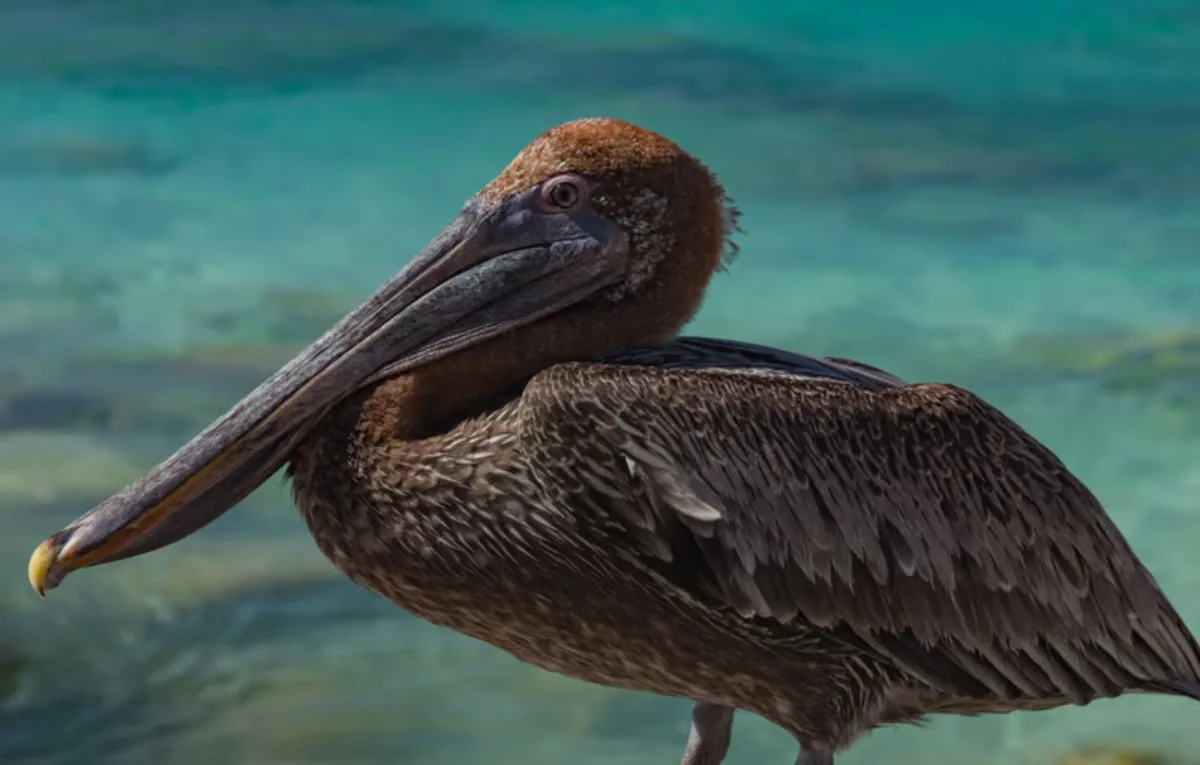
Breeding is seasonal, though the timing varies by latitude. Northern populations breed in spring and early summer. Southern populations might breed at different times depending on local fish availability and weather patterns. The birds build crude nests out of sticks in mangrove trees or on rocky islands. A female lays 2–3 eggs, and both parents share incubation duties. Chicks are born mostly helpless, covered in sparse down, dependent entirely on parental feeding. By eight or nine weeks, they're learning to dive and feed themselves, though they'll continue begging from parents for months.
The chicks grow rapidly, reaching adult size in just a few months. This accelerated growth is partly powered by the extraordinary fishing capability of the parents. A brown pelican can catch a dozen or more fish in a day, each one regurgitated into the expanding mouth of a demanding chick. The parental workload is brutal but manageable because coastal fish are relatively abundant. Food stress becomes an issue during poor years or when prey species shift their distributions.
How endangered is this animal?
Modern Threats Beyond DDT
The DDT story has a satisfying resolution, but newer problems are emerging. Lead ammunition from waterfowl hunting creates the same bioaccumulation issues that DDT did, just on a smaller scale. Oil spills in coastal areas coat feathers and disrupt feeding, as happened dramatically during the Deepwater Horizon spill in 2010. Plastics are accumulating in marine ecosystems, and fish are ingesting tiny plastic fragments. When pelicans eat those fish, they're consuming plastic too.
Climate change is altering water temperatures and fish distributions. Some traditionally rich fishing grounds are becoming less productive. Severe storms are flooding nesting colonies. Rising sea levels threaten low-lying islands where pelicans breed. These are slower-moving threats than DDT, more insidious and harder to address with a simple regulatory fix.
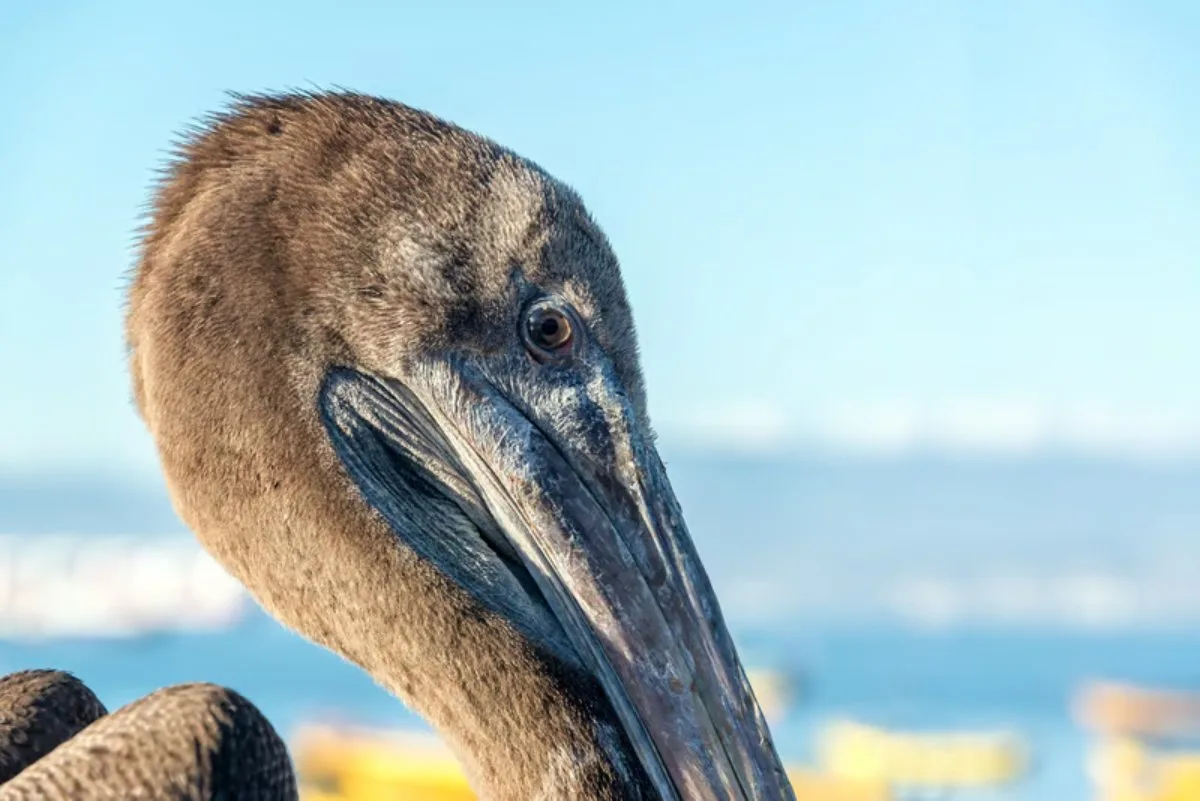
The brown pelican has proven it's capable of recovering from catastrophe. That's genuinely hopeful. But it's also a reminder that recovery requires sustained effort and that new threats keep emerging. Conservation isn't a destination you reach and then stop working toward. It's a continuous process of adaptation and vigilance.
Quick Facts About Brown Pelicans
- Massive birds, weighing up to 2.3 kilograms with wingspans reaching 2.3 meters
- Plunge-dive rather than high-speed vertical dive; can descend to 10 meters deep
- Throat pouch expands during feeding to scoop water and fish, holding up to 13 liters
- Breed in colonies on islands and mangrove swamps across Caribbean and Pacific coastlines
- Were nearly extinct (5,000 birds) due to DDT eggshell thinning; recovered to 25,000+ after DDT ban in 1972
- Global population now stable around 300,000 birds and steadily growing; significant conservation success story
Sources
Overview
Also Known As
Brown pelican (Pelecanus occidentalis)
Size
Wingspan 2–2.3 m; weight 2–5 kg
Distribution
Atlantic and Pacific coasts of the Americas; Gulf Coast, Caribbean
Habitat
Coastal marine environments, estuaries, bays, beaches
Food / Diet
Fish (menhaden, herring, mullet, anchovy)
Lifespan
Up to 25–40 years
Help us save the oceans
by surfing the web!
.png)
.png)
.png)

.png)
.png)
.png)
.png)
.png)
.png)