

Watch a magnificent frigatebird hunting and you're watching piracy in its purest form. The bird doesn't fish itself, not really. Instead, it harasses other seabirds relentlessly until they panic and regurgitate whatever they've just caught, and the frigatebird snatches the meal mid-air with balletic precision. It's called kleptoparasitism, and frigatebirds have refined it into an art form. They're aerial bullies, but they're also so spectacularly adapted to their form of predation that they've essentially abandoned the ability to do anything else. They can't land on water. Their feathers aren't waterproofed like those of other seabirds. They're creatures so perfectly designed for theft and airborne maneuvering that they've locked themselves into a lifestyle of permanent theft and permanent flight.
The Inflation Mechanism That Defies Belief
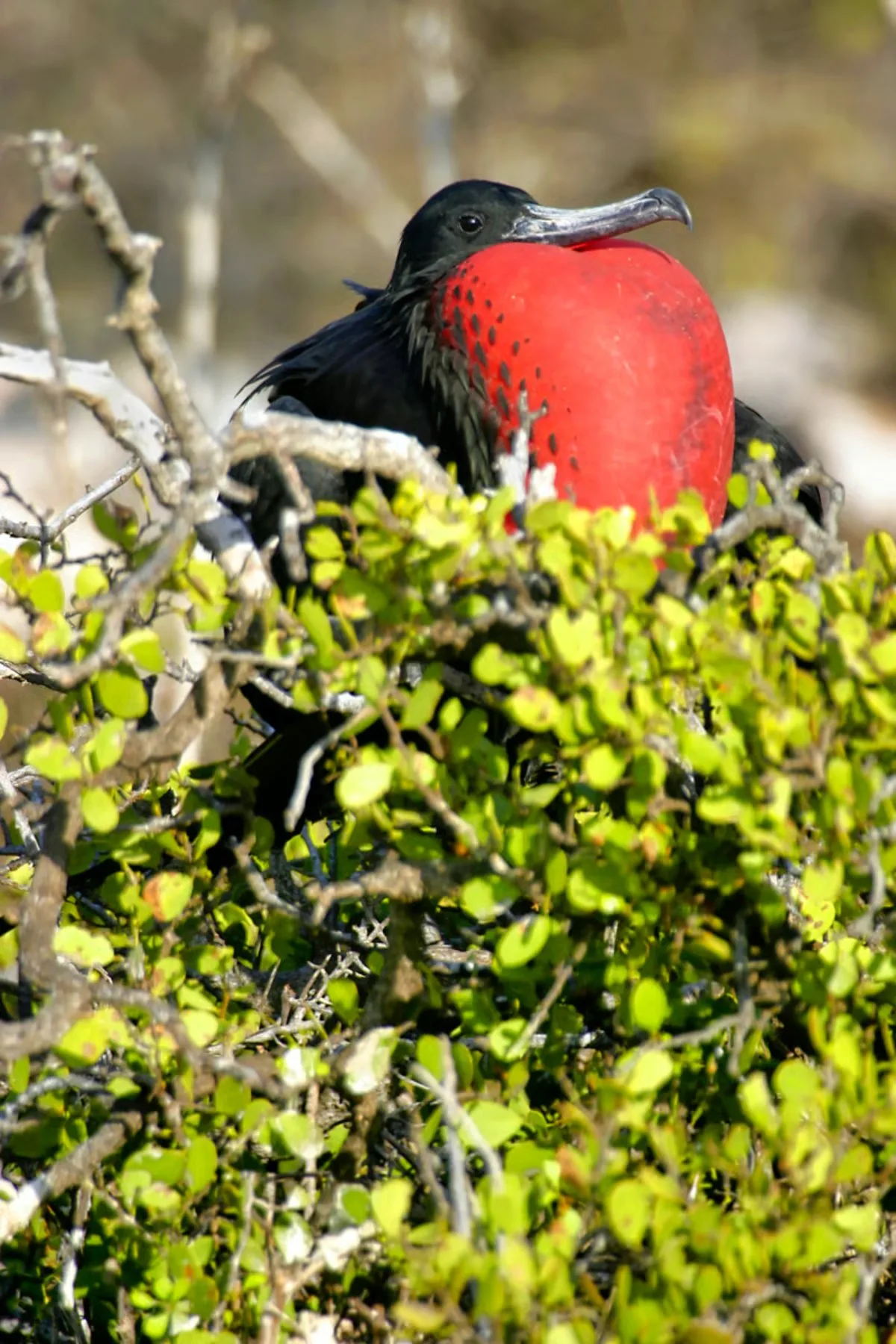
Male magnificent frigatebirds possess a feature found nowhere else in the bird world: an enormous pouch of inflatable skin beneath their throat. During breeding season, this pouch swells to roughly the size of a football, stretched taut and filled with air, turning a brilliant scarlet red. The transformation is almost grotesque. The bird becomes half-body, half-balloon, looking rather like it's swallowed something far too large and the whole thing might rupture at any moment.
The pouch doesn't hold food or water. It's not a fishing adaptation like the pelican's beak-sac. Instead, it's entirely a display organ, an ornament designed to attract females during courtship. Males sit in mangrove trees and brush vegetation, puffing and deflating their pouches while making bizarre rattling and drumming sounds. It turns out that the more impressive and sustained the display, the more likely a female is to choose that male as a mate. So males in prime condition: well-fed, healthy, with strong immune systems, can maintain their displays longer and with more vigor. The pouch is essentially a visual résumé of fitness.
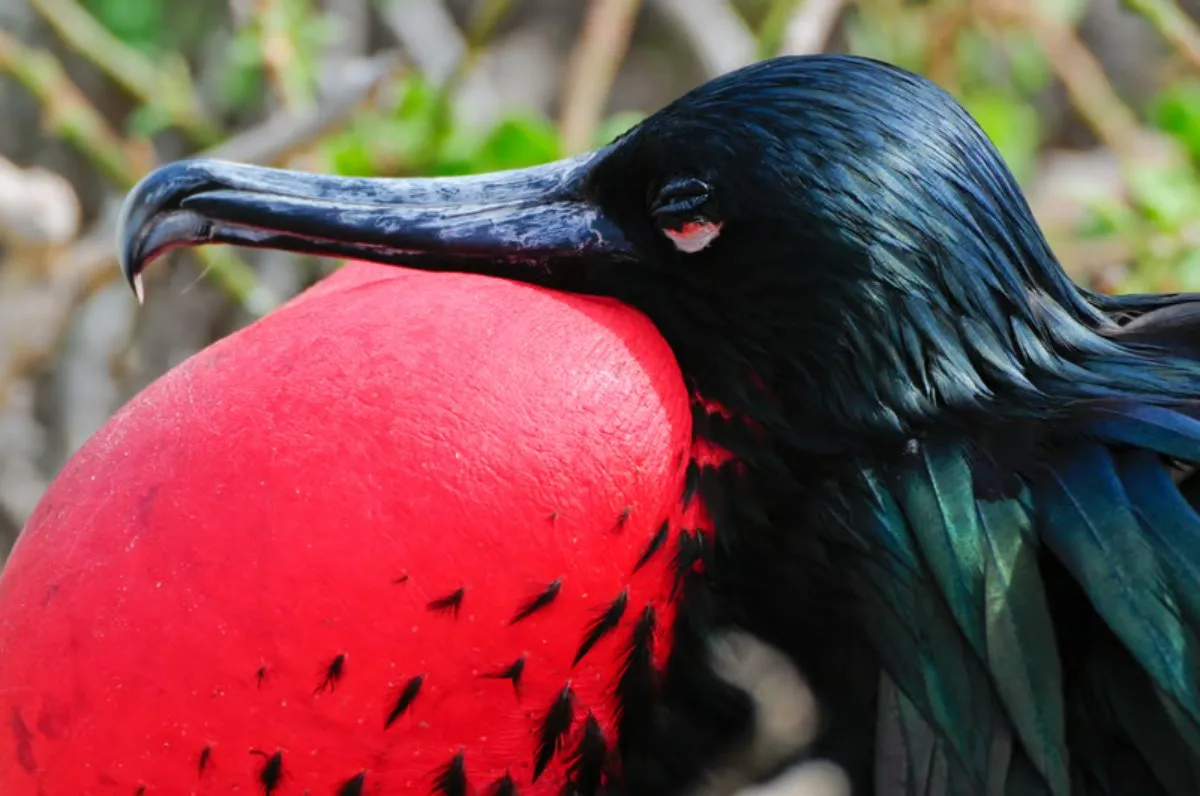
The cost of maintaining this display is substantial. A frigatebird's pouch requires precise vascular control to inflate and deflate properly. The skin is stretched thin and sensitive. During display, a male is relatively immobilized, perched in vegetation rather than soaring and hunting. Females apparently recognize this vulnerability and view the willingness to endure it as a sign of genuine quality. It's less like dating and more like a high-stakes poker game where males are betting their health and survival against the chance of reproductive success.
Aerial Mastery and the Hunting Frenzy
Magnificent frigatebirds are among the most agile fliers in the bird world. They have extremely long, narrow wings and deeply forked tails that give them unmatched maneuverability in the air. Their wings span nearly two and a half meters, but their bodies are remarkably light, sometimes weighing less than a kilogram. The mass-to-wing-area ratio is extreme, giving them the ability to hover, pivot, and accelerate with sudden violence.
When they hunt, they target other seabirds that have successfully caught fish. Boobies are particular favorites. A frigatebird will spot a booby returning to land with a belly full of fish and attack it with relentless harassment. It'll swoop and dive, forcing the booby to dodge and twist. Eventually, the stressed booby panics and regurgitates its catch. The frigatebird catches the meal mid-air and vanishes. The whole interaction lasts seconds. Scientists have documented individual frigatebirds capturing 90 percent of their calories this way.
What's striking is that they've become so specialized in this form of hunting that they've abandoned fishing themselves almost entirely. Their feathers lack the proper waterproofing that other seabirds have. If they attempted a diving plunge like a booby or a tern, they'd become waterlogged and sink. A 2018 study tracking frigatebird movements found that they spend roughly 97 percent of their time in the air. They're perpetually aloft, riding thermal currents, circling, waiting for an opportunity.
Weeks Without Landing
One of the most astonishing frigatebird abilities is their capacity to remain airborne for extended periods without landing. Young frigatebirds, independent and out of necessity, can spend 2–3 weeks continuously flying, riding thermal currents and resting by sleeping while aloft. They doze in short bursts, essentially standing on invisible pillars of warm air, trusting their instincts to keep them aloft. Scientists still aren't entirely sure how they manage it, though GPS tracking data has confirmed the behavior repeatedly.
This perpetual flight is partly a consequence of their habitat. Frigatebirds breed on remote tropical islands and atolls. Finding suitable perches can be challenging. More importantly, they can't land on water, so unlike other seabirds, they can't simply rest on the ocean surface. They're committed to the air with almost religious intensity. They drink by plucking droplets from the ocean while in flight. They bathe in rainstorms, tilting their heads back as precipitation soaks their feathers. They've structured an entire existence around the principle of never stopping, never settling.
Reproduction in a Volatile World
Female frigatebirds are just as remarkable in their own way, though without the dramatic pouch. They're larger than males and heavier, giving them advantages in dominance hierarchies. After choosing a mate based on his display prowess, a female lays a single egg and the pair shares brooding duties. Both parents are fiercely protective. They'll attack humans, other frigatebirds, any perceived threat with surprising aggression, diving and striking with their beaks.
The chicks are helpless and altricial, requiring months of care. Parents make foraging trips that can last hours or days, searching for food. By the time a chick fledges, it's still not independent. Juvenile frigatebirds continue to beg from parents for months, sometimes years, even after they've achieved the ability to capture their own prey. The parental investment is staggering, which explains why frigatebirds breed only once every two years. The energy budget doesn't allow for more frequent reproduction.
Climate change is making things harder. Tropical storms are becoming more intense, flooding nesting sites. Ocean warming is shifting fish distributions, making prey harder to find. Kleptoparasitism only works if there are other seabirds with full bellies to steal from. If those populations decline, the entire frigatebird feeding strategy collapses. Right now, populations seem stable, but they're dependent on ecological conditions that are rapidly destabilizing.
Quick Facts About Magnificent Frigatebirds
- Males inflate a brilliant scarlet throat pouch for breeding display; females are dusky brown without a pouch
- Wingspan reaches 2.3 meters despite weighing less than a kilogram
- Cannot land on water due to non-waterproofed feathers; spend roughly 97% of their time airborne
- Practice kleptoparasitism (food theft) rather than direct fishing, capturing 90% of their diet this way
- Can remain airborne continuously for 2–3 weeks, sleeping during brief episodes while soaring
- Global population estimated at 650,000 birds; populations relatively stable but vulnerable to climate change
How endangered is this animal?
Sources
Overview
Also Known As
Man o' war bird, Pirate bird (Fregata magnificens)
Size
Wingspan 2.1–2.44 m; weight 1–1.8 kg
Distribution
Tropical and subtropical Atlantic and Pacific coasts; Galapagos
Habitat
Tropical coastal waters, islands; rarely lands on water
Food / Diet
Fish, squid, jellyfish; steals food via kleptoparasitism
Lifespan
25–34 years
Help us save the oceans
by surfing the web!
.png)
.png)
.png)

.png)
.png)
.png)
.png)
.png)
.png)