

The first time you see a hammerhead shark, your instinct is to ask: why? The the scalloped hammerhead looks like a shark that suffered a design defect. Its head, called the rostrum or hammer, extends perpendicularly from the body on both sides, making the animal wider than it is tall. The head is flattened and curved, with scalloped edges (hence the name) that make it look almost decorative. For decades, marine biologists had theories about this bizarre morphology. The hammer might help the shark turn quickly. It might provide lift, like an aircraft wing. It might be used as a shovel to dig in sand. All of these theories contained grains of truth, but they missed the real reason the hammerhead evolved its distinctive shape: electroreception.
Sensing the Invisible
Sharks hunt in a sensory landscape completely foreign to human experience. They can smell blood from hundreds of meters away. They can feel vibrations through the water using their lateral line system. But their most sophisticated sense might be electroreception—the ability to detect electrical fields. Every living organism generates a faint electrical current. Sharks have specialized sensors called ampullae of Lorenzini scattered across their head and body, tiny organs filled with a conductive gel that picks up these electrical signatures.
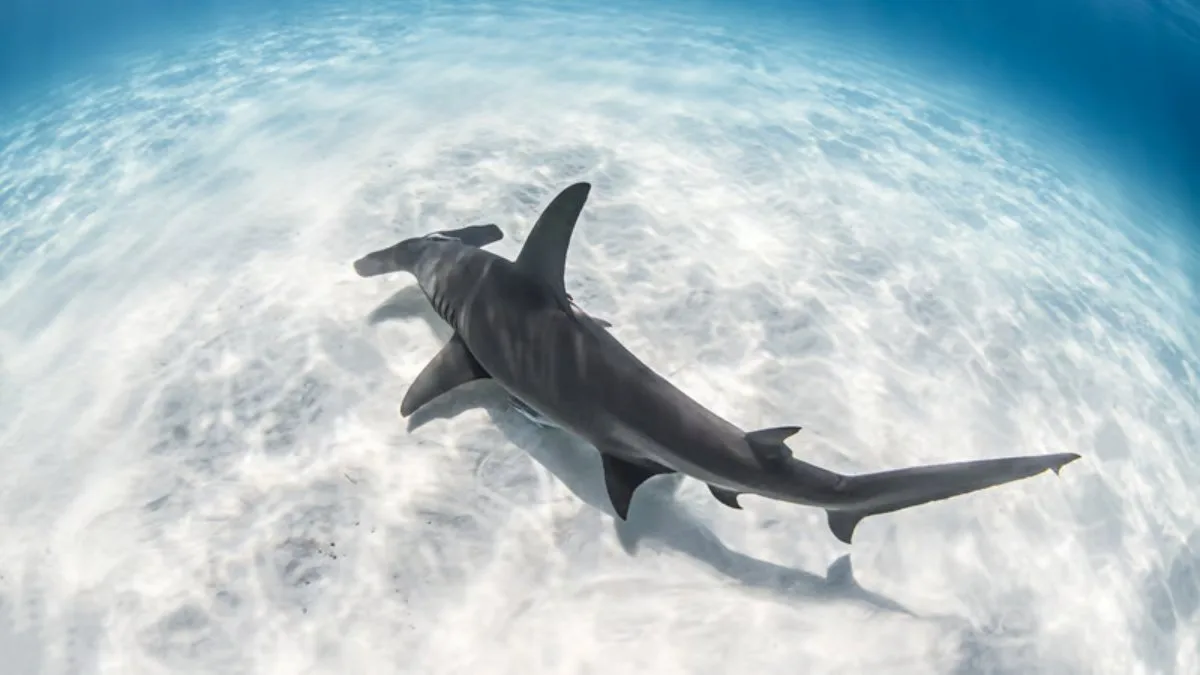
The hammerhead's flat, extended head is essentially an antenna array. By spreading the electroreceptive organs across a wider surface area, the hammerhead can detect electrical fields more precisely than other sharks. More importantly, the wide head allows the shark to detect differences in electrical intensity across its two sides. This gives the hammerhead directional information it can't get from a more compact head shape. Imagine trying to locate a sound source with your ears positioned farther apart, you'd get better directional information. The hammerhead does the same thing with electrical fields. It's like the shark is reading a three-dimensional electrical map of its environment. A stingray buried in sand which still produces an electrical field, becomes detectable to a hammerhead hunting in murky water where vision doesn't work.
A 2018 study from the University of São Paulo tested this hypothesis by attaching electrodes to stingrays and measuring how hammerheads responded. When the stingrays produced electrical signals, the hammerheads oriented toward them in complete darkness. When the electrical signals were masked, the hammerheads reverted to random searching behavior. The experiment confirmed what field observations had suggested: the hammer head isn't vestigial or decorative. It's a highly specialized hunting tool.
The Schooling Mystery
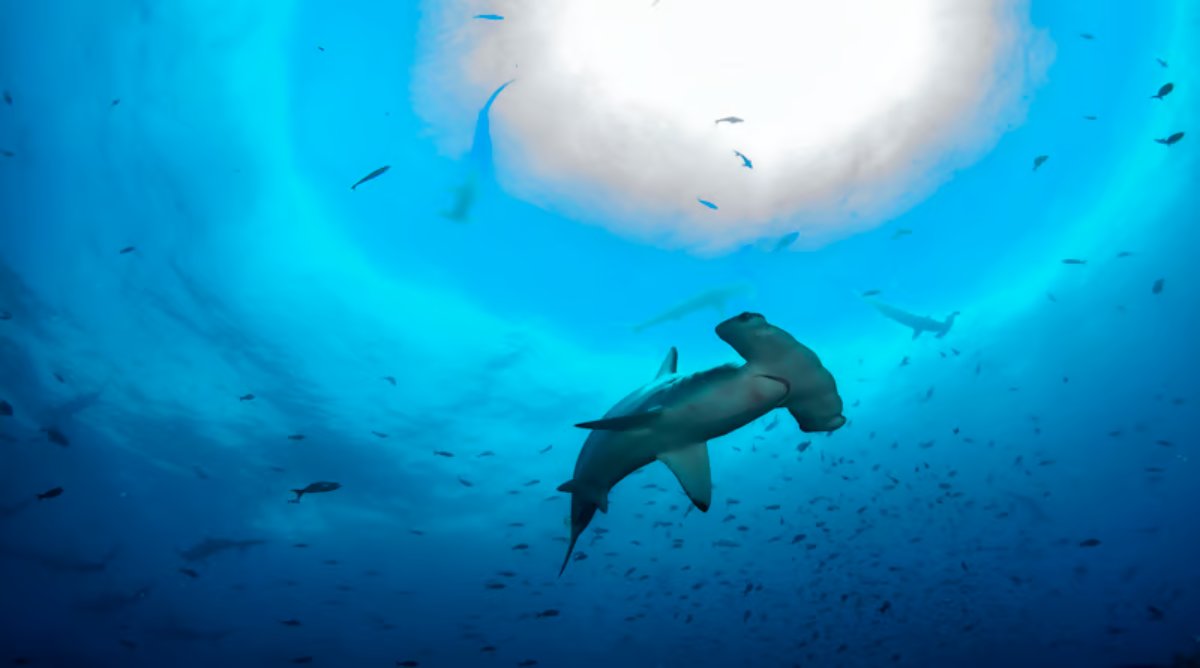
Here's something that makes hammerhead biology even stranger: they're the only sharks that reliably school. Most sharks are solitary hunters that might aggregate in areas with abundant food, but they don't genuinely school the way fish do. Hammerheads, particularly scalloped hammerheads, gather in schools that can number in the hundreds or even thousands. Off Cocos Island in Costa Rica, researchers have documented aggregations of several hundred scalloped hammerheads in shallow water, packed tightly together in movements that look coordinated.
The function of this schooling behavior remains contested. Protection from predators is one hypothesis, a large school might be intimidating to a larger shark. Foraging efficiency is another the school might work together to herd prey. But scalloped hammerheads school during daylight hours in shallow water, not at night when hunting would be most profitable. During daylight, they're resting, essentially. Energy conservation through reduced individual swimming effort in a school might be the primary benefit, which is a more subtle advantage than some researchers initially expected. The act of being in a school might simply be less metabolically expensive than patrolling alone. In an ocean where calories are scarce and competition is fierce, small efficiencies compound.
What's remarkable is that juvenile hammerheads must learn to school, and they don't always succeed. Captive-bred hammerheads frequently fail to school properly, even when raised with other hammerheads. There's a behavioral component that wild pups learn from their mothers or from other juveniles. Scientists still aren't sure exactly what that component is or why some individuals remain solitary while others integrate into schools. The behavior isn't determined purely by genetics, it's learned, context-dependent, and variable in ways that make hammerheads more behaviorally complex than most sharks.
How endangered is this animal?
The Finning Crisis and Population Collapse
Scalloped hammerheads are among the most traded shark species in the global fin trade. Their fins are large and valued for shark fin soup, a status dish in several Asian countries that commands premium prices. Commercial hammerhead finning reached its peak in the early 2000s, when tens of thousands of hammerheads were killed annually for their fins. A 2013 study in
estimated that between 1.3 and 2.7 million scalloped hammerheads were killed for their fins each year at the trade's height. For a species that doesn't reproduce until around 14 years old, that level of fishing pressure is unsustainable.
The result has been severe population crashes across multiple regions. The western Atlantic population has declined roughly 99 percent since the 1970s. The scalloped hammerhead was listed as critically endangered on the IUCN Red List in 2008. Several countries and regional fisheries organizations have implemented bans on hammerhead finning, but enforcement is inconsistent. Some countries require that shark fins be landed with the body attached—a measure designed to prevent finning. But loopholes exist, and fishing pressures continue. A 2021 genetic study found evidence of ongoing fishing pressure in population strongholds like the western Pacific.
Conservation and Hope
The success of marine protected areas in preserving hammerhead populations suggests that these sharks, if given space and protection, can recover. The Galápagos Islands implemented strict protections in 1998, and by the 2010s, hammerhead populations there had stabilized and begun increasing. The Palau government banned all shark fishing in 2009, creating a legal safe haven. In both cases, the economic incentive was tourism living sharks are worth far more to communities than dead sharks sold by weight. Some conservation organizations are working to shift the economic equation globally, funding alternatives to shark fin soup in Asia and creating market-based incentives for shark protection. It's slow work, and hammerhead populations remain under threat in many regions. But the possibility of recovery is there, waiting on human decisions about what value we assign to a shark with a hammer on its head.
Quick Facts:
There are nine species of hammerhead sharks, not all of them closely related despite their similar head shapes. Scalloped hammerheads can give birth to up to 40 pups at a time, with pregnant females sometimes gathering in aggregations called "nurseries." The electroreceptive organs on a hammerhead's head contain up to 3,400 tiny electrical sensors called ampullae of Lorenzini. Fossil evidence suggests hammerhead ancestors didn't have the distinctive head shape, meaning the hammer evolved relatively recently within the last 50 million years. During extreme stress or dying, some hammerhead species exhibit "tonic immobility," a state similar to hypnosis that was once misunderstood as a voluntary paralysis response.
Sources
Overview
Also Known As
Scalloped, Great, and Smooth hammerhead (Sphyrnidae family)
Size
2.5–6.1 m depending on species
Distribution
Tropical and warm temperate waters worldwide
Habitat
Coastal waters, continental shelves, coral reefs
Food / Diet
Fish, rays, squid, octopus, crustaceans
Lifespan
20–30 years
Help us save the oceans
by surfing the web!
.png)
.png)
.png)

.png)
.png)
.png)
.png)
.png)
.png)