

The scientific name is, making it more primitive than both. It doesn't hunt like a squid. It doesn't hunt like an octopus. In fact, it's not much of a hunter at all. Instead, it survives by eating marine snow the constant rain of dead organic matter that falls from the productive surface waters above. For this detritus, the vampire squid hunts through one of Earth's most inhospitable environments: the oxygen minimum zone, where oxygen concentrations drop so low that most aerobic organisms can't survive. Yet the vampire squid has found a way not just to survive but to thrive, becoming the dominant predator of a realm that seems utterly alien to creatures evolved on land.
Not Really a Squid, Not Really a Vampire
The taxonomic confusion isn't accidental. Early naturalists encountering the vampire squid thought it was a squid. It has tentacles, after all. It has a mantle. It seems to fit the basic cephalopod template. But genetic analysis in recent decades revealed something surprising: the vampire squid is actually more distantly related to squid than either squid or octopuses are to each other. It's a living fossil, a survivor from a cephalopod lineage that split off roughly 300 million years ago, before most modern cephalopod families even evolved.
The name's "vampire" aspect is similarly misleading. Early naturalists may have been impressed by its dark coloring and large eyes, or perhaps they were spooked by its alien appearance. Nobody called it a vampire because it actually drinks blood. It doesn't. The name stuck anyway one of those historical accidents that becomes permanent nomenclature.
What the vampire squid actually is, is a detritus feeder. It drifts through the water column, collecting particles of dead plankton, fecal pellets, and organic debris that sink from above. It's not alone in this niche other organisms feed on marine snow but the vampire squid is remarkably efficient at it. Its body is optimized for low-energy existence in a low-oxygen world.
The Oxygen Minimum Zone: Earth's Dead Zone
The vampire squid lives in the oxygen minimum zone (OMZ), a layer of ocean water where dissolved oxygen concentrations drop to levels that would cause hypoxia in most animals. These zones typically occur at depths between 1,600 and 3,300 feet, in areas where the combination of biological oxygen consumption and poor water circulation creates a perfect storm of suffocation.
The OMZ exists in scattered regions worldwide off the coasts of Peru and Chile, in the Arabian Sea, in the Gulf of Mexico, and in the eastern Pacific. They're expanding as ocean temperatures rise and ocean circulation patterns shift. Climate change is enlarging these dead zones, creating more habitat for creatures that can tolerate low oxygen. The vampire squid is benefiting.
In the OMZ, light is minimal. Pressure is moderate high enough to be dangerous to humans but far less extreme than the deep ocean. Temperature is cold but not crushing. The critical factor is oxygen. Most fish and large invertebrates can't function in these waters. Their metabolisms require more oxygen than the OMZ can provide. The vampire squid, however, has adapted. Its blood is unusually efficient at extracting oxygen from seawater. Its metabolism is extraordinarily low, operating at perhaps 40 percent of the rate typical for comparable animals in normoxic (oxygen-rich) conditions.
A Squid Built for Darkness and Starvation
The vampire squid's body is a study in efficiency. It's relatively small rarely exceeding one foot in length, with a soft, gelatinous mantle. Its coloration is deep crimson to black, rendering it nearly invisible in the perpetual night of its habitat. Its eyes are enormous, disproportionately large even for a cephalopod, capable of detecting the faintest glimmer of light from bioluminescent organisms or distant surface light filtered through hundreds of feet of water.
The vampire squid's arms are connected by a thin web of tissue that stretches between them, forming what researchers call the cirrus. This web isn't strong or dexterous. It serves primarily to help capture small particles and entangle bits of debris. The squid also possesses a pair of filaments: thin, delicate structures that extend from the base of its arms. These filaments can be extended and retracted, using sensory organs to detect particles and guide them toward the squid's mouth.
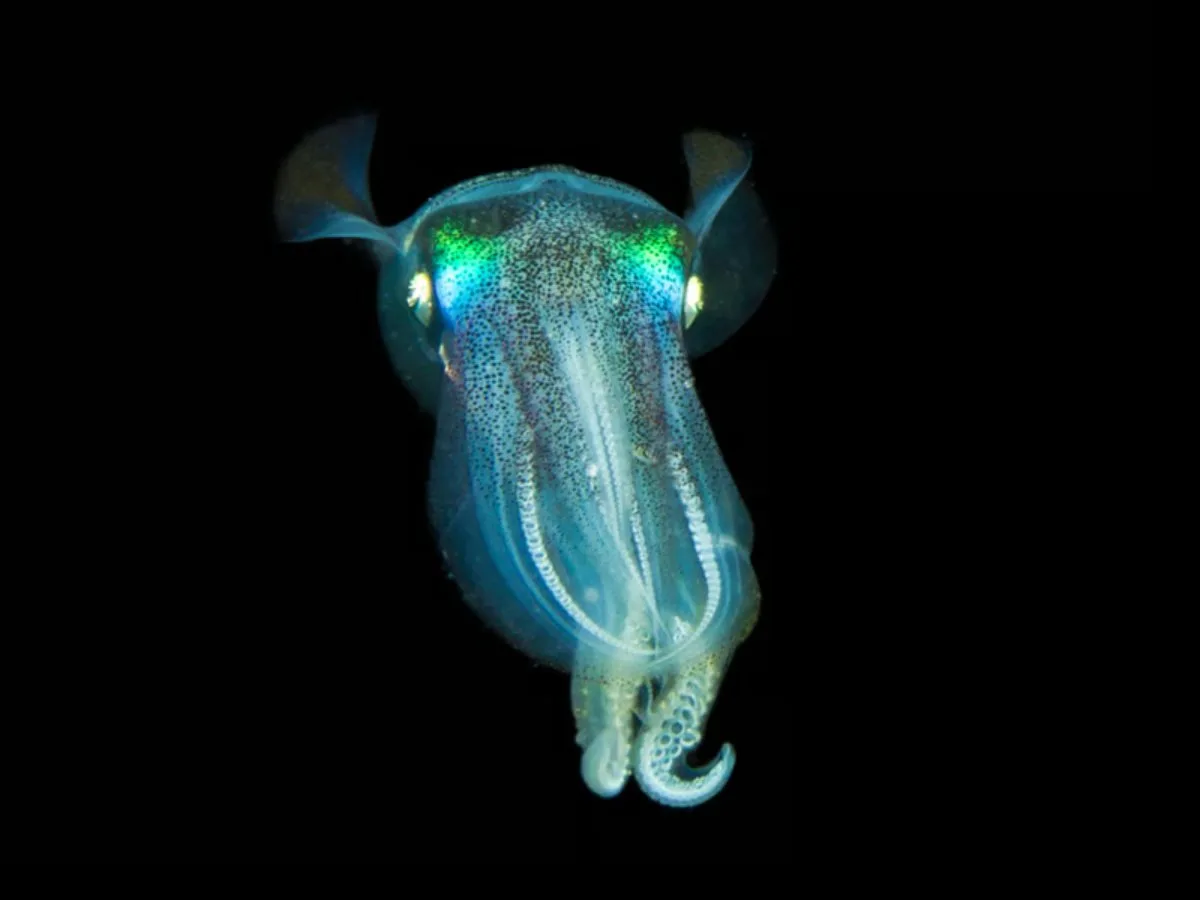
This is not an anatomy built for speed or strength. It's built for patience, for slow drift, for existing on minimal food in a minimal-oxygen environment.
Bioluminescence and the Art of Cloaking
When threatened, the vampire squid has an escape mechanism unlike any other cephalopod. Instead of ink, it produces a cloud of bioluminescent material—particles that glow with a faint light. This has the effect of briefly illuminating potential predators while the vampire squid's body remains dark. It's a reversal of the typical predator-prey relationship. The vampire squid doesn't hide by blending in; it hides by making the predator visible to other predators.
The bioluminescence is produced by photophores specialized light-producing cells similar to those in fireflies. The vampire squid can control the intensity and timing of this light, producing patterns that seem to serve both defensive and communicative functions.
More commonly, the vampire squid simply cloaks itself in darkness, a strategy optimized for an environment where light is so rare that visibility itself becomes the greatest threat. Scientists still aren't sure whether the vampire squid is actually nocturnal in the sense of having active and resting periods. With no sun to mark the passage of days, with the environment always the same temperature and light level, traditional circadian rhythms may be irrelevant.
A Success Story in Earth's Dead Zones
The vampire squid is remarkably abundant within its range. It's not rare or endangered. If anything, as oxygen minimum zones expand due to climate change and coastal eutrophication, the vampire squid's habitat is expanding. It's becoming more common in regions where it was previously rarer. It represents a glimpse into what some regions of the ocean might become: dark, low-oxygen, dominated by creatures adapted to scarcity rather than plenty.
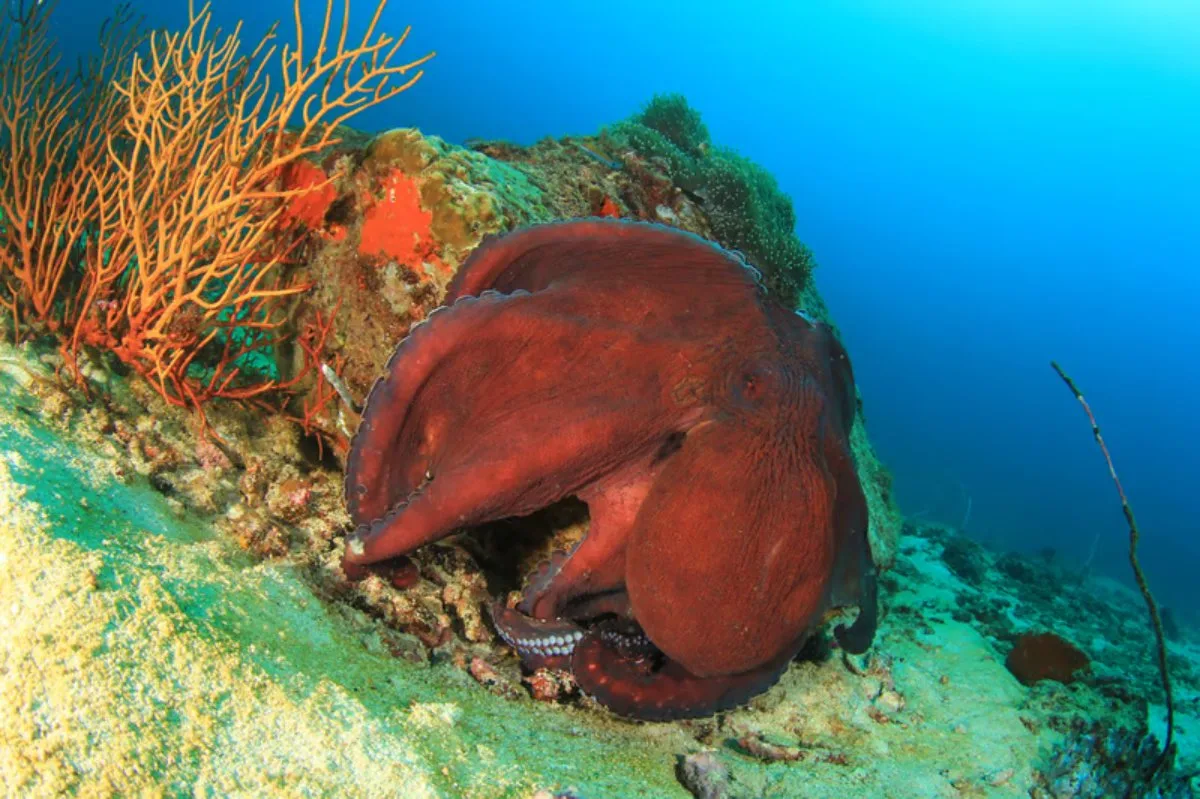
This makes the vampire squid oddly reassuring to researchers studying ocean acidification and oxygen depletion. As human activity changes the oceans, some creatures will lose out. But others will win. The vampire squid is winning. It's thriving in conditions that would kill most organisms. It's a reminder that the ocean's future won't be empty, it'll just be different. It'll be populated by creatures adapted to extremes.
### Quick Facts
- The vampire squid is the only living member of the order Vampyromorpha, making it a taxonomic singleton among cephalopods
- Its bioluminescent display uses a protein similar to that found in deep-sea fish and shrimp
- The vampire squid's blood is unusual in its protein composition, allowing it to extract oxygen more efficiently than most animals
- It produces roughly 5 to 10 times less fecal matter than comparable organisms, indicating extremely efficient digestion
- The scientific name "Vampyroteuthis infernalis" was assigned in 1903, based on early preserved specimens that appeared intimidating
How endangered is this animal?
Sources
Sources & Further Reading
Overview
Also Known As
Vampire squid from hell (Vampyroteuthis infernalis; own order Vampyromorphida)
Size
15–30 cm total length
Distribution
Tropical and subtropical oceans worldwide
Habitat
Oxygen minimum zone; 600–900 m depth
Food / Diet
Marine snow, detritus, dead plankton (not an active predator)
Lifespan
8 years (estimated)
Help us save the oceans
by surfing the web!
.png)
.png)
.png)

.png)
.png)
.png)
.png)
.png)
.png)